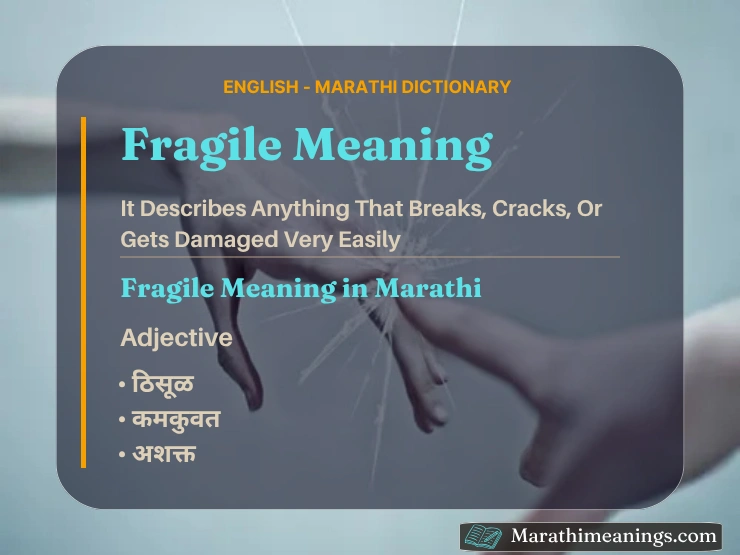
Fragile meaning in Marathi is नाजूक (Najuk) or ठिसूळ (Thisul). It describes anything that breaks, cracks, or gets damaged very easily — whether it is a glass object, a person’s health, or someone’s emotions. In Hindi, the word is नाज़ुक (Nazuk) or कमज़ोर (Kamzor). You will see this word printed on shipping boxes, used in everyday conversation, and in psychological discussions about the fragile ego.
Quick Stats: Fragile
| Detail | Information |
|---|---|
| Word | Fragile |
| Part of Speech | Adjective |
| Marathi Meaning | नाजूक (Najuk), ठिसूळ (Thisul) |
| Hindi Meaning | नाज़ुक (Nazuk), कमज़ोर (Kamzor) |
| Pronunciation | FRAJ-il (British), FRAJ-uhl (American) |
| Origin Language | Latin |
| Root Word | fragilis (Latin) |
| First Recorded Use | Mid-16th century |
| Antonym | Sturdy, Robust, Resilient, Antifragile |
| Common Use Cases | Physical objects, health, emotions, ego |
What Does Fragile Mean in English?

Fragile is an English adjective that means easily broken, damaged, or destroyed. It applies to physical objects like glass or ceramic, to a person’s body when they are weak or unwell, and to intangible things like trust, peace, or a person’s emotional state.
The core idea is delicateness combined with vulnerability. Something fragile cannot handle much stress, pressure, or rough handling before it gives way.
“Please pack the dishes carefully — they are fragile.”
Fragile Meaning In Marathi
Fragile meaning in Marathi is best captured by two primary words:
- नाजूक — Roman: Najuk — Used for delicate, tender, or sensitive things. A fragile flower, a fragile child, or a fragile relationship would all be described as नाजूक.
- ठिसूळ — Roman: Thisul — Specifically means brittle or crumbly. Used more for physical materials that crack or break apart easily, like old pottery or a dry biscuit.
Simple Explanation in Marathi
मराठी: “नाजूक म्हणजे असे काहीतरी जे सहज तुटते किंवा खराब होते. काच, जुनी मातीची भांडी किंवा एखाद्या आजारी माणसाची तब्येत — सर्व ‘नाजूक’ असू शकतात.”
(Najuk mhanje ase kahitari je sahaj tute kiva kharab hote. Kach, juna matichi bhandi kiva ekhadya ajari manasachi tabyat — sarv ‘najuk’ asu shaktat.)
Example Sentences in Marathi
ही काच नाजूक आहे, काळजीपूर्वक हाताळा.
(Hi kach najuk aahe, kaljipurvak hatalva.) — This glass is fragile, handle it carefully.
आजोबांची तब्येत सध्या खूप नाजूक आहे.
(Ajobachi tabyat sadhya khup najuk aahe.) — Grandfather’s health is very fragile right now.
त्यांचे नाते खूप ठिसूळ झाले आहे.
(Tyanche nate khup thisul zale aahe.) — Their relationship has become very fragile.
Fragile Meaning In Hindi
Fragile meaning in Hindi is नाज़ुक (Nazuk) in everyday speech, and भंगुर (Bhangur) in more formal or literary contexts.
- नाज़ुक — delicate, tender, sensitive
- भंगुर — brittle, perishable, prone to breaking
- कमज़ोर — weak, feeble (used when fragility refers to a person’s strength)
Simple Explanation in Hindi
हिंदी: “नाज़ुक यानी ऐसी चीज़ जो आसानी से टूट जाए या खराब हो जाए। शीशे का सामान, किसी की सेहत, या रिश्ता — सभी नाज़ुक हो सकते हैं।”
(Nazuk yaani aisi cheez jo aasani se toot jaye ya kharab ho jaye. Shishe ka saman, kisi ki sehat, ya rishta — sabhi nazuk ho sakte hain.)
Example Sentences in Hindi
- यह सामान बहुत नाज़ुक है, सँभाल कर रखिए। (Yah saman bahut nazuk hai, sambhal kar rakhiye.) — This item is very fragile, keep it carefully.
- उनकी तबीयत इस वक्त बहुत नाज़ुक है। (Unki tabiyat is waqt bahut nazuk hai.) — Their health is very fragile at the moment.
Pronunciation Guide
| Variety | Pronunciation |
|---|---|
| British English | FRAJ-il |
| American English | FRAJ-uhl |
| IPA (General) | /ˈfræd͡ʒ.ɪl/ |
| Marathi speakers | फ्रॅजिल — Frajil |
| Hindi speakers | फ्रेजाइल — Frejail |
Origin and Etymology of Fragile

The word fragile comes from Latin fragilis, meaning “easily broken.” Fragilis itself is derived from the Latin verb frangere, which means “to break.” This same root gave English several related words:
- Fragment — a broken piece
- Fracture — a break or crack
- Infraction — a breaking of a rule
- Fraction — originally, a “breaking” of a whole number
The word entered English in the mid-16th century, borrowed through Old French fragile or directly from Latin. Its first recorded uses described physical objects that shattered easily. Over time, its meaning extended to health, emotions, peace, and character.
Marathi Synonyms for Fragile
| Marathi Word | Roman Transliteration | Meaning in English |
|---|---|---|
| नाजूक | Najuk | Delicate, tender |
| ठिसूळ | Thisul | Brittle, crumbly |
| कमकुवत | Kamkuvat | Weak, feeble |
| तकलादू | Takladu | Flimsy, shoddy |
| मृदू | Mridu | Soft, gentle (context-specific) |
| क्षणभंगुर | Kshanabhangur | Transient, perishable |
Different Meanings of Fragile by Context
The word fragile shifts meaning depending on where and how it is used. Here is a clear breakdown:
| Context | What Fragile Means | Example |
|---|---|---|
| Physical objects | Easily broken or cracked | A fragile glass sculpture |
| Human health | Weak, delicate physical condition | A fragile patient recovering from surgery |
| Emotions / Psychology | Easily hurt, sensitive, unstable | She is emotionally fragile right now |
| Relationships | Easily damaged, unstable | A fragile peace between two countries |
| Economy | Vulnerable to shocks | A fragile economy dependent on one export |
| Ego | Easily wounded pride | He has a very fragile ego |
Fragile Meaning For a Person

When we say a person is fragile, we can mean two different things:
1. Physically fragile: The person’s body is weak, easily injured, or in poor health. An elderly person with thin bones, or someone recovering from a serious illness, may be described as physically fragile.
2. Emotionally fragile: The person’s mental or emotional state is delicate. They get hurt easily, struggle to cope with criticism, or break down under pressure. This is different from being weak-willed — it often reflects deep sensitivity, past trauma, or burnout.
“A person can be physically strong but emotionally fragile, or vice versa.”
In Marathi:
माणसाबद्दल नाजूक म्हणजे — तो शारीरिक किंवा भावनिकदृष्ट्या सहज दुखावतो.
(Manasabaddal najuk mhanje — to sharirik kiva bhavanikdrustya sahaj dukhavto.)
Fragile Ego Meaning
Fragile ego is a very commonly searched phrase. It refers to a person whose self-esteem is easily threatened. Someone with a fragile ego:
- Reacts with disproportionate anger or defensiveness to mild criticism
- Needs constant validation and praise
- Cannot tolerate being wrong in front of others
- Feels deeply insulted by minor comments
A fragile ego is not about being arrogant — in fact, it often coexists with deep insecurity beneath a confident exterior.
Male Ego Is Fragile Meaning
The phrase “male ego is fragile” refers to a social observation — and sometimes a critique — that many men are conditioned to tie their self-worth to dominance, capability, and being seen as strong. When any of these are challenged, even mildly, their ego reacts strongly. This is a sociological and cultural commentary, not a biological fact, and it varies widely by individual.
Marathi: पुरुषांचा अहंकार नाजूक असतो — म्हणजे त्यांचा स्वाभिमान सहज दुखावतो. (Purushanche ahankara najuk asato — mhanje tyanche svabhiman sahaj dukhavto.)
Antifragile Meaning
Antifragile is a concept introduced by author and statistician Nassim Nicholas Taleb in his 2012 book Antifragile: Things That Gain from Disorder.
- Fragile things break under stress.
- Resilient things withstand stress and return to the same state.
- Antifragile things actually get stronger from stress, disorder, and volatility.
Examples of antifragile systems: the human immune system (gets stronger when exposed to mild threats), entrepreneurship ecosystems (thrive on trial and error), and bones (strengthen with controlled stress from exercise).
In Marathi:
अँटीफ्रेजाइल म्हणजे असे जे दबावाखाली अधिक मजबूत होते — जसे व्यायामाने हाडे.
(Antifrajile mhanje ase je dabaavakhali adhik majabut hote — jase vyayamane hade.)
Wild But Fragile Meaning
“Wild but fragile” is a poetic phrase used in literature, music, and personal descriptions. It describes a person or thing that is bold, free-spirited, and intense on the outside but deeply sensitive and easily hurt on the inside.
It captures a contradiction: someone who appears untamed or fearless but carries a core of emotional delicateness. This phrase is popular in Gen-Z and millennial creative writing, song lyrics, and social media bios.
Example: “She was wild but fragile — loud in a crowd, quiet in her heart.”
Fragile Handle With Care

“Fragile — Handle With Care” is a standard shipping and packaging instruction printed on boxes containing breakable or delicate items. It warns handlers to treat the parcel gently and avoid dropping, throwing, or stacking heavy objects on it.
Fragile stickers are printed adhesive labels — usually red and white — placed on parcels, courier packages, and moving boxes. They are universally recognized and communicate the same message across languages.
In a figurative sense, “handle with care” is used for people who are going through a difficult emotional time and need gentle treatment.
Synonyms and Antonyms of Fragile
Understanding the words closest in meaning to fragile — and the words that sit at the opposite end — sharpens your vocabulary and helps you choose the right word in every context. Below are full tables covering English synonyms and antonyms with their meanings, Marathi equivalents, and Hindi equivalents.
Synonyms of Fragile (With Meanings)
Each synonym shares a family resemblance with fragile but carries its own shade of meaning. They are not always interchangeable.
| Synonym | Meaning in English | When to Use It | Marathi Equivalent | Hindi Equivalent |
|---|---|---|---|---|
| Delicate | Fine, easily damaged, requiring gentle handling; can also be positive (delicate beauty) | Objects, health, situations that need care | नाजूक (Najuk) | नाज़ुक (Nazuk) |
| Brittle | Hard but liable to snap or shatter suddenly; no flexibility | Glass, bones, dry materials, rigid personalities | ठिसूळ (Thisul) | भंगुर (Bhangur) |
| Frail | Physically weak, especially due to age or illness; almost always used for living beings | Elderly people, sick individuals | अशक्त (Ashakt) | कमज़ोर (Kamzor) |
| Breakable | Capable of being broken; straightforward, literal term | Physical objects | तोडता येण्यासारखे (Todta yenyasarakhe) | टूटने योग्य (Tutne yogya) |
| Flimsy | Poorly made, thin, lacking strength or substance | Cheap objects, weak arguments, thin fabric | तकलादू (Takladu) | कमज़ोर / पतला (Kamzor / Patla) |
| Feeble | Lacking strength or force; weak in body or character | People, voices, efforts, excuses | कमकुवत (Kamkuvat) | निर्बल (Nirbal) |
| Vulnerable | Open to harm, attack, or damage; exposed to risk | People, systems, emotions, relationships | असुरक्षित (Asurakshit) | असुरक्षित (Asurakshit) |
| Tender | Soft, easily bruised, gentle; implies sensitivity rather than weakness | Young plants, skin, emotions, feelings | कोमल (Komal) | कोमल (Komal) |
| Perishable | Likely to decay, rot, or expire quickly | Food, biological material, short-lived things | नाशवंत (Nashavant) | नाशवान (Nashawan) |
| Dainty | Small, delicate, and pretty; suggests fragility with elegance | Fine china, small flowers, graceful things | सुकुमार (Sukumar) | नाज़ुक / सुकुमार (Nazuk / Sukumar) |
| Weak | Lacking physical or mental strength; broad general term | People, structures, arguments, health | कमकुवत (Kamkuvat) | कमज़ोर (Kamzor) |
Key distinction to remember: Brittle implies hardness that snaps. Frail implies leanness or age. Flimsy implies poor quality. Fragile is the broadest of these — it can cover all of the above situations.
Antonyms of Fragile (With Meanings)
These words describe things that are the opposite of easily broken — things that hold up under pressure, stress, or rough handling.
| Antonym | Meaning in English | When to Use It | Marathi Equivalent | Hindi Equivalent |
|---|---|---|---|---|
| Sturdy | Strongly built, solid, and able to withstand force | Furniture, structures, people’s builds | मजबूत (Majabut) | मज़बूत (Mazboot) |
| Robust | Strong and healthy; able to perform well under varied conditions | Health, systems, economies, arguments | सक्षम (Saksham) | मज़बूत / ठोस (Mazboot / Thos) |
| Durable | Able to last a long time without breaking or wearing out | Materials, products, relationships | टिकाऊ (Tikau) | टिकाऊ (Tikau) |
| Tough | Difficult to break, cut, or damage; can also mean mentally strong | Materials, people, decisions | कठीण (Kathin) | कठोर / मज़बूत (Kathor / Mazboot) |
| Resilient | Able to recover quickly from difficulty, stress, or damage | People, systems, economies, ecosystems | लवचिक (Lavachik) | लचीला (Lachila) |
| Solid | Firm, stable, and well-constructed; not hollow or weak | Structures, plans, arguments, character | घट्ट / भक्कम (Ghatt / Bhakkam) | ठोस (Thos) |
| Unbreakable | Impossible or very hard to break | Bonds, materials, will, spirit | न तुटणारे (Na Tutanare) | अटूट (Atoot) |
| Antifragile | Gets stronger from stress and disorder rather than just surviving it | Systems, habits, mindsets, economies | दबावाने बळकट होणारे (Dabaavane balkat honare) | दबाव में और मज़बूत होने वाला (Dabaav mein aur mazboot) |
| Hardy | Capable of enduring difficult conditions; built to survive | Plants, animals, people in harsh climates | काटक (Katak) | कठोर / कड़ा (Kathor / Kada) |
| Strong | Having great physical or mental power; opposite of weak | People, materials, emotions, positions | बलवान / शक्तिशाली (Balavan / Shaktishali) | मज़बूत / शक्तिशाली (Mazboot / Shaktishali) |
Quick Reference: Fragile Synonyms and Antonyms at a Glance
| Category | Words |
|---|---|
| Synonyms (English) | Delicate, Brittle, Frail, Breakable, Flimsy, Feeble, Vulnerable, Tender, Perishable, Dainty, Weak |
| Antonyms (English) | Sturdy, Robust, Durable, Tough, Resilient, Solid, Unbreakable, Antifragile, Hardy, Strong |
| Synonyms (Marathi) | नाजूक, ठिसूळ, कमकुवत, तकलादू, असुरक्षित, कोमल, नाशवंत |
| Antonyms (Marathi) | मजबूत, टिकाऊ, कठीण, लवचिक, भक्कम, काटक, बलवान |
| Synonyms (Hindi) | नाज़ुक, भंगुर, कमज़ोर, पतला, असुरक्षित, कोमल, नाशवान |
| Antonyms (Hindi) | मज़बूत, टिकाऊ, कठोर, लचीला, ठोस, अटूट, शक्तिशाली |
Fragile Meaning In Other Indian Languages
| Language | Word | Script | Notes |
|---|---|---|---|
| Tamil | நாசமான / நுண்ணிய | Nasamana / Nunniya | Fragile meaning in Tamil; नुण्णिय is used for fine/delicate things |
| Telugu | పెళుసైన | Pelusaina | Fragile meaning in Telugu; means brittle |
| Bengali | ভঙ্গুর | Bhanghur | Fragile meaning in Bengali; literary/formal use |
| Kannada | ಸುಲಭವಾಗಿ ಮುರಿಯುವ | Sulabhavagi Muriyuva | Fragile meaning in Kannada; descriptive phrase |
| Malayalam | പൊട്ടുന്ന | Pottunna | Fragile meaning in Malayalam; means “that which breaks” |
| Punjabi | ਨਾਜ਼ੁਕ | Nazuk | Fragile meaning in Punjabi; same root as Hindi |
| Gujarati | નાજુક | Najuk | Fragile meaning in Gujarati; close to Marathi form |
| Assamese | ভাঙোণশীয়া | Bhangonshiya | Fragile meaning in Assamese; means breakable |
Common Mistakes and Confusions
1. Fragile vs. Frail Both mean weak, but frail is used almost exclusively for living beings (a frail old man), while fragile applies to both objects and people.
2. Fragile vs. Delicate Delicate can be positive (a delicate flavor, delicate artwork), while fragile almost always carries a sense of risk or vulnerability.
3. Fragile vs. Brittle Brittle specifically means hard but liable to break (like glass or dry twigs). Fragile is broader and includes soft, weak, or easily damaged things too.
4. Mispronouncing as “Frag-ILE” In British English it is FRAJ-ile (rhymes with “mile”). In American English it is FRAJ-uhl (the second syllable sounds like “ul”). Both are correct depending on dialect.
Read Also: Audacity Meaning In Marathi
Conclusion
Fragile meaning in Marathi covers a wide landscape — from a simple नाजूक (Najuk) label on a parcel to complex discussions about emotional vulnerability and ego. Whether you are packing delicate items and reaching for a fragile sticker, describing a loved one’s health, or reflecting on someone’s fragile ego, this single word carries remarkable depth.
Across Indian languages, the concept translates cleanly: نازک (Nazuk) in Hindi, నాజూక్ in Telugu, நாசமான in Tamil — all pointing to the same truth: some things break easily, and knowing that helps us treat them with the care they deserve.
Understanding this word in its full context — physical, emotional, psychological, and cultural — gives you a richer vocabulary in English, Marathi, and Hindi alike.
? Frequently Asked Questions
Q1. What is the fragile meaning in Marathi?
Fragile meaning in Marathi is नाजूक (Najuk) for delicate/sensitive things and ठिसूळ (Thisul) for brittle or crumbly things.
Q2. What does fragile mean for a person?
For a person, fragile means either physically weak (easily injured or ill) or emotionally sensitive (easily hurt, deeply affected by criticism or stress).
Q3. What is fragile ego meaning?
A fragile ego means a person’s self-esteem is easily threatened. They overreact to criticism, need constant validation, and feel deeply insulted by minor comments.
Q4. What is antifragile meaning?
Antifragile is the opposite of fragile. It describes systems or people that get stronger from stress and disorder, not just survive it. The term was coined by Nassim Nicholas Taleb.
Q5. What does “fragile handle with care” mean?
It is a shipping instruction telling handlers to treat a package very gently because its contents are easily broken or damaged. Fragile stickers are placed on parcels for the same purpose.
Q6. What does “wild but fragile” mean?
It describes a person who appears bold and free on the outside but is deeply sensitive and emotionally delicate on the inside — a popular phrase in creative writing and social media.
Q7. What is the male ego is fragile meaning?
It is a social observation that many men, due to cultural conditioning, tie their identity to strength and dominance, and react defensively when either is challenged.
Q8. Is fragile only used for physical objects?
No. Fragile is used for physical objects, human health, emotions, relationships, economies, and personality traits like the ego.