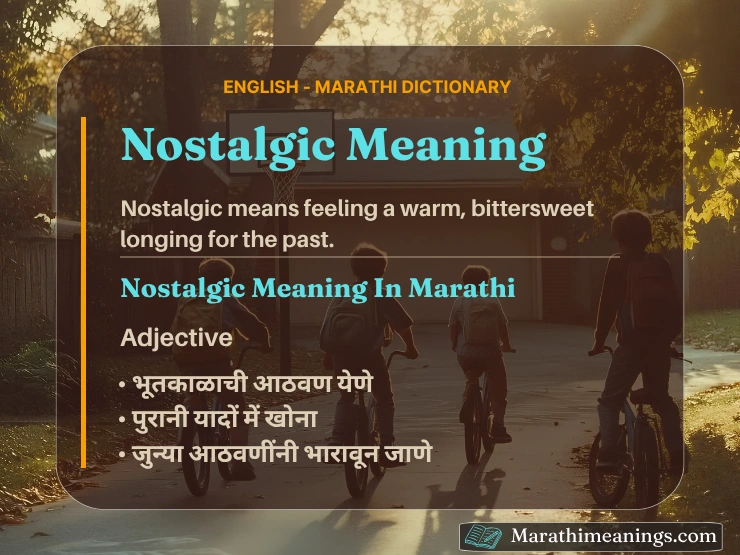
Nostalgic means feeling a warm, bittersweet longing for the past — for people, places, or moments you miss deeply. In Marathi, it is expressed as भूतकाळाची आठवण येणे (Bhootkaaḷāchī āṭhavaṇ yeṇe) or जुन्या आठवणींनी भारावून जाणे (Junyā āṭhavaṇīnnī bhārāvūn jāṇe). In Hindi, the closest expression is पुरानी यादों में खोना (Purānī yādon mein khonā). Whether you are searching for nostalgic meaning in Marathi, Hindi, Tamil, or any other Indian language, the core feeling is the same — a tender ache for what once was.
Word at a Glance: Nostalgic Meaning
| Feature | Details |
|---|---|
| Root Word | Nostalgia |
| Word Form | Adjective |
| Root Language | Greek (via Modern Latin) |
| Greek Roots | nóstos (return home) + álgos (pain/ache) |
| First Recorded Use | 1688 (coined by Johannes Hofer) |
| Marathi Meaning | भूतकाळाची आठवण येणारा (Bhootkaaḷāchī āṭhavaṇ yeṇārā) |
| Hindi Meaning | पुरानी यादों में खोया हुआ (Purānī yādon mein khoyā huā) |
| Part of Speech | Adjective |
| Pronunciation (English) | /nɒˈstæl.dʒɪk/ |
| Pronunciation (Easy Guide) | naw-STAL-jik |
| Noun Form | Nostalgia |
| Adverb Form | Nostalgically |
Have you ever heard an old song and suddenly felt transported back to your childhood? Or smelled something — maybe your grandmother’s kitchen or old school chalk — and felt your heart ache sweetly for a time long gone? That feeling has a name: nostalgic.
It is one of the most universally human emotions, and yet many people search for the nostalgic meaning in Marathi because English words do not always capture what we feel in our mother tongue. This article breaks down everything about the word — its meaning in English, Marathi, Hindi, and several other Indian languages — with real examples, synonyms, and cultural context.
Nostalgic Meaning in English

Nostalgic is an adjective used to describe a person who is experiencing nostalgia — a sentimental or wistful longing for a period in the past, often one’s own childhood, hometown, or a relationship that no longer exists.
The feeling is not purely sad, nor is it purely happy. It sits in between — a bittersweet mixture of warmth and loss. You remember something beautiful, but you also know you cannot go back to it. That tension is what makes “nostalgic” such a rich and meaningful word.
Example sentences in English:
- “Listening to that old Bollywood song made me feel extremely nostalgic.”
- “She gave a nostalgic smile when she saw her old school photograph.”
- “The monsoon smell always has a nostalgic effect on people who grew up in the Konkan region.”
Nostalgic Meaning in Marathi
This is the core of what most readers are searching for: the exact nostalgic meaning in Marathi.
Marathi does not have a single one-word equivalent for “nostalgic,” but the feeling is beautifully expressed through phrases rooted in everyday Marathi speech.
Primary Marathi Meaning
| English | Marathi (Devanagari) | Roman Transliteration |
|---|---|---|
| Nostalgic (adj.) | जुन्या आठवणींनी भारावलेला | Junyā āṭhavaṇīnnī bhārāvlelā |
| Feeling nostalgic | भूतकाळाची आठवण येणे | Bhootkaaḷāchī āṭhavaṇ yeṇe |
| Nostalgic (for a person) | जुन्या दिवसांची आठवण काढणारा | Junyā divasāñcī āṭhavaṇ kāḍhṇārā |
| Nostalgic feeling | हळव्या आठवणींचा अनुभव | Haḷavyā āṭhavaṇīñcā anubhav |
Simple Explanation in Marathi
मराठीत: “नॉस्टेल्जिक” म्हणजे जुन्या आठवणींनी मन हळवे होणे. एखादे जुने गाणे, एखादा वास, किंवा जुना फोटो पाहून मनात गोड-कडू भावना येते — तीच नॉस्टेल्जिक भावना आहे.
Example Sentences in Marathi
“ते जुने मराठी गाणे ऐकताना मला खूप जुन्या आठवणी आल्या.”
(Listening to that old Marathi song made me feel very nostalgic.)
“शाळेच्या मैदानात गेल्यावर ती जुन्या दिवसांच्या आठवणींनी भारावून गेली.”
(When she went to the school ground, she was overwhelmed by nostalgic memories.)
“पावसाचा वास आला की मला बालपणाची आठवण येते.”
(The smell of rain makes me feel nostalgic about my childhood.)
Nostalgic Meaning in Hindi
For readers searching for nostalgic meaning in Hindi, here is the complete breakdown.
Hindi, like Marathi, uses expressive phrases rather than a single direct word.
Primary Hindi Meaning
| English | Hindi (Devanagari) | Roman Transliteration |
|---|---|---|
| Nostalgic | पुरानी यादों में खोया हुआ | Purānī yādon mein khoyā huā |
| Feeling nostalgic | पुरानी यादें आना | Purānī yādein ānā |
| Nostalgic moment | भावुक पुरानी याद | Bhāvuk purānī yād |
| To feel nostalgic | पुरानी यादों में डूब जाना | Purānī yādon mein ḍūb jānā |
Simple Explanation in Hindi
हिंदी में: “नॉस्टेल्जिक” का मतलब है पुराने दिनों की याद में खो जाना। जब कोई पुरानी चीज़ — जैसे कोई गाना, खुशबू या तस्वीर — मन में मीठी-कड़वी भावना जगाए, उसे नॉस्टेल्जिक फीलिंग कहते हैं।
Example Sentences in Hindi
“वो पुरानी फिल्म देखकर मुझे बहुत नॉस्टेल्जिक महसूस हुआ।”
(Watching that old film made me feel very nostalgic.)
“बारिश की खुशबू आते ही वो पुरानी यादों में खो गई।”
(As soon as the fragrance of rain came, she was lost in nostalgic memories.)
Pronunciation Guide
Getting the pronunciation right is important, especially for students and non-native English speakers.
| Format | Pronunciation |
|---|---|
| IPA (International) | /nɒˈstæl.dʒɪk/ |
| Easy English Guide | naw-STAL-jik |
| Marathi-friendly | नॉ-स्टॅल-जिक |
| Hindi-friendly | नॉ-स्टैल-जिक |
| Stressed Syllable | STAL (second syllable) |
The stress falls on the second syllable — “STAL.” Avoid saying “NOS-tal-jik” with stress on the first syllable, as that is the most common mispronunciation among Indian English speakers.
Part of Speech and Word Family
Nostalgic is an adjective. It belongs to the word family built around the noun nostalgia.
| Word | Part of Speech | Meaning |
|---|---|---|
| Nostalgia | Noun | The feeling of longing for the past |
| Nostalgic | Adjective | Experiencing or evoking nostalgia |
| Nostalgically | Adverb | In a nostalgic manner |
| Nostalgist | Noun (rare) | A person prone to nostalgia |
Usage tip: “Nostalgic” describes a person or thing. You can say “I feel nostalgic” or “a nostalgic song,” but not “I feel nostalgia” (nostalgia is the noun, not an adjective).
Origin and Etymology

The word nostalgic comes from the noun nostalgia, which was coined in 1688 by Swiss physician Johannes Hofer in a medical dissertation. He combined two Greek words:
- nóstos (νόστος) — meaning “a return home” or “homecoming”
- álgos (ἄλγος) — meaning “pain,” “ache,” or “suffering”
Originally, Hofer used it as a medical diagnosis for Swiss mercenary soldiers who became physically ill while stationed far from home. The condition was considered serious — soldiers longed so intensely for Switzerland that they lost appetite, fell into depression, and even died.
Over the centuries, the word evolved from a medical term describing homesickness to its current broader meaning: a wistful longing for any cherished moment, place, or person from one’s past.
Marathi Synonyms for Nostalgic
Marathi is a deeply expressive language, and several phrases and words carry the spirit of the nostalgic meaning in Marathi:
| Marathi Synonym | Transliteration | Meaning |
|---|---|---|
| हळवा | Haḷavā | Tender, emotionally sensitive, touched |
| भावुक | Bhāvuk | Sentimental, emotional |
| आठवणींनी व्याकूळ | Āṭhavaṇīnnī vyākūḷ | Distressed/overwhelmed by memories |
| जुन्या दिवसांची ओढ | Junyā divasāñcī oḍh | A pull/longing for old days |
| मनात रुतलेला | Manāt rutalelā | Lodged deep in the heart |
| भूतकाळात रमणारा | Bhootkāḷāt ramaṇārā | One who dwells in the past |
Synonyms, Antonyms, and Related Words (English)
Synonyms of Nostalgic
- Sentimental
- Wistful
- Longing
- Reminiscent
- Yearning
- Homesick
- Mournful (in mild usage)
- Bittersweet
Antonyms of Nostalgic
- Forward-looking
- Future-oriented
- Indifferent
- Unsentimental
- Detached
- Progressive
Related Expressions
- Feeling nostalgic — the act of experiencing nostalgic emotions (commonly searched as feeling nostalgic meaning)
- Nostalgia trip — informal; a deliberate revisiting of the past
- Throwback — informal term for something that evokes nostalgia
- Memory lane — idiomatic; “a walk down memory lane” means recalling fond past memories
Nostalgic Meaning in Other Indian Languages
Many readers search for the nostalgic meaning in Tamil, Bengali, Kannada, Telugu, Gujarati, Punjabi, Urdu, Malayalam, and Assamese. Here is a concise reference table:
| Language | Translation / Expression | Transliteration |
|---|---|---|
| Tamil | பழைய நினைவுகளில் மூழ்கிய | Paḻaiya niṉaivukaḷil mūḻkiya |
| Bengali | পুরনো স্মৃতিতাড়িত | Purono smr̥titāḍita |
| Kannada | ಹಳೆಯ ನೆನಪಿನಲ್ಲಿ ಮುಳುಗಿದ | Haḷeya nenapinalli muḷugida |
| Telugu | పాత జ్ఞాపకాలతో నిండిన | Pāta jñāpakālato niṇḍina |
| Gujarati | જૂની યાદોમાં ખોવાઈ ગયેલ | Jūnī yādomāṃ khovāī gayel |
| Punjabi | ਪੁਰਾਣੀਆਂ ਯਾਦਾਂ ਵਿੱਚ ਗੁੰਮ | Purāṇīāṃ yādāṃ vich gumm |
| Urdu | ماضی کی یادوں میں کھویا ہوا | Māzī kī yādon mein khoyā huā |
| Malayalam | പഴയ ഓർമ്മകളിൽ ആണ്ട | Paḻaya ōrmmakaḷil āṇṭ |
| Assamese | পুৰণি স্মৃতিত হেৰাই যোৱা | Puroni smr̥tit herāi joā |
Note: These are natural-language expressions, not single-word translations, as most Indian languages express “nostalgic” through meaningful phrases rather than direct word-for-word equivalents.
Cultural Significance and Regional Usage
Nostalgia in Marathi Culture
The nostalgic meaning in Marathi lives deeply in Marathi literature, folk music, and cinema. The concept of “जुन्या आठवणी” (old memories) is a recurring theme in Marathi poetry (kavitā) and natya sangeet (classical Marathi theatre music).
Writers like Pu. La. Deshpande (P. L. Deshpande) are celebrated for their ability to evoke deep nostalgia — his writing about old Pune, childhood games, and Marathi middle-class life consistently produces that warm, bittersweet feeling in readers. His work is a masterclass in what feeling nostalgic truly means.
Marathi lavani and bhavgeet often carry nostalgic tones — longing for a village, a river, a loved one. Songs like “Ye Re Ye Re Pavsa” and countless natya sangeet pieces are culturally nostalgic anchors for Marathi speakers across generations.
What Are the Elders in Goa Nostalgic About?
A specific and interesting search query circulates online: what are the elders in Goa nostalgic about? This question likely originates from a school lesson or reading comprehension passage.
The elders of Goa are typically described as nostalgic about the pre-liberation era — the Portuguese period and the cultural life that accompanied it. They recall the old tavernas, Portuguese-style music, a slower pace of life, the architecture, and the unique Goan-Catholic cultural fusion that has since faded. They are also nostalgic about a Goa before mass tourism — the quieter beaches, close-knit fishing communities, and festivals celebrated in a more traditional manner.
This is a very culturally specific form of the nostalgic feeling — not longing for personal memories, but for an entire way of life that belonged to a community.
Nostalgia in Hindi Pop Culture
In Bollywood, nostalgia is a major emotional currency. Songs, dialogues, and entire films are built around the nostalgic feeling — Do Dooni Chaar, Kapoor and Sons, Tamasha, and countless others. The phrase “पुराने दिन याद आते हैं” (the old days come to mind) is one of the most commonly used nostalgic expressions in Hindi everyday speech.
Usage in Different Contexts
The meaning of nostalgic shifts slightly depending on context:
| Context | How “Nostalgic” Is Used | Example |
|---|---|---|
| Personal | Recalling one’s own childhood or youth | “Old cartoons make me nostalgic.” |
| Cultural | Longing for a past era or cultural moment | “The exhibition was a nostalgic tribute to 90s Bollywood.” |
| Marketing | Brands using past imagery to trigger warm feelings | “The ad campaign had a nostalgic 1980s aesthetic.” |
| Literary | Used to describe a tone or narrative style | “The novel has a beautifully nostalgic quality.” |
| Music | Songs that evoke memories | “That track is deeply nostalgic for anyone who grew up in the 2000s.” |
Common Mistakes to Avoid
1. Confusing “nostalgic” with “sad” Nostalgic is not the same as simply sad. It contains warmth and fondness alongside the ache. Something can be nostalgic and joyful at the same time.
2. Using “nostalgia” as an adjective Wrong: “I feel nostalgia today.” Right: “I feel nostalgic today.” / “I am filled with nostalgia today.”
3. Mispronouncing it as “NOS-tal-jik” The stress falls on the second syllable: “naw-STAL-jik.”
4. Assuming nostalgia is always about the distant past You can feel nostalgic about something from just a few years ago — a college room, a previous job, a relationship.
Conclusion
Nostalgic is one of those rare words that captures a feeling almost everyone knows — that warm, bittersweet pull toward a past that no longer exists. Whether you are reading about the nostalgic meaning in Marathi, trying to express it in Hindi as पुरानी यादों में खोना, or searching for equivalents in Tamil, Bengali, Kannada, Telugu, Urdu, Gujarati, Punjabi, Malayalam, or Assamese, the emotion at the heart of the word is universal.
In Marathi culture, this feeling runs deep through literature, music, and everyday conversation. The next time you hear an old Marathi song and feel your heart become a little hazy and warm, you now have the perfect word — and its meaning in your mother tongue.
Read Also: Flaxseed Meaning in Marathi
? FAQs About Nostalgic Meaning
Q1. What is the nostalgic meaning in Marathi in one line?
“Nostalgic” in Marathi means जुन्या आठवणींनी भारावून जाणे (Junyā āṭhavaṇīnnī bhārāvūn jāṇe) — being emotionally overwhelmed by memories of the past.
Q2. What is the nostalgic meaning in Hindi?
In Hindi, “nostalgic” is best expressed as पुरानी यादों में खोया हुआ (Purānī yādon mein khoyā huā) — one who is lost in old memories.
Q3. What is the meaning of “feeling nostalgic”?
Feeling nostalgic means actively experiencing that bittersweet longing for a past time, person, or place. It is the emotional state of nostalgia in action.
Q4. What are the elders in Goa nostalgic about? T
he elders of Goa are nostalgic about the pre-liberation period — the Portuguese cultural influence, old tavernas, traditional music, quieter beaches, and close-knit community life that predates mass tourism.
Q5. What is the difference between “nostalgic” and “sentimental”?
Nostalgic specifically refers to a longing for the past. Sentimental is broader — it means being emotionally affected by something, which may or may not involve the past. All nostalgic feelings are sentimental, but not all sentimental feelings are nostalgic.
Q6. Can a place or thing be nostalgic?
Yes. In English, “nostalgic” can describe objects, smells, music, or places — anything that triggers nostalgic feelings. Example: “That song is nostalgic” or “The old neighbourhood has a nostalgic feel.”
Q7. What is the noun form of “nostalgic”?
The noun form is nostalgia (नॉस्टेल्जिया). Example: “She was filled with nostalgia.”