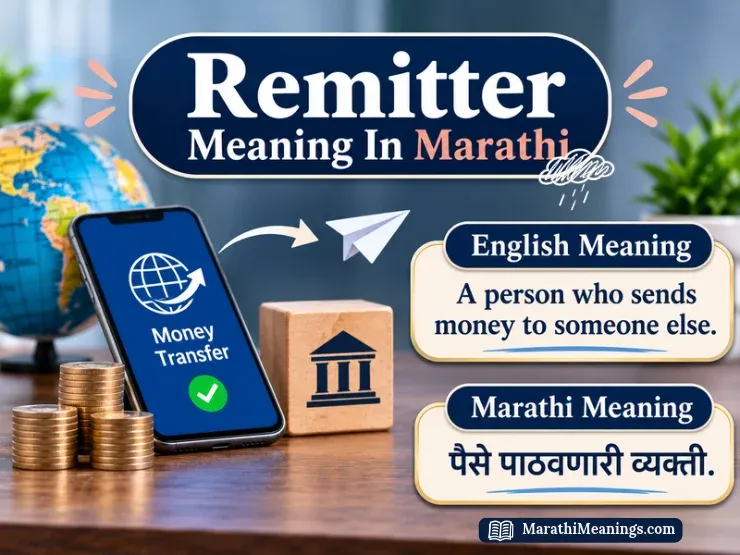
Remitter = प्रेषक = पैसे पाठवणारी व्यक्ती. तुम्ही जेव्हाही — बँकेत, RTGS मध्ये, UPI वर, किंवा NEFT द्वारे — पैसे पाठवता, तुम्हीच Remitter आहात. घेणारा नाही — देणारा.
Quick Facts: Remitter Meaning
| माहिती | तपशील |
|---|---|
| Remitter Meaning In Marathi | प्रेषक / पैसे पाठवणारी व्यक्ती |
| Remitter Meaning In English | The person who sends or transfers money |
| Used In | RTGS, NEFT, IMPS, UPI, DD, Challan |
| Opposite Term | Beneficiary (लाभार्थी — पैसे मिळणारा) |
| Key Form Fields | नाव (Name), खाते क्रमांक (Account No.), सही (Signature) |
| Related Act | PMLA – मनी लॉंडरिंग प्रतिबंध कायदा (Prevention of Money Laundering Act) |
| In UPI Language | Payer / Sender — पाठवणारा (तुम्ही) |
| In NRI Transfers | अनिवासी भारतीय (NRI) — परदेशातून पैसे पाठवणारा |
Have you ever filled a bank form or an RTGS slip and stared at the word “Remitter” — wondering, “हे काय आहे? हे मी आहे की दुसरा कोणी?”
You’re not alone. Thousands of people across Maharashtra — students, homemakers, small business owners — face this every single day. It shows up on RTGS forms, NEFT slips, Demand Drafts (मागणी मसुदा), and even mobile banking (मोबाईल बँकिंग) screens.
So let’s settle this once and for all — in plain, simple Marathi and English.
Remitter Meaning In Marathi — सोप्या भाषेत
Remitter म्हणजे पैसे पाठवणारी व्यक्ती.
मराठीत याला “प्रेषक” असे म्हणतात.
शब्द उच्चार: रे-मि-टर (Re-mi-ter)
| भाषा | अर्थ |
|---|---|
| मराठी | प्रेषक — पैसे पाठवणारा / पाठवणारी |
| हिंदी | प्रेषक / भेजने वाला |
| इंग्रजी | Sender / Payer / Transferor |
“रेमिटर म्हणजे ती व्यक्ती जी दुसऱ्याला पैसे पाठवते — मग ते बँकेद्वारे असो, RTGS द्वारे असो, किंवा UPI द्वारे असो.”
एक ओळीत: तुम्ही पाठवत असाल तर तुम्ही Remitter (प्रेषक). तुम्ही मिळवत असाल तर तुम्ही Beneficiary (लाभार्थी).
Word Origin of “Remitter”
| Stage | Language | Word | Meaning |
|---|---|---|---|
| Root | Latin | mittere | to send (पाठवणे) |
| Prefix | Latin | re- | back / again (परत / पुन्हा) |
| Combined | Latin | remittere | to send back (परत पाठवणे) |
| Old French | French | remettre | to put back / send again |
| Modern English | English | remit → remitter | to send money / the one who sends |
💡 थोडक्यात: “Remitter” हा शब्द 2,000 वर्षांपूर्वीच्या Latin भाषेतून आला आहे. Latin मध्ये “mittere” म्हणजे पाठवणे — त्यातूनच Mission, Missile, Transmit, Submit हे शब्दही आले आहेत. Banking मध्ये “Remitter” या अर्थाने वापर 18व्या शतकात (1700s) युरोपीय बँकिंग प्रणालीसोबत रूढ झाला.
Word Forms (Grammar Family)
| Word Form | Type | Meaning | Marathi अर्थ |
|---|---|---|---|
| Remit | Verb (क्रियापद) | To send money | पैसे पाठवणे |
| Remitter | Noun (नाम) | The person who sends | पाठवणारा / प्रेषक |
| Remittance | Noun (नाम) | The money/act of sending | प्रेषण / पाठवलेली रक्कम |
| Remitted | Past Tense | Money already sent | पाठवलेले (पैसे) |
| Remitting | Present Participle | Act of currently sending | पाठवत असलेले |
| Remittee | Noun | The one who receives | मिळवणारा / लाभार्थी |
| Remittal | Noun (formal) | The formal act of remitting | अधिकृत प्रेषण |
Who Is a Remitter? Real-Life Example
Imagine this:
Raju lives in Pune. His sister Priya lives in Mumbai and needs ₹50,000 for her college admission.
Raju goes to SBI and fills an RTGS form. The form has two sections:
- Remitter Details (प्रेषकाचा तपशील) → Raju fills his own name, account number, and signature.
- Beneficiary Details (लाभार्थीचा तपशील) → Raju fills Priya’s name and account number.
Raju = Remitter (प्रेषक). Priya = Beneficiary (लाभार्थी). Done.
It doesn’t matter how much money, which bank, or which method — if you are sending (पाठवत असाल), you are the Remitter.
Remitter Meaning in the Digital Age — UPI, GPay, PhonePe
Here’s something most people don’t realise:
Every time you send money on UPI — you are the Remitter (प्रेषक).
Whether it’s PhonePe, Google Pay, Paytm, or BHIM — the moment you hit “Pay” or “Send,” you become the remitter. The person receiving is the beneficiary (लाभार्थी).
India now processes over 14 billion UPI transactions every month. That means billions of remitters are transacting daily — most without even knowing the word!
UPI च्या भाषेत:
- Payer / Sender = Remitter (प्रेषक) — पैसे पाठवणारा
- Payee / Receiver = Beneficiary (लाभार्थी) — पैसे मिळवणारा
So when your UPI app shows “Transaction initiated by [Your Name]” (व्यवहार सुरू केला) — that’s your remitter details being logged in the system.
💡 Did You Know? Under RBI’s UPI guidelines, every digital transfer is recorded with the remitter’s VPA — Virtual Payment Address (आभासी देयक पत्ता), mobile number, and device ID — making every transaction traceable to the sender (प्रेषकापर्यंत शोधता येते).
Remitter Meaning In Bank
The Remitter Meaning In Bank is consistent everywhere. Wherever you see the word “remitter” in a bank document — it means the person who is initiating and sending the payment (व्यवहार सुरू करणारी व्यक्ती).
You’ll see it on:
- RTGS and NEFT Transfer Forms (निधी हस्तांतरण फॉर्म)
- Demand Draft / DD applications (मागणी मसुदा अर्ज)
- Bank Challan slips (बँक चलन पावत्या)
- Mobile and Internet Banking portals (मोबाईल आणि इंटरनेट बँकिंग)
- Foreign remittance forms (परकीय प्रेषण फॉर्म)
Whether you’re at SBI, HDFC, ICICI, Axis, Bank of Maharashtra, or a cooperative bank (सहकारी बँक) — the word always points to you, the sender (प्रेषक).
Name of Remitter & Signature of Remitter
These are two of the most important fields on any bank transfer form.
Name of the Remitter (रेमिटरचे नाव) = Your full name as registered in the bank.
Why does it matter?
- The bank verifies your name against account records (खाते नोंदी).
- Prevents fraud and unauthorized transfers (अनधिकृत व्यवहार).
- Legally required under PMLA — मनी लॉंडरिंग प्रतिबंध कायदा — for all transfers above ₹50,000.
⚠️ Quick Tip: Always write your name exactly as it appears in your bank records. A small spelling difference can cause the transaction to get flagged or rejected.
Signature of Remitter (रेमिटरची सही) = Your signature on the form.
This is your legal authorization (कायदेशीर परवानगी). It tells the bank: “हो, मी हा व्यवहार मंजूर करतो / करते.” Without it, most banks reject the form outright.
🚨 Never sign a blank bank form or allow someone else to sign on your behalf without written authority — Power of Attorney (मुखत्यारपत्र). Your signature is your legal consent — protect it.
Forms on Bank Documents / Forms
These are the exact field names you’ll see on RTGS, NEFT, DD, and other bank forms:
| Form Field Name | Marathi अर्थ | What to Fill |
|---|---|---|
| Remitter Name | रेमिटरचे नाव | Your full name |
| Name of the Remitter | प्रेषकाचे नाव | Your full name (bank records प्रमाणे) |
| Remitter Account Number | रेमिटरचा खाते क्रमांक | Your bank account number |
| Remitter Account | प्रेषक खाते | Your source account |
| Remitter Bank Name | रेमिटरची बँक | Your bank name (e.g., SBI, HDFC) |
| Remitter Bank Branch | रेमिटरची बँक शाखा | Your bank branch name |
| Remitter IFSC Code | रेमिटरचा IFSC कोड | Your branch’s IFSC code |
| Remitter Address | रेमिटरचा पत्ता | Your registered address |
| Remitter Mobile Number | रेमिटरचा मोबाईल क्रमांक | Your registered mobile number |
| Remitter Signature | रेमिटरची सही | Your signature |
| Signature of Remitter | प्रेषकाची सही | Your authorizing signature |
| Details of Remitter | रेमिटरचा तपशील | All your personal + account details |
| Details of Applicant / Remitter | अर्जदार / प्रेषकाचा तपशील | Full applicant details section |
| Remitter Reference Number | रेमिटरचा संदर्भ क्रमांक | Transaction reference assigned to sender |
| Remitter ID | रेमिटरचा ओळख क्रमांक | Your KYC or customer ID |
| Remitter PAN | रेमिटरचे पॅन कार्ड | Your PAN card number |
NEFT vs RTGS vs IMPS — Remitter’s Role in Each
This is where most people get confused. Here’s a clear breakdown of the three main payment methods — and what the remitter needs to know about each:
| Feature | NEFT | RTGS | IMPS |
|---|---|---|---|
| Full Form | National Electronic Funds Transfer (राष्ट्रीय इलेक्ट्रॉनिक निधी हस्तांतरण) | Real-Time Gross Settlement (तत्काळ एकूण निपटारा) | Immediate Payment Service (त्वरित देयक सेवा) |
| किमान रक्कम | कोणतीही मर्यादा नाही | ₹2 लाख | कोणतीही मर्यादा नाही |
| कमाल रक्कम | कोणतीही मर्यादा नाही | कोणतीही मर्यादा नाही | ₹5 लाख (साधारणतः) |
| Settlement Speed (निपटारा वेळ) | 30-मिनिटांच्या बॅचमध्ये | तत्काळ (Real-Time) | तत्काळ (Real-Time) |
| Availability (उपलब्धता) | 24×7 | 24×7 | 24×7 |
| Remitter ला लागते | नाव, खाते क्र., IFSC | नाव, खाते क्र., IFSC | मोबाईल नं. किंवा खाते + IFSC |
| सर्वोत्तम कशासाठी | नियमित हस्तांतरणासाठी | मोठ्या, तातडीच्या रकमेसाठी | लहान–मध्यम तत्काळ हस्तांतरणासाठी |
Remitter Meaning In RTGS specifically: Since RTGS handles ₹2 lakh+, the remitter details here carry extra weight — banks verify identity (ओळख पडताळणी) more strictly for high-value transfers.
Types of Remittance (Remittance चे प्रकार)
| Type | Marathi अर्थ | Meaning |
|---|---|---|
| Inward Remittance | आंतरगामी प्रेषण | Money coming INTO India / your account |
| Outward Remittance | बहिर्गामी प्रेषण | Money going OUT of India / your account |
| Domestic Remittance | देशांतर्गत प्रेषण | Transfer within India |
| Foreign Remittance | परकीय प्रेषण | International money transfer |
| NRI Remittance | अनिवासी भारतीय प्रेषण | Money sent by NRIs to India |
| Family Remittance | कौटुंबिक प्रेषण | Money sent to family members |
| Wire Remittance | वायर प्रेषण | Bank-to-bank international transfer |
What Happens If Remitter Details Go Wrong?
हा प्रश्न प्रत्येकाला माहीत असायला हवा — पण बहुतेकांना नसतो.
Say you accidentally entered a wrong account number (चुकीचा खाते क्रमांक) while doing an NEFT transfer. What happens?
The hard truth: The money goes to the wrong account. And getting it back is not easy.
Here’s why:
- Banks cannot reverse unilaterally (बँक एकट्याने पैसे परत करू शकत नाही) — The receiving bank cannot take money back from the wrong recipient without their consent (संमती). This is per RBI guidelines.
- Wrong recipient must agree (चुकीच्या व्यक्तीने स्वेच्छेने परत करणे आवश्यक) — If the wrong person received your money, they have to voluntarily return it.
- If they refuse (नकार दिल्यास) — You may need to take legal action or approach the Banking Ombudsman (बँकिंग लोकपाल — ग्राहकांच्या तक्रारींसाठी RBI ने नेमलेला अधिकारी).
- Raise a complaint immediately (तत्काळ तक्रार करा) — Contact your bank within 24 hours. The faster you act, the better the chance of resolution.
🚨 Golden Rule for Every Remitter: Always do a small test transfer of ₹1 before sending large amounts to a new account. This confirms the account is correct before you transfer the full amount. — मोठे पैसे पाठवण्यापूर्वी नेहमी ₹1 चा test transfer करा.
Details of Applicant / Remitter — What You Must Carry
For high-value transactions like Demand Drafts (मागणी मसुदा) or foreign remittances (परकीय प्रेषण), banks ask for a full section called “Details of Applicant / Remitter.”
The Details of Applicant Remitter Meaning — it means all information about the person sending the money.
Before we go further — a quick note on Remitter Account Meaning: the remitter account (प्रेषक खाते) is the bank account from which money is debited (कापले जाते). It is YOUR account — the sender’s account. The beneficiary account is where it arrives. So when a form asks for “Remitter Account Number,” it is asking for your account number, not the recipient’s.
Here’s what the Details of Applicant / Remitter section typically collects:
- Full Name (पूर्ण नाव)
- Bank Account Number (बँक खाते क्रमांक)
- Registered Address (नोंदणीकृत पत्ता)
- Mobile Number (मोबाईल नंबर)
- PAN Card (पॅन कार्ड) — ₹50,000 पेक्षा जास्त रकमेसाठी अनिवार्य (mandatory)
- Aadhaar (आधार कार्ड) — काही KYC (ओळख पडताळणी) प्रकरणांमध्ये आवश्यक
Always carry these documents to the bank for any large transfer.
No Card Record Remitter Meaning
If you’ve seen the message “No Card Record Remitter” on your mobile banking or ATM screen — it means:
“No valid debit/credit card is linked to the remitter’s account for this transaction.”
मराठीत: रेमिटरच्या खात्याशी (account शी) कोणतेही valid कार्ड (debit/credit card) जोडलेले नाही असे system ला आढळले.
कारण काय असू शकते?
- Debit card expired झाले (कालबाह्य झाले)
- Card चे details system मध्ये update नाहीत
- Card-linked transfer साठी कोणतेही card registered (नोंदणीकृत) नाही
उपाय (Fix): Net Banking किंवा Mobile Banking मध्ये card update करा, किंवा बँकेच्या शाखेत (branch) जा.
Error / Status Messages with “Remitter”
These appear on banking apps and ATM screens:
| Message | Marathi अर्थ | What It Means |
|---|---|---|
| No Card Record Remitter | रेमिटरशी कोणतेही कार्ड जोडलेले नाही | No card linked to remitter’s account |
| Remitter Account Blocked | रेमिटरचे खाते बंद केले आहे | Your account is blocked / frozen |
| Invalid Remitter Details | चुकीचा रेमिटर तपशील | Your details don’t match bank records |
| Remitter Authentication Failed | रेमिटर ओळख पडताळणी अयशस्वी | Your identity verification failed |
| Remitter Limit Exceeded | रेमिटरची मर्यादा ओलांडली | You’ve crossed your daily transfer limit |
| Remitter KYC Pending | रेमिटरचे KYC अपूर्ण | Your KYC is not complete |
5 Common Mistakes Remitters Make
या चुका दररोज हजारो लोकांच्या वेळ, पैसे आणि मनःशांतीवर परिणाम करतात. टाळा.
| # | Mistake (चूक) | Consequence (परिणाम) |
|---|---|---|
| 1 | Wrong account number (चुकीचा खाते क्रमांक) | पैसे चुकीच्या व्यक्तीकडे जातात — परत मिळणे कठीण |
| 2 | Wrong IFSC code (चुकीचा IFSC कोड) | व्यवहार (transaction) fail होतो किंवा उशीर होतो |
| 3 | Name mismatch (नावात फरक) | व्यवहार flag होऊन नाकारला (rejected) जाऊ शकतो |
| 4 | No PAN for ₹50,000+ transfers (पॅन कार्ड न देणे) | व्यवहार block होतो — PMLA compliance issue |
| 5 | Skipping test transfer (₹1 test न करणे) | मोठी रक्कम पाठवण्यापूर्वी खाते verify होत नाही |
Bonus mistake: Sharing your remitter account details — account number + IFSC — publicly on social media (सोशल मीडियावर). While this is needed for receiving money (पैसे मिळवण्यासाठी), scammers (फसवणूक करणारे) can misuse it for phishing attacks.
Remitter in NRI / International Money Transfers
Here’s a lesser-known but important angle:
If you’re an NRI — Non-Resident Indian (अनिवासी भारतीय) sending money from the USA, UK, UAE, or any other country to your family in India — you are the remitter (प्रेषक).
A few key points:
- Inward remittances — भारतात येणारे पैसे — have no limit (कोणतीही मर्यादा नाही) as per RBI rules.
- The Indian recipient (भारतातील लाभार्थी) just needs a valid bank account.
- For amounts above USD 10,000, US banks require declaration under FinCEN rules.
- In India, large inward remittances may require Form 15CA/CB if they involve taxable income (करपात्र उत्पन्न).
- Under FEMA — Foreign Exchange Management Act (परकीय चलन व्यवस्थापन कायदा, 1999), all international remittances must be properly documented.
India receives the highest inward remittance in the world — over $125 billion annually — making NRI remitters one of the most significant financial contributors to the Indian economy.
Remitter vs Beneficiary — The Complete Picture
| Feature | Remitter (प्रेषक) | Beneficiary (लाभार्थी) |
|---|---|---|
| Role | पैसे पाठवतो | पैसे मिळवतो |
| Also Called | Sender, Payer, Applicant (पाठवणारा, अर्जदार) | Receiver, Payee (मिळवणारा) |
| Account Action | Money debited — खात्यातून कापले जाते | Money credited — खात्यात जमा होते |
| In UPI | Payer — पाठवणारा | Payee — मिळवणारा |
| In RTGS Form | स्वतःचे तपशील + सही भरतो | फक्त नाव आणि खाते क्रमांक दिला जातो |
| Legal Role | व्यवहार अधिकृत (authorize) करणे आवश्यक | अधिकृत निधी (authorized funds) मिळवतो |
| In NRI Transfer | परदेशातून पैसे पाठवणारा (अनिवासी भारतीय) | भारतात पैसे मिळवणारा कुटुंबातील सदस्य |
Related Banking Terms (Same Family)
| Term | Marathi अर्थ | Relation to Remitter |
|---|---|---|
| Beneficiary | लाभार्थी | Opposite of Remitter — receiver |
| Payer | देणारा / भरणारा | Same as Remitter in payment context |
| Payee | मिळवणारा | Same as Beneficiary |
| Sender | पाठवणारा | Informal word for Remitter |
| Transferor | हस्तांतरणकर्ता | Legal term for Remitter |
| Drawer | आहर्ता | Remitter in cheque/DD context |
| Applicant | अर्जदार | Remitter in DD/challan forms |
| Originator | सुरुवात करणारा | Remitter in SWIFT/international context |
| Payer VPA | देणाऱ्याचा UPI पत्ता | Remitter’s UPI ID |
Conclusion — निष्कर्ष
तर मित्रांनो, आता Remitter Meaning In Marathi तुम्हाला पूर्णपणे स्पष्ट झाले असेल!
आजच्या लेखातून आपण शिकलो:
- Remitter = प्रेषक = पैसे पाठवणारी व्यक्ती — मराठी, हिंदी, इंग्रजी — सर्वत्र एकच अर्थ
- UPI वर Pay करताना तुम्ही Remitter (प्रेषक) आहात — हे बऱ्याच जणांना माहीत नसते
- RTGS (तत्काळ एकूण निपटारा), NEFT (राष्ट्रीय इलेक्ट्रॉनिक निधी हस्तांतरण), IMPS (त्वरित देयक सेवा) — तिन्ही मध्ये Remitter ची भूमिका एकच: पाठवणारा
- Wrong details = मोठी समस्या — नेहमी ₹1 चा test transfer करा आणि खाते क्रमांक double-check करा
- NRI (अनिवासी भारतीय) असाल तर तुम्ही जगातील सर्वात महत्त्वाच्या remitters पैकी एक आहात
पुढच्या वेळी बँकेत किंवा UPI वर जाताना — Remitter म्हणजे मी! हे आठवा. 😊
FAQs — Remitter Meaning In Marathi
Q1. Remitter Meaning In Marathi काय आहे?
A: Remitter म्हणजे मराठीत “प्रेषक” — पैसे पाठवणारी व्यक्ती. तुम्ही जेव्हाही — बँकेत, UPI वर, किंवा RTGS द्वारे — पैसे transfer (हस्तांतरित) करता, तेव्हा तुम्ही Remitter आहात.
Q2. Who Is Remitter in a bank transaction?
A: Remitter म्हणजे ती व्यक्ती जी स्वतःच्या बँक खात्यातून (bank account) दुसऱ्याच्या खात्यात पैसे पाठवते — म्हणजेच पैसे पाठवणारा / प्रेषक. In English: the person who initiates and sends money. पैसे मिळवणारा Beneficiary (लाभार्थी) असतो.
Q3. Remitter and Beneficiary मध्ये काय फरक आहे?
A: Remitter पाठवतो (sender / प्रेषक), Beneficiary मिळवतो (receiver / लाभार्थी). RTGS किंवा NEFT form मध्ये, Remitter section मध्ये तुमची माहिती भरायची आणि Beneficiary section मध्ये ज्याला पैसे पाठवायचे त्याची माहिती.
Q4. RTGS form मध्ये Remitter म्हणजे काय भरायचे?
A: RTGS (तत्काळ एकूण निपटारा) form मध्ये Remitter section मध्ये तुमचे नाव, तुमचा खाते क्रमांक (account number), तुमची बँक शाखा, IFSC code, मोबाईल नंबर, आणि सही (signature) भरायची असते.
Q5. UPI वर Remitter कोण असतो?
A: UPI वर जो पैसे पाठवतो तो Remitter (प्रेषक) असतो. तुम्ही PhonePe, GPay किंवा BHIM वर “Pay” दाबता तेव्हा तुम्ही Remitter आहात आणि दुसरी व्यक्ती Beneficiary (लाभार्थी) आहे. हे बँकेतल्या RTGS / NEFT इतकेच लागू होते.
Q6. चुकीच्या account ला पैसे गेले तर काय करावे?
A: लगेच — 24 तासांच्या आत — तुमच्या बँकेशी संपर्क करा आणि लेखी तक्रार (complaint) द्या. बँक RBI guidelines नुसार चुकीच्या बँकेला कळवेल. पण reverse होण्यासाठी चुकीच्या account holder ची संमती (consent) लागते. ते नकार देत असतील तर Banking Ombudsman (बँकिंग लोकपाल) कडे तक्रार करता येते. म्हणूनच पाठवण्यापूर्वी ₹1 चा test transfer करा.
Q7. Signature of Remitter म्हणजे काय?
A: Signature of Remitter म्हणजे तुमची सही — जी bank form वर व्यवहार (transaction) authorize करते. याशिवाय बँक transfer process करत नाही. ही तुमची कायदेशीर परवानगी (legal authorization) आहे — त्यामुळे blank form वर कधीही सही करू नका.
Q8. NRI Remittance मध्ये Remitter कोण असतो?
A: NRI — अनिवासी भारतीय (Non-Resident Indian) — remittance मध्ये परदेशातील NRI हाच Remitter (प्रेषक) असतो. भारतात पैसे मिळवणारी कुटुंबातील व्यक्ती Beneficiary (लाभार्थी) असते. FEMA (परकीय चलन व्यवस्थापन कायदा) नुसार हे व्यवहार नोंदणीकृत असणे आवश्यक आहे.
If You Liked This, Check Out Our Previous Blog As Well: [Leverage Meaning In Marathi]