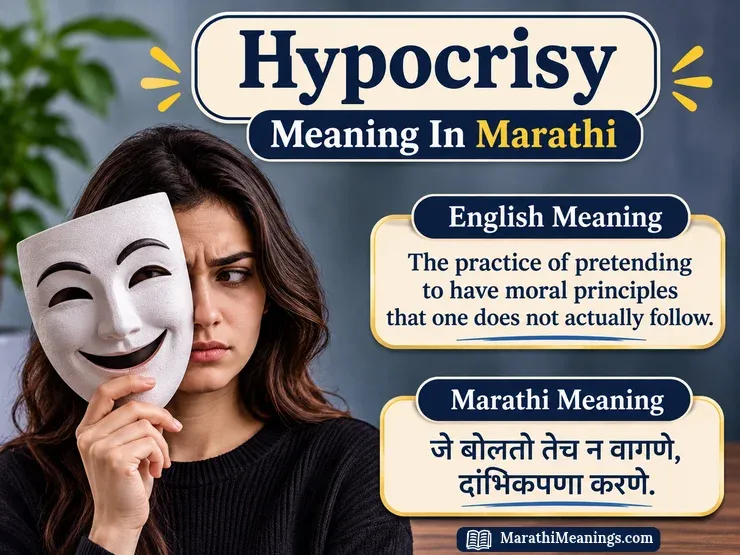
Hypocrisy Meaning In Marathi is ढोंगीपणा (Dhongipana) — saying one thing and doing the opposite. A hypocrite (ढोंगी) preaches good values but lives differently. Inside: full meaning, Indian cultural roots, real-life examples, social media hypocrisy, the psychology behind it, synonyms, quotes, and practical tips — all in simple, everyday language.
Quick Facts: Hypocrisy Meaning
| Feature | Details |
|---|---|
| Word | Hypocrisy |
| Hypocrisy Meaning In Marathi | ढोंगीपणा (Dhongipana) |
| Hypocrisy Pronunciation | hi-POK-ruh-see |
| Part of Speech | Noun |
| Hypocrite in Marathi | ढोंगी (Dhongi) |
| Word Origin | Greek — “hypokrisis” (play-acting, pretense) |
| First Known Use | 13th century English, via Latin hypocrisis |
| Antonym (विरुद्धार्थी) | Sincerity / Integrity — प्रामाणिकपणा / सचोटी |
| Related Words | Hypocrite, Hypocritical, Dambhikata (दांभिकता) |
| In Bhagavad Gita | दम्भ (Dambha) — Chapter 16 |
What Is Hypocrisy? — Hypocrisy Definition
Have you ever met someone who preaches honesty all day — but lies to your face?
Or lectures you about healthy eating — while secretly ordering fries at midnight?
That is hypocrisy.
Hypocrisy definition: The act of claiming to have moral values, beliefs, or standards — while not actually following them yourself.
In plain language — “do as I say, not as I do.”
The hypocrisy meaning traces back to the Greek word “hypokrisis” — which literally meant play-acting on a stage. A stage actor pretends to be a hero. A hypocrite does the same — in real life — but drops the act the moment no one is watching.
The key distinction: hypocrisy is not an occasional slip. We all make mistakes. Hypocrisy is a deliberate, consistent gap between what you project and how you actually live.
Hypocrisy Meaning In Marathi — ढोंगीपणा
Hypocrisy Meaning In Marathi is most commonly expressed as:
ढोंगीपणा (Dhongipana)
Say it: Dhon – gi – pa – na
It means — a false outward show. Pretending to be virtuous or righteous on the outside while being the complete opposite inside.
But Hypocrisy Meaning In Marathi is not just one word. The Marathi language is rich — and captures different shades of this behaviour precisely:
- दुटप्पीपणा (Dutappipana) — double standards; different rules for yourself and others
- पाखंड (Pakhand) — false religious piety; a show of spirituality without substance
- दांभिकता (Dambhikata) — a sanctimonious, proud form of hypocrisy
- कपट (Kapat) — deceit with cunning intent
- बनावटीपणा (Banavtipana) — fakeness; a manufactured personality
- नाटकीपणा (Natakipana) — theatrical, over-performed pretense
- पाखंडी (Pakhandī) — a religious fraud; someone who fakes sainthood
- दुतोंड्या (Dutondya) — literally “two-mouthed”; completely two-faced
Each word shades the concept a little differently — but all point to the same core gap: what you say versus how you live.
All Marathi Translations of Hypocrisy
| Marathi Word | Transliteration | Nuanced Meaning |
|---|---|---|
| ढोंगीपणा | Dhongipana | False show, general hypocrisy |
| दुटप्पीपणा | Dutappipana | Double standards, two-faced behaviour |
| पाखंड | Pakhand | False religious or spiritual piety |
| दांभिकता | Dambhikata | Proud, sanctimonious hypocrisy |
| कपट | Kapat | Deceit, cunning dishonesty |
| बनावटीपणा | Banavtipana | Fakeness, artificial personality |
| नाटकीपणा | Natakipana | Theatrical, over-performed pretense |
Hypocrisy Pronunciation
Hypocrisy pronunciation: hi-POK-ruh-see
The stress falls on the second syllable — “POK.” Practice it three times and it sticks.
In Marathi, simply say ढोंगीपणा (Dhongipana) — everyone will know exactly what you mean.
Hypocrisy in Indian Culture — The Bhagavad Gita Connection
Here’s something most people don’t know.
Hypocrisy is not just a modern English concept. In Indian philosophy, it has been discussed for thousands of years — and the Bhagavad Gita addresses it directly.
In Chapter 16, Lord Krishna lists the qualities of people with a demonic nature (आसुरी सम्पद). The very first quality he names is:
“दम्भो दर्पोऽभिमानश्च…” (Bhagavad Gita 16:4) (Pride, arrogance, conceit, and दम्भ (Dambha — hypocrisy / ostentation)…)
दम्भ (Dambha) in Sanskrit means — a false outward show of virtue. It is exactly what we call ढोंगीपणा in Marathi today.
Krishna calls it one of the most dangerous human qualities — not because it harms one moment, but because it corrodes trust, relationships, and inner character over time.
So when someone says “ढोंगी नको होऊस” (Don’t be a hypocrite) — they are echoing wisdom that is thousands of years old.
Hypocrisy Meaning In Marathi With Example
Let’s make it real. Here are three everyday examples that show Hypocrisy Meaning In Marathi With Example — ones you will instantly recognise.
Example 1 — The Lying Teacher
A teacher tells his students: “Never tell lies.” But he calls the school saying he’s sick — when he’s actually at a cricket match.
शिक्षक विद्यार्थ्यांना सांगतो “खोटं बोलू नका.” पण तो स्वतः आजारी असल्याचं सांगून मॅचला जातो.
ढोंगीपणा (Hypocrisy)
Example 2 — The Anti-Corruption Politician
A politician gives fiery speeches about ending corruption. But behind closed doors, he takes bribes.
नेता भ्रष्टाचाराच्या विरोधात मोठी भाषणे देतो. पण स्वतः मागून लाच घेतो.
दुटप्पीपणा (Hypocrisy)
Example 3 — The Preachy Relative
Your uncle constantly tells you to save money. But he buys a new phone every three months.
काका नेहमी पैसे वाचवायचा सल्ला देतो. पण स्वतः दर तीन महिन्यांनी नवीन फोन घेतो.
पाखंड (Hypocrisy)
Example 4 — The Fitness Influencer
A fitness influencer posts daily about clean eating and no junk food. But behind the camera, they eat burgers and skip workouts for weeks.
फिटनेस इन्फ्लुएन्सर रोज जंक फूड खाऊ नका असं सांगतो. पण कॅमेऱ्यामागे स्वतः बर्गर खातो आणि व्यायाम बुडवतो.
ढोंगीपणा (Hypocrisy)
Example 5 — The Strict Parent
A father scolds his child for watching TV during study time. But he himself scrolls through his phone all evening doing nothing.
बाबा मुलाला अभ्यासाच्या वेळी TV बघू नको म्हणतात. पण स्वतः संध्याकाळभर मोबाईल स्क्रोल करत बसतात.
दुटप्पीपणा (Hypocrisy)
Example 6 — The Office Gossip
A colleague always says “I never talk behind anyone’s back.” But they are the first one to gossip in the break room.
सहकारी नेहमी म्हणतो “मी कधीच पाठीमागे बोलत नाही.” पण ब्रेकरूममध्ये सर्वात आधी गॉसिप तोच करतो.
नाटकीपणा (Hypocrisy)
Example 7 — The Social Media Activist
Someone posts every day about respecting women. But at home, they treat their own mother and sister poorly.
कोणी रोज महिला सन्मानाच्या पोस्ट टाकतो. पण घरात आई आणि बहिणीशी वाईट वागतो.
दांभिकता (Hypocrisy)
Daily Life Examples of Hypocrisy
| Situation | What They Say | What They Do | Marathi Term |
|---|---|---|---|
| Parent to child | “Don’t waste food” | Throws leftovers daily | ढोंगीपणा |
| Politician | “I’m a man of the people” | Lives in a luxury bungalow | दुटप्पीपणा |
| Fitness influencer | “No junk food!” | Eats burgers in private | पाखंड |
| Boss at office | “Work-life balance matters” | Emails at midnight | दांभिकता |
| Religious leader | “Be humble and simple” | Craves public attention | ढोंगीपणा |
| Climate activist online | “Save the planet!” | Flies private jets | दांभिकता |
Social Media Hypocrisy — The 2026 Reality
This is a big one. And honestly, it’s getting worse.
Social media has created an entirely new arena for ढोंगीपणा — and it’s everywhere you look.
Virtue signaling is the modern form of hypocrisy. Someone posts a black-and-white photo “supporting” a cause — but takes no real action. Someone rants about climate change, then flies to Bali for a vacation. Someone preaches about mental health awareness — and bullies people in comments.
The “Instagram vs Reality” trend went viral for a reason. People carefully curate a life of wellness, simplicity, and authenticity — while behind the screen, the truth is completely different.
Cancel culture adds another layer of irony. People who cancel others for past mistakes are often caught doing the exact same thing. The internet never forgets — and hypocrites always leave a trail.
This is 21st-century दुटप्पीपणा — dressed up in hashtags.
💡 Think About It: Next time you share a cause online, ask yourself — am I just performing, or am I actually doing something? That gap between performance and action is exactly what Hypocrisy Meaning In Marathi — ढोंगीपणा — is all about.
Who Is A Hypocrite? (ढोंगी व्यक्ती)
A hypocrite (ढोंगी — Dhongi) is someone who practises ढोंगीपणा as a consistent habit — not just an occasional slip.
The word comes from Greek “hypokrites” — meaning an actor on stage. They perform virtue for an audience.
Key signs of a hypocrite:
- Judges others harshly for things they do themselves
- Gives advice they never follow
- Shifts values based on what is convenient
- Gets defensive or angry when called out
The difference between a hypocrite and someone who makes mistakes? Awareness and intent. A person who slips and owns it is not a hypocrite. A person who preaches and knowingly lives the opposite — that is ढोंगी.
Marathi Proverbs on Hypocrisy
The Marathi and broader Indian tradition has powerful proverbs on this subject — passed down for generations precisely because ढोंगीपणा is so common and so damaging.
“तोंडात राम, बगलेत सुरी” (Ram — God’s name — on the lips; a knife hidden under the arm)
This is one of the most famous expressions for hypocrisy in the Indian tradition. It describes someone who takes God’s name outwardly — while plotting harm in secret. Pure ढोंगीपणा.
“वरून साळू, आतून काळू” (Clean and bright on the outside; dark and rotten on the inside)
This proverb perfectly captures the gap between outward appearance and inner reality — the very heart of हायपोक्रिसी.
“उपदेश करणे सोपे, आचरण कठीण” (It is easy to preach; living it is hard)
This is not exactly calling someone a hypocrite — but it is an honest acknowledgment that the gap between words and action is a universal human struggle.
Hypocrisy Synonyms (समानार्थी शब्द)
| English Synonym | Marathi Meaning |
|---|---|
| Pretense | ढोंग |
| Deceit | कपट |
| Insincerity | अप्रामाणिकपणा |
| Double standards | दुटप्पीपणा |
| Two-facedness | दुहेरी वागणूक |
| Phoniness | खोटेपणा |
| Duplicity | दुहेरी चारित्र्य |
| Sanctimoniousness | दांभिकता |
| Self-righteousness | स्वतःला श्रेष्ठ समजणे |
| Disingenuous | कपटी |
| Pretentious | दिखाव्याचा |
Hypocrisy synonyms like these are useful when you want to describe the same behaviour more precisely — or add variety to your writing.
Hypocrisy Related Words At A Glance
| Word Form | English | Marathi |
|---|---|---|
| Noun | Hypocrisy | ढोंगीपणा (Dhongipana) |
| Person | Hypocrite | ढोंगी (Dhongi) |
| Adjective | Hypocritical | ढोंगी वृत्तीचा |
| Adverb | Hypocritically | ढोंगीपणाने |
| Opposite (Noun) | Integrity | सचोटी |
| Opposite (Adj.) | Authentic / Sincere | खरा / प्रामाणिक |
Hypocrisy Quotes (विचार)
Some of the sharpest hypocrisy quotes ever written:
“The only vice that cannot be forgiven is hypocrisy.” — William Hazlitt, Characteristics (1823)
“Beware of practising your piety before others in order to be seen by them.” — Matthew 6:1 (Bible)
“दम्भो दर्पोऽभिमानश्च — Pride, arrogance, and hypocrisy are the marks of a demonic nature.” — Bhagavad Gita, Chapter 16
In Marathi:
“स्वतः न करता दुसऱ्याला उपदेश करणे — हाच ढोंगीपणा आहे.”
(Advising others what you don’t do yourself — that itself is hypocrisy.)
The lesson from all of them is the same: it is far easier to point fingers than to look in the mirror.
Why Do We Become Hypocrites? — The Psychology
Here is something fascinating — and humbling.
Research shows we are all at least a little hypocritical sometimes. And there is a psychological reason for it.
Psychologists call it “Moral Licensing” — first documented by Monin & Miller in research published in the Journal of Personality and Social Psychology (2001). The concept is this: when we do something good — donate, help someone, recycle — our brain gives us a kind of “moral credit.” And then we feel quietly entitled to cut corners elsewhere.
You donate to charity on Sunday — and you are rude to a waiter on Monday. That is moral licensing at work.
A second factor is “Motivated Reasoning” — our brain works hard to justify our own behaviour while judging the same behaviour in others more harshly. This is why a smoker can genuinely believe they are healthier than another smoker.
The takeaway? Hypocrisy — ढोंगीपणा — is often more unconscious than we like to admit. The antidote is not perfection. It is honest self-reflection.
How to Handle A Hypocrite — Practical Tips
Knowing the hypocrisy meaning in Marathi is one thing. Knowing what to do when you encounter ढोंगीपणा is another — and far more useful.
Here are five practical steps:
| # | Tip | What To Do |
|---|---|---|
| 1 | Don’t argue in the moment | Hypocrites are defensive by nature. Confronting them publicly makes things worse — wait for a calm, private moment. |
| 2 | Point to actions, not character | Don’t say “you’re a hypocrite.” Say “you said X, but you did Y.” Let the facts speak for themselves. |
| 3 | Set clear boundaries | If their double standards affect you — at work or at home — be direct about what you need, not what you think they are. |
| 4 | Manage your expectations | A person unaware of their own ढोंगीपणा will not change overnight. Protect your peace first. |
| 5 | Check yourself too | The most honest response to spotting hypocrisy around you is to make sure you are not practising it yourself. That is the real test. |
“ज्याला दुसऱ्याचा ढोंगीपणा दिसतो, त्याने आधी स्वतःकडे पाहावे.”
(One who sees hypocrisy in others should first look at themselves.)
Conclusion
So, here it is — Hypocrisy Meaning In Marathi is ढोंगीपणा (Dhongipana). And as we have seen, it is not just a word. It is a human flaw that cuts across time, culture, social media, and everyday relationships.
The Bhagavad Gita warned against दम्भ. Marathi proverbs captured it in “तोंडात राम, बगलेत सुरी.” Psychology explains why it happens. And in 2026, social media gives us front-row seats to it every single day.
The goal is not to never slip up. The goal is to live with सचोटी — integrity. To close the gap between what you say and how you live.
Recognise ढोंगीपणा when you see it. Handle it wisely. But most importantly — make sure you are not practising it yourself.
Now you know the hypocrisy meaning in Marathi — the word, the culture, the psychology, and what to do about it.
FAQs About Hypocrisy Meaning In Marathi
Q1. Hypocrisy Meaning In Marathi काय आहे?
ढोंगीपणा (Dhongipana) — pretending to hold values or beliefs you don’t actually practise. Other Marathi words: दुटप्पीपणा, पाखंड, and दांभिकता. Each carries a slightly different shade of meaning.
Q2. What is Hypocrisy Meaning In English?
“The practice of claiming to have higher moral standards or beliefs than is actually the case.” — Simply put: saying one thing and consistently doing another.
Q3. How do you use Hypocrisy in a sentence?
“It was pure hypocrisy for him to preach equality while treating his own staff unfairly.” Marathi: “समानतेचा उपदेश करायचा आणि स्वतःच्या कर्मचाऱ्यांशी वाईट वागायचं — हा शुद्ध ढोंगीपणा आहे.”
Q4. What is the Hypocrisy Pronunciation?
hi-POK-ruh-see — stress on the second syllable, “POK.” In Marathi: ढोंगीपणा (Dhongipana).
Q5. What is the difference between Hypocrisy and a simple mistake?
A mistake is a one-time slip — often unintentional. Hypocrisy (ढोंगीपणा) is a repeated pattern — a deliberate gap between what you preach and what you practise. The intent and consistency are what separate the two.
Q6. Is hypocrisy mentioned in the Bhagavad Gita?
Yes. In Chapter 16, Verse 4, Lord Krishna lists दम्भ (Dambha) — hypocrisy or false ostentation — as one of the first qualities of a demonic nature (आसुरी सम्पद). It is considered one of the most corrosive human flaws in Indian philosophy.
Q7. How to identify a hypocrite (ढोंगी)?
Watch for these signs: they judge others for things they do themselves, their values shift based on convenience, they give advice they never follow, and they react with anger or defensiveness when their contradiction is pointed out calmly.
If You Liked This, Check Out Our Previous Blog As Well: [Remitter Meaning In Marathi]