Quick Summary:
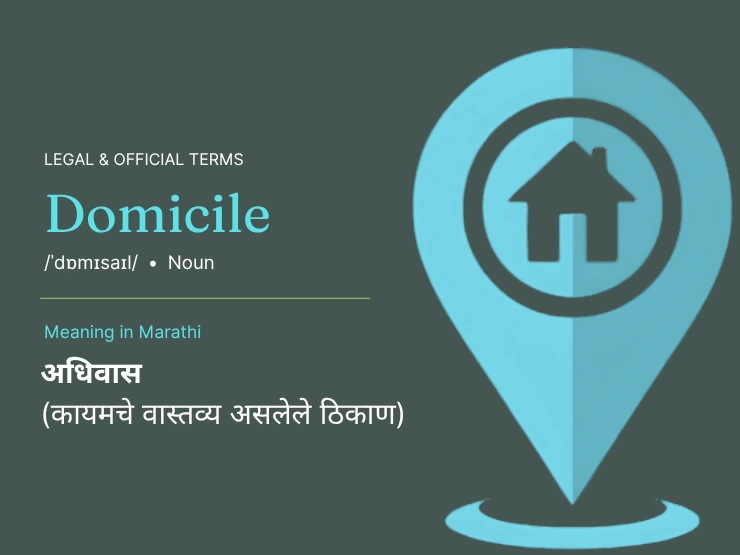
Domicile meaning in Marathi is अधिवास (Adhivaas) — your permanent, legally recognized place of residence. In Hindi, it means स्थायी निवास (Sthaayee Nivaas). A domicile is not just where you currently live — it is the place where you have settled permanently and intend to stay. In India, proof of domicile comes in the form of a Domicile Certificate (अधिवास प्रमाणपत्र), issued by the state government. This certificate matters most when applying for state government jobs, college admissions under the state quota, or state scholarship schemes.
Quick Stats: Domicile
| Feature | Detail |
|---|---|
| Root Word | Latin domicilium |
| Root Meaning | Home / Dwelling place |
| Word Family | Domicile, Domiciled, Domiciliary, Non-domicile |
| First Recorded Use | 15th century (English) |
| Register | Formal, Legal, Administrative |
| Equivalent Marathi Word | अधिवास (Adhivaas) |
| Equivalent Hindi Word | अधिवास / स्थायी निवास |
| Common Document | Domicile Certificate (अधिवास प्रमाणपत्र) |
| Issuing Authority (India) | State Revenue Department / Tehsildar |
Introduction
If you have ever applied for a government job, college admission, or state scholarship in India, you have almost certainly come across the word domicile. But what exactly does it mean — especially in legal, educational, and administrative contexts?
Domicile meaning in Marathi is अधिवास (Adhivaas) or कायमचे निवासस्थान (Kaayamche Nivaassthaan), which literally translates to “permanent place of residence.” In simple terms, your domicile is the place — usually a state or country — where you legally and permanently reside, and where you are considered a resident for official purposes.
This word appears in forms, certificates, college applications, bank account openings, and even in tax and inheritance law. Whether you are a student filling out a Maharashtra state quota form, a professional applying for a local government post, or a senior citizen submitting documents for pension benefits, understanding domicile meaning in Marathi will save you confusion and errors.
This article covers the meaning, pronunciation, etymology, usage examples in English, Marathi, and Hindi, related Indian language translations, and answers to the most commonly asked questions about domicile.
Domicile Meaning In Marathi
Domicile (noun) means your permanent legal place of residence — the place where you have settled with the intention of living indefinitely.
In Marathi (Devanagari)
अधिवास (Adhivaas) कायमचे निवासस्थान (Kaayamche Nivaassthaan) स्थायी राहण्याची जागा (Sthaayee Raahanyaachee Jaagaa)
The most widely used official Marathi term is अधिवास (Adhivaas), which appears directly on the अधिवास प्रमाणपत्र (Domicile Certificate) issued by the Maharashtra government.
Simple explanation in Marathi:
अधिवास म्हणजे एखाद्या व्यक्तीचे कायमचे राहण्याचे ठिकाण, जे शासकीय कागदपत्रांमध्ये नमूद केले जाते. हे एखाद्या राज्यातील कायमस्वरूपी रहिवाशी असल्याचे प्रमाण असते.
(Adhivaas mhanje ekhaadhyaa vyakteeche kaayamche raahanyaache thikaaN, je shaasakeey kaagadapatraaṃmadhe namuud kele jaate. He ekhaadhyaa raajyaateeel kaayamaswaroopee rahivaashee asalyaache pramaan asate.)
Translation of explanation: Domicile refers to a person’s permanent place of residence, noted in official documents. It serves as proof of being a permanent resident of a particular state.
Domicile Meaning In Hindi
Domicile meaning in Hindi is अधिवास (Adhivaas) or स्थायी निवास (Sthaayee Nivaas).
Hindi (Devanagari): अधिवास / स्थायी निवास / स्थायी आवास Roman Transliteration: Adhivaas / Sthaayee Nivaas / Sthaayee Aawaas
Simple explanation in Hindi:
अधिवास का मतलब है किसी व्यक्ति का स्थायी निवास स्थान, जहाँ वह कानूनी रूप से रहता है। यह किसी राज्य या देश में स्थायी निवासी होने का प्रमाण होता है।
(Adhivaas kaa matlab hai kisee vyakti kaa sthaayee nivaas sthaan, jahaan vah kaanoonee roop se rehtaa hai. Yah kisee raajya yaa desh mein sthaayee nivaasee hone kaa pramaan hotaa hai.)
Translation: Domicile means a person’s permanent place of residence where they legally live. It is proof of being a permanent resident of a state or country.
Pronunciation Guide
| Style | Pronunciation |
|---|---|
| English (IPA) | /ˈdɒm.ɪ.saɪl/ |
| English (Easy) | DOM-uh-syl |
| Marathi (Roman) | Adhivaas |
| Hindi (Roman) | Adhivaas / Sthaayee Nivaas |
| Common Mispronunciation | “doh-MIE-seel” or “doh-mi-SILL” (both wrong) |
Tip: The stress falls on the first syllable — DOM-i-sile. Many people mispronounce it as “doh-mi-SEEL.” The correct English pronunciation rhymes with “Tom-a-tile.”
Part of Speech & Grammar
Domicile functions as both a noun and a verb in English.
As a Noun:
“Her domicile is in Pune, Maharashtra.” (She permanently lives in Pune.)
As a Verb (less common, formal/legal usage):
“He has domiciled in Mumbai for the past fifteen years.” (He has established his permanent residence in Mumbai.)
In Indian administrative usage — including domicile meaning in Marathi contexts — the word is almost always used as a noun, referring to the place of permanent residence or the official certificate proving it.
Origin & Etymology
The word domicile has a clear and traceable Latin origin:
| Stage | Language | Word | Meaning |
|---|---|---|---|
| Ancient | Latin | domus | House / Home |
| Latin | Latin | domicilium | Dwelling place / Abode |
| Medieval | Old French | domicile | Place of residence |
| Modern | English | domicile | Legal permanent home |
The Latin root domus (house) also gave us related English words like domestic, domain, domination, and condominium — all carrying the underlying idea of home, ownership, or belonging to a place.
In Indian legal tradition, the concept of domicile was formally introduced during British colonial rule as part of the system of legal domicile used to determine jurisdiction, inheritance rights, and residency qualifications. The Marathi equivalent, अधिवास (Adhivaas), is a Sanskrit-origin word: अधि (Adhi) meaning “upon/over” + वास (Vaas) meaning “residence/dwelling.”
Different Meanings by Context
The word domicile carries slightly different nuances depending on the context in which it is used. Here is a clear breakdown:
| Context | Meaning |
|---|---|
| General (Everyday) | The place where a person permanently lives |
| Legal / Law | The jurisdiction a person is considered a permanent legal resident of, for purposes of courts, taxation, and inheritance |
| Education (India) | Proof of being a resident of a particular state, required for state quota seats |
| Banking & Finance | The branch or country where an account, bond, or bill is registered and payable |
| Government / Administrative | A certificate proving long-term residency in a state (Domicile Certificate) |
| International Law | The country a person is legally attached to, distinct from nationality or citizenship |
State of Domicile Meaning
State of domicile meaning refers to the specific Indian state (or any country’s state/province) where a person has their legal permanent home. In India, your state of domicile determines your eligibility for:
- State government job reservations
- State quota seats in medical and engineering colleges
- State scholarship programs
- Various welfare schemes
State of domicile meaning in Hindi:
राज्य का अधिवास — वह राज्य जहाँ कोई व्यक्ति स्थायी रूप से निवास करता है और जिसके आधार पर उसे सरकारी सुविधाएँ और आरक्षण मिलता है।
Country of Domicile Meaning
Country of domicile meaning refers to the country where a person is legally considered a permanent resident for tax, legal, or banking purposes. This is especially relevant for NRIs (Non-Resident Indians) and expatriates. A person can be a citizen of one country but have their country of domicile in another if they have settled there permanently.
District of Domicile Meaning
District of domicile meaning refers to the specific administrative district within a state where a person permanently resides. This is recorded on domicile certificates and is used to determine local administrative jurisdiction, local reservation quotas, and district-specific government benefits.
Place of Domicile Meaning
Place of domicile meaning is the most general form — it simply refers to the specific location (city, town, village, district, or state) that a person considers their permanent home and that is recognized as such in official records.
Non-Domicile Meaning
Non-domicile meaning (often shortened to “non-dom”) refers to a person who, although living in a country, is NOT legally considered a permanent resident or domiciliary of that country. In the UK tax system, for example, a non-domicile resident is taxed differently from those permanently domiciled there. In India, non-domicile most commonly refers to a student or applicant who does NOT hold a domicile certificate of a particular state and is therefore ineligible for that state’s reserved seats or schemes.
What Is a Domicile Certificate?
A Domicile Certificate (अधिवास प्रमाणपत्र in Marathi) is an official government document issued by a state’s revenue department. It certifies that the holder is a bona fide permanent resident of that state.
Who Issues It?
In Maharashtra, the domicile certificate is issued by the Tehsildar or Sub-Divisional Magistrate (SDM) through the revenue department. Applications are accepted both offline (at district offices) and online through the Maharashtra Aaple Sarkar portal.
Why Is It Required?
| Purpose | Details |
|---|---|
| Education | Required for state quota seats in colleges (medical, engineering, law) |
| Government Jobs | Required for state cadre positions and local body recruitments |
| Scholarships | Mandatory for most state government scholarship applications |
| OBC/SC/ST Benefits | Helps establish local residency for caste certificate-linked benefits |
| Property Transactions | Sometimes needed in certain land or property matters |
| Banking | Required for specific account types or loan applications |
Eligibility for Maharashtra Domicile Certificate
To obtain a domicile certificate in Maharashtra, the applicant generally needs to prove at least 15 years of continuous residence in the state. Required documents typically include:
- Aadhar Card
- Ration Card
- School Leaving Certificate
- Voter ID
- Property documents (if applicable)
Note: Eligibility criteria and required documents may change. Always verify with the official Maharashtra government portal or your local Tehsildar’s office.
Domicile Meaning In India — Legal Perspective
In India, domicile is used in two broad senses:
1. Domicile of Origin: The domicile a person acquires at birth, typically based on the domicile of the father (under traditional law) or the place of birth.
2. Domicile of Choice: The domicile a person voluntarily acquires by settling in a new state or country with the clear intention of making it a permanent home.
The concept is particularly important in private international law, governing which court has jurisdiction over a person and which state’s laws apply to matters like marriage, divorce, and inheritance.
In everyday Indian usage, however, domicile meaning in India is most commonly understood as simply having a state domicile certificate that proves long-term residency.
Usage Examples
In English
- “She attached her domicile certificate along with her college application.”
- “His state of domicile is Maharashtra, so he is eligible for the state quota.”
- “For tax purposes, the country of domicile matters more than nationality.”
- “The district of domicile must be clearly mentioned in the application form.”
- “Non-domicile students must apply under the open merit category.”
In Marathi (Devanagari + Transliteration)
- तिने आपले अधिवास प्रमाणपत्र महाविद्यालयाच्या अर्जासोबत जोडले. (Tine aaple adhivaas pramaanapatra mahaavidyaalaayaachyaa arjaasobat joDale.) She attached her domicile certificate with the college application.
- त्याचा राज्य अधिवास महाराष्ट्र आहे, त्यामुळे तो राज्य कोट्यासाठी पात्र आहे. (Tyaachaa raajya adhivaas Mahaaraashtra aahe, tyaamuLe to raajya kotyaasaathee paatr aahe.) His state of domicile is Maharashtra, so he is eligible for the state quota.
- अधिवास प्रमाणपत्र मिळवण्यासाठी महाराष्ट्रात किमान १५ वर्षे राहणे आवश्यक आहे. (Adhivaas pramaanapatra miLavaNyaasaathee Mahaaraashtraat kimaaan 15 varshe raahaNe aavashyak aahe.) To obtain a domicile certificate, it is necessary to have lived in Maharashtra for at least 15 years.
In Hindi (Devanagari + Transliteration)
- उसने अपना अधिवास प्रमाण पत्र कॉलेज आवेदन के साथ लगाया। (Usne apnaa adhivaas pramaan patra college aavedan ke saath lagaayaa.) She attached her domicile certificate with the college application.
- उसका राज्य अधिवास महाराष्ट्र है, इसलिए वह राज्य कोटे के लिए पात्र है। (Uskaa raajya adhivaas Mahaaraashtr hai, isliye vah raajya kote ke liye paatr hai.) His state of domicile is Maharashtra, so he is eligible for the state quota.
- अधिवास प्रमाण पत्र के लिए राज्य में कम से कम १५ साल रहना जरूरी होता है। (Adhivaas pramaan patra ke liye raajya mein kam se kam 15 saal rehnaa zaroori hotaa hai.) To get a domicile certificate, it is necessary to have lived in the state for at least 15 years.
Marathi Synonyms for Domicile
| Marathi Word | Transliteration | Meaning |
|---|---|---|
| अधिवास | Adhivaas | Permanent residence / Domicile |
| निवासस्थान | Nivaassthaan | Place of residence |
| कायमचे घर | Kaayamche Ghar | Permanent home |
| स्थायी राहण्याची जागा | Sthaayee Raahanyaachee Jaagaa | Permanent place of living |
| वास्तव्य | Vaastavya | Residence / Dwelling |
| घरदार | Ghardaar | Home and household (informal) |
| राहण्याचे ठिकाण | Raahanyaache Thikaaan | Place of residence |
Synonyms, Antonyms & Related Words (English)
Synonyms
- Residence
- Abode
- Dwelling
- Permanent home
- Habitation
- Place of settlement
- Legal residence
Antonyms
- Transient location
- Temporary stay
- Non-domicile
- Statelessness
Related Words / Word Family
| Word | Meaning |
|---|---|
| Domiciled | Having established a permanent residence |
| Domiciliary | Relating to a place of residence (e.g., domiciliary visit = home visit) |
| Non-domicile / Non-dom | A person not legally domiciled in a particular place |
| Domiciliation | The act of establishing a legal domicile |
Domicile Meaning In Other Indian Languages
Many users search for domicile meaning across different regional languages. Here is a concise, accurate reference:
| Language | Word / Phrase | Transliteration |
|---|---|---|
| Marathi | अधिवास / कायमचे निवासस्थान | Adhivaas / Kaayamche Nivaassthaan |
| Hindi | अधिवास / स्थायी निवास | Adhivaas / Sthaayee Nivaas |
| Kannada | ವಾಸಸ್ಥಾನ / ನಿರಂತರ ನಿವಾಸ | Vaasasthaaana / Nirantara Nivaasa |
| Telugu | నివాస స్థలం / శాశ్వత నివాసం | Nivaasa Sthalam / Shaashvata Nivaasam |
| Bengali | আবাসস্থল / স্থায়ী বাসস্থান | Abasasthol / Sthaayee Baasasthaan |
| Tamil | வசிப்பிடம் / நிரந்தர இருப்பிடம் | Vasippitam / Nirantara Iruppitam |
| Malayalam | വാസസ്ഥലം / സ്ഥിരതാമസം | Vaaasasthalam / Sthirathaamasam |
| Gujarati | નિવાસસ્થાન / કાયમી રહેઠાણ | Nivaassthaan / Kaayamee Raheṭhaan |
| Punjabi | ਨਿਵਾਸ ਸਥਾਨ / ਸਥਾਈ ਘਰ | Nivaas Sathaan / Sathaae Ghar |
Note: Translations above reflect the standard administrative or educational usage of the term in each language. Local usage may vary.
Cultural Significance & Regional Usage in India
In India, domicile is not merely a word — it is a deeply practical concept tied to social equity, educational opportunity, and employment rights.
The Indian Constitution and state laws recognize that people who have spent most of their lives in a particular state have a special relationship with its resources, language, and culture. This is why states maintain domicile-based reservations in education and government employment.
For Marathi speakers, the domicile certificate (अधिवास प्रमाणपत्र) is especially important because Maharashtra has competitive admission processes for professional courses, and state residents get a significant advantage in government job recruitments, including Zilla Parishad, Maharashtra Public Service Commission (MPSC), and municipal corporation posts.
The concept also holds weight in banking and finance. When you open a Non-Resident External (NRE) or Non-Resident Ordinary (NRO) account, your country of domicile determines tax treatment and repatriation rules.
Common Mistakes & Misconceptions
1. Confusing Domicile with Nationality: Your domicile is your permanent place of residence, not your citizenship. An Indian citizen can be domiciled in the UAE, and a foreign national can be domiciled in India.
2. Confusing Domicile with Temporary Residence: Staying somewhere for work or study for a short period does not make it your domicile. Domicile requires long-term intention to remain permanently.
3. Assuming Aadhaar Card = Domicile Certificate: An Aadhaar Card proves identity and address but is NOT equivalent to a domicile certificate. They serve different purposes.
4. Wrong Pronunciation: Saying “doh-mi-SEEL” instead of “DOM-uh-syl” is a very common error among Indian English speakers.
5. Treating Domicile and Residential Certificate as the Same: A residential certificate proves you are currently living somewhere. A domicile certificate proves you have been a permanent resident for a required number of years and are legally entitled to that state’s benefits.
Read Also: Carpediem Meaning In Marathi
Conclusion
Domicile meaning in Marathi is अधिवास (Adhivaas) — your permanent legal place of residence, backed by official documentation. Whether you are a student securing a state quota seat, a professional applying for a government post, or a citizen accessing state welfare schemes, understanding what domicile means and what the domicile certificate (अधिवास प्रमाणपत्र) represents is genuinely useful.
The word comes from the Latin root domus (home) and has evolved into a critical legal and administrative term across all Indian languages. From domicile meaning in Hindi to domicile meaning in Kannada, Telugu, Bengali, Tamil, Malayalam, Gujarati, and Punjabi — the concept is the same everywhere: your permanent, legally recognized home.
Remember the key distinctions — domicile is not the same as temporary residence, it is not the same as your Aadhaar address, and it is not the same as nationality. It is the place you call your permanent home in the eyes of the law, and it carries real, tangible rights.
? Frequently Asked Questions (FAQs)
1. What is domicile meaning in Marathi?
Domicile meaning in Marathi is अधिवास (Adhivaas) or कायमचे निवासस्थान (Kaayamche Nivaassthaan). It means a person’s permanent place of legal residence.
2. What is domicile meaning in Hindi?
Domicile meaning in Hindi is अधिवास (Adhivaas) or स्थायी निवास (Sthaayee Nivaas) — meaning a person’s permanent home as recognized by law.
3. What is a domicile certificate and who issues it in Maharashtra?
A domicile certificate (अधिवास प्रमाणपत्र) is an official document proving permanent residency in a state. In Maharashtra, it is issued by the Tehsildar or Sub-Divisional Magistrate under the Revenue Department.
4. What is state of domicile meaning in India?
State of domicile refers to the particular Indian state where a person has their permanent legal residence. It determines eligibility for state-level job reservations, college admissions, and welfare schemes.
5. What is non-domicile meaning?
Non-domicile (non-dom) refers to a person who does not hold legal permanent residency status in a particular state or country. In India, non-domicile students are ineligible for state quota benefits in educational institutions.
6. How many years of residence are needed for a Maharashtra domicile certificate?
Generally, a minimum of 15 years of continuous residence in Maharashtra is required to obtain a domicile certificate. Always verify current requirements with the official Maharashtra government portal as rules may be updated.
7. What is the difference between domicile and residence?
Residence is where you currently live (can be temporary). Domicile is where you permanently and legally belong, with the intent to stay indefinitely. A person can have multiple residences but typically only one domicile.
8. What is country of domicile meaning?
Country of domicile is the country where a person is permanently settled and legally recognized as a domiciliary. This matters for taxation, banking, and legal jurisdiction — especially for NRIs and expatriates.