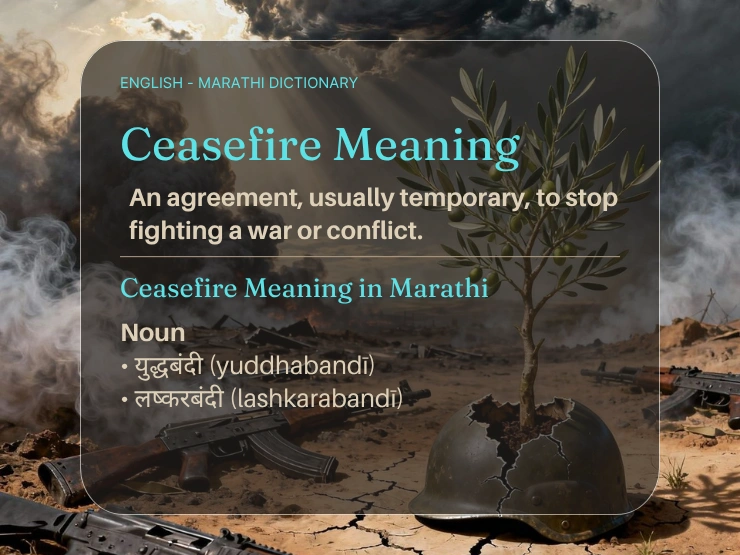
The Ceasefire Meaning In Marathi is primarily युद्धविराम (Yuddhaviram), संघर्षविराम (Sangharshaviram), or लढाई थांबवणे (Ladhai thambavane). In English, ceasefire means an agreed or declared stopping of fighting between opposing sides, especially during a war or armed conflict.
In simple words, when two sides that are fighting agree to stop attacks or military action, this stopping of hostilities is called a ceasefire.
Hindi meaning: युद्धविराम, संघर्ष विराम, लड़ाई रोकना
Roman Hindi: Yuddhaviram, sangharsh viram, ladai rokna
A ceasefire may be temporary, limited to a particular area, or subject to specific conditions. It does not necessarily mean that the war or political conflict has permanently ended.
Quick Overview: Ceasefire Meaning
| Feature | Details |
|---|---|
| Word | Ceasefire |
| Part of Speech | Noun |
| Pronunciation | sees-fire |
| IPA | /ˈsiːs.faɪər/ |
| Marathi Meaning | युद्धविराम, संघर्षविराम, लढाई थांबवणे |
| Roman Transliteration | Yuddhaviram, Sangharshaviram, Ladhai thambavane |
| Hindi Meaning | युद्धविराम, संघर्ष विराम, लड़ाई रोकना |
| Root Words | cease + fire |
| Synonyms | truce, armistice, suspension of hostilities |
| Antonyms | resumption of fighting, renewed hostilities |
| Common Context | War, armed conflict, diplomacy, international relations |
What Is Ceasefire?
What Is Ceasefire? A ceasefire is an arrangement, decision, or declaration through which opposing parties stop fighting or carrying out specified hostile military actions.
The parties involved may be countries, armies, armed groups, or other organized forces. A ceasefire can be reached through direct negotiations, mediation, diplomatic discussions, or an announcement by one side.
For example, if two groups have been exchanging attacks and subsequently agree to stop those attacks while negotiations continue, their agreement can be described as a ceasefire.
The important point is that a ceasefire concerns the stopping or suspension of hostilities. It does not automatically settle the political, territorial, economic, or other issues that caused the conflict.
Simple definition
Ceasefire = an agreement or arrangement to stop fighting.
Marathi explanation
युद्धविराम म्हणजे युद्ध किंवा सशस्त्र संघर्षामध्ये सुरू असलेली लढाई किंवा हल्ले थांबवण्याची व्यवस्था किंवा सहमती.
The expression लढाई थांबवणे is especially useful when explaining the meaning in simple Marathi, while युद्धविराम is a concise formal term.
Ceasefire Meaning In Marathi
The Ceasefire Meaning In Marathi changes slightly according to context. The main Marathi equivalents are given below.
युद्धविराम
युद्धविराम (Yuddhaviram) is a formal Marathi equivalent for a suspension or stopping of war or fighting.
It is particularly suitable in formal writing, news reports, diplomatic discussions, and descriptions of armed conflicts.
Example:
English: The countries announced a ceasefire.
Marathi: दोन्ही देशांनी युद्धविराम जाहीर केला.
संघर्षविराम
संघर्षविराम (Sangharshaviram) refers to a suspension of conflict or hostilities.
It can be appropriate when the parties involved are engaged in an armed conflict that may not necessarily be described simply as a conventional war.
लढाई थांबवणे
लढाई थांबवणे (Ladhai thambavane) literally conveys the idea of stopping the fighting.
This is a straightforward explanatory expression and is useful when explaining the word to someone who is unfamiliar with formal terminology.
Which Marathi meaning should you use?
There is no need to force one translation into every sentence.
- युद्धविराम — formal and concise
- संघर्षविराम — emphasizes suspension of conflict or hostilities
- लढाई थांबवणे — simple and descriptive
Therefore, the appropriate Ceasefire Meaning In Marathi depends on the sentence and the nature of the conflict.
Meaning Of Ceasefire in English
The Meaning Of Ceasefire is a temporary or agreed suspension of fighting, particularly between parties involved in an armed conflict.
The noun can refer either to the stoppage of fighting itself or to the arrangement under which the fighting is stopped.
For example:
The government called for a ceasefire.
This means the government requested that the fighting should stop.
Another sentence is:
The two sides agreed to a ceasefire.
Here, the sentence indicates that the opposing parties reached an agreement to suspend fighting.
A ceasefire can have conditions. The conditions may specify when the suspension begins, where it applies, which activities are prohibited, and how long it is expected to last.
Ceasefire Meaning In English: Pronunciation and Grammar
Ceasefire is pronounced:
sees-fire
IPA: /ˈsiːs.faɪər/
It is a noun.
The word is formed from:
- cease — to stop or come to an end
- fire — in a military context, gunfire or weapons fire
The compound therefore expresses the basic idea of stopping fire or armed fighting.
Singular and plural
Singular: a ceasefire
A ceasefire was announced overnight.
Plural: ceasefires
Several ceasefires were attempted during the conflict.
Common combinations
- ceasefire agreement
- ceasefire talks
- ceasefire proposal
- ceasefire negotiations
- ceasefire violation
- ceasefire line
- temporary ceasefire
- permanent ceasefire
- fragile ceasefire
- immediate ceasefire
Ceasefire Meaning In War
The Ceasefire Meaning In War refers to the suspension of fighting between opposing forces.
During an armed conflict, a ceasefire may be used to reduce immediate violence while the parties communicate or negotiate. It may also create a period during which civilians can receive assistance or other arrangements can be made.
A ceasefire may cover:
- a specific geographic area,
- particular types of military activity,
- a limited period,
- the entire conflict,
- or certain parties to the conflict.
Its scope depends on the terms under which it is established.
Does a ceasefire end a war?
Not necessarily.
A ceasefire can stop active fighting without resolving the disagreements behind the conflict. The parties may still have unresolved political, territorial, security, or other disputes.
This distinction is important:
Ceasefire: Fighting is stopped or suspended.
Peace agreement: The parties reach a broader settlement intended to resolve the conflict.
Peace: A condition in which hostilities have ended or are absent.
Thus, a ceasefire can be an important stage in a peace process without itself being equivalent to permanent peace.
Types of Ceasefire
Ceasefires can differ according to how they are established and where they apply.
Temporary Ceasefire
A temporary ceasefire lasts for a specified period.
For example, parties may suspend fighting for several hours or days before negotiations resume.
Local Ceasefire
A local ceasefire applies to a particular geographical area rather than an entire conflict.
It may be established around a town, border area, or other location affected by fighting.
General Ceasefire
A general ceasefire applies more broadly across the conflict and can involve multiple areas or parties.
Unilateral Ceasefire
A unilateral ceasefire is announced or observed by one side without necessarily requiring an equivalent agreement from the opposing side.
Mutual Ceasefire
A mutual ceasefire occurs when opposing sides agree to suspend fighting under mutually accepted conditions.
The exact legal or diplomatic character of any ceasefire depends on its specific terms and circumstances.
Fragile Ceasefire Meaning
The Fragile Ceasefire Meaning is an unstable or uncertain suspension of fighting that could easily collapse.
In Marathi, fragile ceasefire can naturally be expressed as:
नाजूक युद्धविराम
अस्थिर युद्धविराम
Roman: Najuk yuddhaviram, Asthir yuddhaviram
Here, fragile does not refer to something physically breakable. It describes a ceasefire that remains vulnerable because tensions, disagreements, or risks of renewed fighting continue.
English: The region remained under a fragile ceasefire.
Marathi: त्या प्रदेशात नाजूक युद्धविरामाची स्थिती कायम राहिली.
Lifting Ceasefire Meaning
Lifting Ceasefire Meaning refers to ending or bringing a ceasefire arrangement to an end.
In Marathi, this can be expressed naturally as:
- युद्धविराम समाप्त करणे
- युद्धविराम उठवणे
The exact expression depends on the context and the intended meaning.
For example:
English: The authorities decided to lift the ceasefire.
Marathi: अधिकाऱ्यांनी युद्धविराम समाप्त करण्याचा निर्णय घेतला.
The expression indicates that the arrangement suspending fighting is being ended. It does not by itself specify what happens afterward.
Ceasefire Meaning In Hindi
The Ceasefire Meaning In Hindi includes:
- युद्धविराम
- संघर्ष विराम
- लड़ाई रोकना
- युद्ध रोकना
Roman transliteration: Yuddhaviram, Sangharsh viram, Ladai rokna, Yuddh rokna
For example:
English: The two sides agreed to a ceasefire.
Hindi: दोनों पक्ष युद्धविराम पर सहमत हुए।
Marathi: दोन्ही बाजू युद्धविरामाला सहमत झाल्या.
Hindi and Marathi both use formal compounds based on the idea of stopping war or conflict, although the wording used in everyday speech may vary.
Ceasefire Meaning In Tamil, Telugu and Other Indian Languages
The term is also searched in several Indian languages. The following compact table provides useful equivalents.
| Language | Meaning |
|---|---|
| Marathi | युद्धविराम / संघर्षविराम |
| Hindi | युद्धविराम / संघर्ष विराम |
| Tamil | போர் நிறுத்தம் |
| Telugu | కాల్పుల విరమణ |
| Urdu | جنگ بندی |
| Punjabi | ਜੰਗਬੰਦੀ |
| Kannada | ಕದನ ವಿರಾಮ |
| Gujarati | યુદ્ધવિરામ |
| Malayalam | വെടിനിർത്തൽ |
| Bengali | যুদ্ধবিরতি |
These translations communicate the general concept of suspending or stopping fighting. Exact wording can vary according to the context and language register.
Ceasefire Meaning In Salaar
The phrase Ceasefire Meaning In Salaar refers to the ordinary meaning of the word ceasefire when it is used in connection with the film Salaar.
In a cinematic context involving rival groups, armed conflict, or political power struggles, ceasefire still means a suspension or stopping of fighting between opposing sides.
Its Marathi sense remains:
युद्धविराम / संघर्षविराम / लढाई थांबवणे
The presence of the word in a movie, title, dialogue, review, or fan discussion does not create a separate dictionary definition. The surrounding story determines the particular situation in which the term is being used.
Ceasefire Examples in Marathi, English and Hindi
Example 1
English: The two governments signed an agreement calling for a ceasefire.
Marathi: दोन्ही सरकारांनी युद्धविरामाचे आवाहन करणाऱ्या करारावर स्वाक्षरी केली.
Hindi: दोनों सरकारों ने युद्धविराम का आह्वान करने वाले समझौते पर हस्ताक्षर किए।
Example 2
English: The ceasefire began at midnight.
Marathi: युद्धविराम मध्यरात्री सुरू झाला.
Hindi: युद्धविराम आधी रात से शुरू हुआ।
Example 3
English: The negotiators worked throughout the night to preserve the ceasefire.
Marathi: युद्धविराम कायम ठेवण्यासाठी मध्यस्थांनी रात्रभर प्रयत्न केले.
Hindi: युद्धविराम बनाए रखने के लिए वार्ताकारों ने पूरी रात प्रयास किया।
Example 4
English: The proposed ceasefire included restrictions on military operations.
Marathi: प्रस्तावित युद्धविरामामध्ये लष्करी कारवायांवर निर्बंधांचा समावेश होता.
Hindi: प्रस्तावित युद्धविराम में सैन्य अभियानों पर प्रतिबंध शामिल थे।
Example 5
English: Residents hoped that the ceasefire would reduce violence in the area.
Marathi: युद्धविरामामुळे परिसरातील हिंसाचार कमी होईल अशी रहिवाशांना आशा होती.
Hindi: निवासियों को उम्मीद थी कि युद्धविराम से क्षेत्र में हिंसा कम होगी।
Example 6
English: The ceasefire agreement required both parties to stop attacks.
Marathi: युद्धविरामाच्या करारानुसार दोन्ही पक्षांनी हल्ले थांबवणे आवश्यक होते.
Hindi: युद्धविराम समझौते के अनुसार दोनों पक्षों को हमले रोकना आवश्यक था।
Example 7
English: Officials said that monitoring would be necessary to maintain the ceasefire.
Marathi: युद्धविराम कायम ठेवण्यासाठी देखरेख आवश्यक असल्याचे अधिकाऱ्यांनी सांगितले.
Hindi: अधिकारियों ने कहा कि युद्धविराम बनाए रखने के लिए निगरानी आवश्यक होगी।
Example 8
English: The parties discussed extending the ceasefire before it expired.
Marathi: युद्धविरामाची मुदत संपण्यापूर्वी तो वाढवण्याबाबत संबंधित पक्षांनी चर्चा केली.
Hindi: युद्धविराम की अवधि समाप्त होने से पहले पक्षों ने उसे बढ़ाने पर चर्चा की।
Ceasefire Synonyms
Some words have meanings close to ceasefire, but they should not automatically be treated as perfect substitutes.
Truce
A truce is an agreement to temporarily stop fighting.
Armistice
An armistice is a formal agreement to stop fighting, particularly between organized opposing forces.
Suspension of hostilities
This is a formal expression describing the stopping of hostile military action.
Halt in fighting
This is a straightforward phrase describing a stop in fighting.
Cessation of hostilities
This refers to the ending or suspension of hostile actions and is often used in formal contexts.
The appropriate term depends on the exact circumstances, level of formality, and nature of the agreement.
Ceasefire Antonyms
There is no single universal opposite of ceasefire, but several expressions can convey the opposite situation:
- resumption of fighting
- renewed hostilities
- continuation of fighting
- renewed attacks
- escalation of conflict
For example:
The ceasefire collapsed, followed by a resumption of fighting.
The phrase resumption of fighting clearly describes the opposite development.
Common Expressions With Ceasefire
Call for a ceasefire
To call for a ceasefire means to request that fighting should stop.
Declare a ceasefire
To declare a ceasefire means to formally announce a suspension of fighting.
Agree to a ceasefire
This means that parties accept an arrangement to stop fighting.
Observe a ceasefire
This means to follow the conditions of the ceasefire by refraining from prohibited fighting.
Violate a ceasefire
To violate a ceasefire means to breach its conditions by carrying out actions that the arrangement prohibits.
Break a ceasefire
This means to cause or participate in the ending of the suspension of fighting.
Extend a ceasefire
To extend a ceasefire means to continue the arrangement beyond its original period.
Ceasefire vs Truce vs Armistice vs Peace
These terms are closely related but have different nuances.
| Term | Basic meaning |
|---|---|
| Ceasefire | Suspension or stopping of fighting |
| Truce | Agreement to temporarily stop fighting |
| Armistice | Formal agreement to stop fighting |
| Peace agreement | Broader settlement addressing a conflict |
| Peace | A condition in which hostilities have ended or are absent |
A ceasefire therefore focuses primarily on the cessation of fighting. A broader peace agreement may address the causes of the conflict and establish longer-term arrangements.
Common Mistakes When Using Ceasefire
1. Thinking ceasefire always means permanent peace
A ceasefire may be temporary. It can stop active fighting without settling the underlying dispute.
2. Using ceasefire for ordinary personal arguments
The word is strongly associated with armed conflict and hostilities. It would sound unnatural to say that two friends reached a “ceasefire” after an ordinary disagreement unless the expression is deliberately humorous or figurative.
3. Assuming every ceasefire is mutual
Some ceasefires are mutual agreements, while others may be unilateral declarations or temporary suspensions initiated by one side.
4. Treating ceasefire and peace as identical
A ceasefire concerns the stopping of fighting. Peace generally carries a broader meaning.
5. Treating every related term as a direct synonym
Words such as truce and armistice overlap with ceasefire but can have different formal or contextual meanings.
Why Ceasefire Is Important in Conflict Contexts
A ceasefire can create a period in which active fighting is suspended. During such a period, parties may communicate, negotiate, arrange humanitarian operations, or address immediate security concerns.
Its practical significance depends on whether the parties observe the agreed conditions and whether the suspension can be maintained.
A ceasefire can therefore be:
- a short-term pause in violence,
- a confidence-building measure,
- part of negotiations,
- a step toward a wider agreement,
- or simply a temporary suspension without a lasting settlement.
The term should always be interpreted according to the actual conditions and context of the conflict.
Conclusion
The Ceasefire Meaning In Marathi is युद्धविराम, संघर्षविराम, or लढाई थांबवणे. In English, ceasefire means an agreed, declared, or arranged suspension of fighting between opposing sides, particularly during a war or armed conflict.
The most useful formal Marathi equivalent is युद्धविराम (Yuddhaviram), while लढाई थांबवणे (Ladhai thambavane) provides a simple explanation of the concept. In Hindi, the corresponding expressions include युद्धविराम and संघर्ष विराम.
A ceasefire is not necessarily the same as permanent peace. It may be temporary, local, mutual, unilateral, or part of a broader negotiation. Expressions such as fragile ceasefire, lifting ceasefire, ceasefire agreement, ceasefire violation, call for a ceasefire, and extend a ceasefire describe different situations surrounding the suspension of hostilities.
Understanding these contextual differences makes the meaning of ceasefire clearer in news reports, diplomatic discussions, literature, films, and everyday explanations of armed conflict.
? FAQs About Ceasefire Meaning
1. What is the Ceasefire Meaning In Marathi?
The Ceasefire Meaning In Marathi is युद्धविराम, संघर्षविराम, or लढाई थांबवणे. It means stopping or suspending fighting between opposing parties, especially during an armed conflict.
2. What Is Ceasefire in simple English?
A ceasefire is an arrangement in which opposing sides stop fighting or suspend hostile military activities.
3. What is the Meaning Of Ceasefire in Hindi?
The Hindi meaning is युद्धविराम, संघर्ष विराम, or लड़ाई रोकना. The appropriate expression depends on the sentence and context.
4. What does ceasefire mean in war?
In war, a ceasefire means that opposing forces stop or suspend fighting according to an agreed, declared, or otherwise established arrangement.
5. Does a ceasefire mean the war is over?
No. A ceasefire can be temporary and does not necessarily resolve the causes of a war. A separate peace agreement or political settlement may be required.
6. What does fragile ceasefire mean?
A fragile ceasefire is an unstable suspension of fighting that remains at risk of breaking down because tensions or disagreements continue.
7. What does lifting ceasefire mean?
Lifting ceasefire means ending the arrangement under which fighting had been suspended. In Marathi, it can be expressed as युद्धविराम समाप्त करणे.
8. What is the difference between ceasefire and truce?
Both terms involve stopping fighting. Truce generally emphasizes an agreement for a temporary suspension of hostilities, while ceasefire broadly refers to the stopping or suspension of fighting.
 Also Read These Word Meanings to Build a Stronger English-Marathi Vocabulary :
- Gigantic Meaning In Marathi
- Introvert Meaning In Marathi
- Domicile Meaning In Marathi
- Carpediem Meaning In Marathi
- Narcissist Meaning In Marathi
- Pookie Meaning In Marathi
- Audacity Meaning In Marathi
- Manifestation Meaning In Marathi
- Consent Meaning In Marathi
- Nephew Meaning In Marathi
- Harmony Meaning In Marathi
- Overwhelmed Meaning in Marathi
- Migraine Meaning in Marathi
- Antonyms Meaning In Marathi
- Pcod Full Form In Marathi