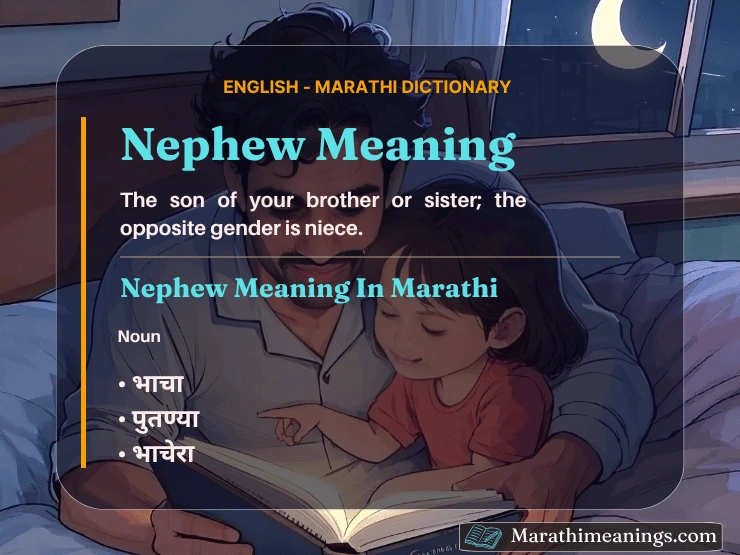
Nephew meaning in Marathi is भाचा (Bhacha). This word refers to the son of your brother or sister. In Hindi, it is called भतीजा (son of a brother) or भांजा (son of a sister). The feminine form, Niece, is भाची in Marathi and भतीजी or भांजी in Hindi.
Quick Stats: Nephew
| Field | Details |
|---|---|
| Word | Nephew |
| Part of Speech | Noun |
| Nephew Meaning In Marathi | भाचा (Bhacha) |
| Nephew Meaning In Hindi | भतीजा / भांजा (Bhatija / Bhanja) |
| Opposite Gender (Feminine) | Niece |
| Marathi Opposite Gender | भाची (Bhachi) |
| Hindi Opposite Gender | भतीजी / भांजी |
| IPA Pronunciation | /ˈnɛfjuː/ |
| Origin | Old French neveu, Latin nepos |
| Register | Formal and everyday |
Family relationships carry deep cultural weight in Indian languages, and English words like “nephew” often map onto very specific, nuanced terms in Marathi and Hindi. If you have been searching for nephew meaning in Marathi, you are in the right place.
The word nephew is a common English kinship term used daily in schools, offices, legal documents, and family conversations. Knowing its precise nephew meaning in Marathi helps students, professionals, and families communicate accurately whether they are filling out official forms, writing letters, or simply talking with relatives.

Nephew Meaning In Marathi
Nephew meaning in Marathi is भाचा (Bhacha).
In Marathi, भाचा specifically refers to the son of your sister. Marathi, like many Indian languages, distinguishes between paternal and maternal side relationships, but in everyday modern usage, भाचा is broadly used for any nephew, whether the child of a brother or a sister.
| English | Marathi (Devanagari) | Marathi (Roman Transliteration) |
|---|---|---|
| Nephew (sister’s son) | भाचा | Bhacha |
| Nephew (brother’s son) | पुतण्या | Putanya |
| Niece (sister’s daughter) | भाची | Bhachi |
| Niece (brother’s daughter) | पुतणी | Putani |
Simple Explanation in Marathi: भाचा म्हणजे तुमच्या बहिणीचा मुलगा. तर पुतण्या म्हणजे तुमच्या भावाचा मुलगा.
Simple Explanation in English: In Marathi, there are two distinct words. भाचा (Bhacha) is your sister’s son, and पुतण्या (Putanya) is your brother’s son. Both translate to “nephew” in English.
Nephew Meaning In Hindi
Nephew meaning in Hindi also splits into two terms based on which side of the family the child belongs to.
| Relationship | Hindi (Devanagari) | Hindi (Roman) | English |
|---|---|---|---|
| Brother’s son | भतीजा | Bhatija | Nephew |
| Sister’s son | भांजा | Bhanja | Nephew |
Simple Explanation in Hindi: भतीजा वह होता है जो आपके भाई का बेटा हो, और भांजा वह होता है जो आपकी बहन का बेटा हो। अंग्रेजी में दोनों के लिए एक ही शब्द है: Nephew.
Pronunciation Guide
The word nephew can be tricky for non-native speakers.
| Format | Pronunciation |
|---|---|
| IPA | /ˈnɛfjuː/ |
| Simple Roman | NEF-yoo |
| Marathi speakers say | नेफ्यू |
| Hindi speakers say | नेफ्यू |
The “ph” in nephew is pronounced like “f,” not “p.” Many learners mistakenly say “nep-hew.” The correct sound is NEF-yoo.
Origin and Etymology

The word nephew comes from Old French neveu, which itself came from Latin nepos, meaning grandson, descendant, or nephew. In ancient Latin, nepos had a broader meaning covering any male descendant or close male relative.
Over centuries, as the English language evolved, the meaning narrowed specifically to the son of one’s brother or sister.
Interestingly, the Sanskrit root naptr carries a similar sense of “descendant” or “grandson,” showing the shared Indo-European origin of this kinship vocabulary. This explains why related forms appear across Hindi, Marathi, and other Indian languages with overlapping meanings for nephew, grandson, and male relative.
Niece and Nephew Meaning In Hindi
Niece and nephew meaning in Hindi is often asked together because they are a natural pair.
| English | Hindi | Roman |
|---|---|---|
| Nephew (brother’s son) | भतीजा | Bhatija |
| Nephew (sister’s son) | भांजा | Bhanja |
| Niece (brother’s daughter) | भतीजी | Bhatiji |
| Niece (sister’s daughter) | भांजी | Bhanji |
Niece and nephew together represent the children of your siblings. In Hindi, the relationship is always specified by whether it is from the paternal (brother’s) side or maternal (sister’s) side.
Nephew Opposite Gender: Niece

The nephew opposite gender is Niece. This is one of the most commonly searched grammar questions related to this word.
| Gender | English | Marathi | Hindi |
|---|---|---|---|
| Masculine | Nephew | भाचा / पुतण्या | भांजा / भतीजा |
| Feminine (Nephew Feminine Gender) | Niece | भाची / पुतणी | भांजी / भतीजी |
The nephew feminine gender is Niece in English, भाची (Bhachi) in Marathi, and भांजी / भतीजी in Hindi.
Marathi Synonyms for Nephew
Marathi has specific vocabulary depending on the relationship side.
| Word | Devanagari | Usage |
|---|---|---|
| Bhacha | भाचा | Sister’s son (most common) |
| Putanya | पुतण्या | Brother’s son |
| Bhachara | भाचेरा | Cousin’s son (extended usage) |
In spoken Marathi, भाचा is the most commonly used term and is often understood to mean any nephew in casual conversation.
Nephew Meaning In Other Indian Languages
Nephew Meaning In Tamil
மருமகன் (Marumakan) or அண்ணன் மகன் (Annan Magan). Tamil also distinguishes between elder brother’s son and younger brother’s son in formal usage.
Nephew Meaning In Malayalam
അനന്തിരവൻ (Anandiravan). Malayalam uses highly specific kinship terms that reflect the matrilineal traditions of Kerala.
Nephew Meaning In Kannada
ಅಳಿಯ (Aliya) in some dialects or ಸೋದರಳಿಯ (Sodaraliya) more formally. Sodaraliya translates closely to “brother’s nephew” or “sister’s son.”
Nephew Meaning In Gujarati
ભત્રીજો (Bhatrijo) for a brother’s son and ભાણેજ (Bhanej) for a sister’s son.
Nephew Meaning In Bengali
ভাগনে (Bhagne) for a sister’s son and ভাইপো (Bhaipo) for a brother’s son.
Nephew Meaning In Punjabi
ਭਤੀਜਾ (Bhatija) for a brother’s son and ਭਾਣਜਾ (Bhanja) for a sister’s son, closely mirroring Hindi usage.
Nephew Meaning In Urdu
بھتیجا (Bhatija) for a brother’s son and بھانجا (Bhanja) for a sister’s son. Urdu kinship terms match Hindi very closely due to shared vocabulary.
Nephew Meaning In Assamese
ভাতিজা (Bhatija) for a brother’s son and ভগিনীপুত্ৰ (Bhagineeputra) in formal usage for a sister’s son.
Usage and Example Sentences
In English
- My nephew just started his first year of engineering college.
- She bought a birthday gift for her nephew.
- His nephew works at a technology company in Pune.
In Marathi (with Devanagari)
माझा भाचा खूप हुशार आहे.
(Majha bhacha khup hushar aahe.) My nephew is very intelligent.
तिने आपल्या भाच्यासाठी भेटवस्तू आणली.
(Tine aapalya bhachyasathi bhetvastoo aanali.) She brought a gift for her nephew.
माझ्या पुतण्याचे लग्न पुढच्या महिन्यात आहे.
(Majhya putanyache lagna pudhchya mahiniyat aahe.) My nephew’s wedding is next month.
In Hindi (with Devanagari)
मेरा भतीजा दिल्ली में पढ़ता है।
(Mera bhatija Dilli mein padhta hai.) My nephew studies in Delhi.
उसका भांजा बहुत प्यारा बच्चा है।
(Uska bhanja bahut pyara bacha hai.) Her nephew is a very sweet child.
मेरे भतीजे की नौकरी मुंबई में लगी है।
(Mere bhatije ki naukri Mumbai mein lagi hai.) My nephew got a job in Mumbai.
Cultural Significance in Marathi and Indian Families
In Indian culture, the relationship between an aunt or uncle and a nephew holds strong emotional and social significance. The भाचा (Bhacha) relationship in Marathi families is often celebrated with rituals, gifts during festivals like Diwali, Rakhi, and Dussehra, and is considered a bond of love and responsibility.
In many Marathi households, a sister’s son (भाचा) holds a special honorary role during wedding ceremonies and religious functions. This cultural depth is not captured in the simple English translation of “nephew,” making it all the more important to understand the correct Nephew Meaning in Marathi in its full cultural context.
Similarly, in Hindi-speaking families, the भतीजा and भांजा relationships both carry strong bonds of affection. The maternal uncle (mama) and paternal uncle (chacha) each share a uniquely different relationship with their respective nephews, and these are celebrated differently across states and communities.
Common Mistakes
1. Using भाचा for both relationships without distinction. In formal Marathi writing, भाचा means a sister’s son and पुतण्या means a brother’s son. In everyday speech, भाचा is used loosely, but for legal or formal documents, use the precise term.
2. Pronouncing nephew as “nep-hew.” The correct pronunciation is NEF-yoo. The “ph” makes an “f” sound, not a “p” sound.
3. Confusing Niece with Nephew. Niece is the nephew opposite gender and refers to a girl, not a boy. A common error among learners is mixing these up in English.
4. Using भतीजा for a sister’s son in Hindi. भतीजा strictly means brother’s son. For a sister’s son, always use भांजा.
Conclusion
Nephew meaning in Marathi is भाचा (Bhacha) for a sister’s son and पुतण्या (Putanya) for a brother’s son. In Hindi, the terms are भांजा (Bhanja) and भतीजा (Bhatija) respectively. Across all Indian languages, kinship vocabulary is rich, precise, and culturally meaningful, often making distinctions that English simply does not.
Whether you need the nephew meaning in Tamil, Malayalam, Kannada, Gujarati, Bengali, Punjabi, Urdu, or Assamese, each language has its own specific and deeply rooted term for this relationship. The nephew opposite gender is Niece, and the nephew feminine gender across Indian languages follows the same relational logic.
Knowing the correct word for your family relationships in your native language is a small but important part of keeping cultural identity alive across generations.
? Frequently Asked Questions
1. What is the nephew meaning in Marathi?
Nephew meaning in Marathi is भाचा (Bhacha) for a sister’s son and पुतण्या (Putanya) for a brother’s son.
2. What is the nephew meaning in Hindi?
Nephew meaning in Hindi is भतीजा (Bhatija) for a brother’s son and भांजा (Bhanja) for a sister’s son.
3. What is the nephew opposite gender called?
The nephew opposite gender is Niece. In Marathi, the niece is called भाची (Bhachi) or पुतणी (Putani). In Hindi, she is called भतीजी or भांजी.
4. What is the nephew feminine gender in English?
The nephew feminine gender is Niece.
5. What is niece and nephew meaning in Hindi?
Niece and nephew meaning in Hindi: Nephew is भतीजा (brother’s son) or भांजा (sister’s son), and Niece is भतीजी (brother’s daughter) or भांजी (sister’s daughter).
6. How do you pronounce nephew correctly?
Nephew is pronounced as NEF-yoo. The “ph” sounds like “f,” not “p.”
7. Is भाचा used for both nephew and niece in Marathi?
No. भाचा is masculine (nephew) and भाची is feminine (niece). They are separate words.
📚 Also Read These Word Meanings to Build a Stronger English Vocabulary :
- Fragile Meaning in Marathi
- Nostalgic Meaning In Marathi
- Flaxseed Meaning in Marathi
- Brat Meaning in Marathi
- Gigantic Meaning In Marathi
- Introvert Meaning In Marathi
- Ceasefire Meaning In Marathi
- Domicile Meaning In Marathi
- Carpediem Meaning In Marathi
- Narcissist Meaning In Marathi
- Pookie Meaning In Marathi
- Audacity Meaning In Marathi
- Manifestation Meaning In Marathi
- Consent Meaning In Marathi