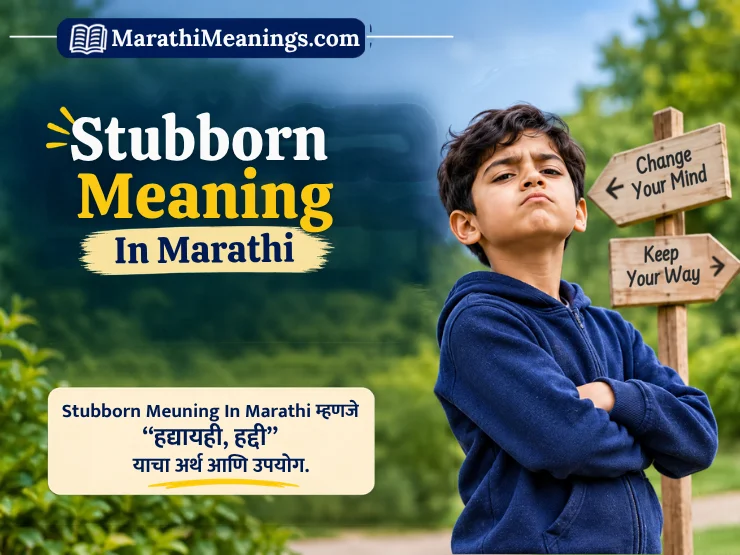
Stubborn Meaning In Marathi is हट्टी (Hatti). But Marathi has 5 unique words for stubbornness each with a different flavour. It also addresses what science says about stubborn people, famous stubborn personalities from Maharashtra and how to actually deal with someone who just won’t budge.
Stubborn Meaning In Marathi At A Glance
| Feature | Details |
|---|---|
| English Word | Stubborn |
| Primary Stubborn Meaning In Marathi | हट्टी (Hatti) |
| Other Marathi Words | आडमुठा, हेकेखोर, जिद्दी, दुराग्रही |
| Part of Speech | Adjective |
| English Pronunciation | /ˈstʌb.ərn/ — STUB-ern |
| Marathi Pronunciation | हट्टी = Hatt-ee |
| Antonym In Marathi | लवचिक (Lavchik) = Flexible |
| Positive Version | चिकाटी (Chikati) = Tenacious / Determined |
| Famous Stubborn Maharashtrian | Dr. B.R. Ambedkar — refused to accept injustice despite decades of resistance |
What Is Stubborn Meaning In Marathi? Let’s Start Right Here
Stubborn Meaning In Marathi is हट्टी (Hatti) — and you’ve probably heard this word in some form your entire life.
That kid refusing to eat bhakri? हट्टी. That colleague who shoots down every idea in a meeting? हट्टी. That relative who’s been in the same argument since 2019 and still hasn’t let it go? Absolutely, completely हट्टी.
But Marathi is a wonderfully expressive language. Just like English has stubborn, obstinate, pigheaded, and bullheaded, Marathi has its own rich set of words — each with its own shade of meaning.
Let’s break all of them down.
5 Marathi Words For “Stubborn” — Pronunciation & Real Examples
1. हट्टी (Hatti) — The One Everyone Uses
Pronunciation: Hatt-ee | Comes from हट्ट (Hatt) = insistence, demand
Your everyday go-to. A हट्टी person doesn’t just disagree — they insist on their position, no matter what.
Stubborn Meaning In Marathi With Example:
“तो खूप हट्टी आहे.” — He is very stubborn.
“माझी मुलगी हट्टी आहे, ती ऐकतच नाही.” — My daughter is stubborn; she just won’t listen.
2. आडमुठा (Aadmutha) — Stubborn AND Unreasonable
Pronunciation: Aad-moo-tha | Widely used in rural Maharashtra and Marathi literature
This is a step heavier than हट्टी. आडमुठा implies not just stubbornness but deliberate rigidity — the kind that makes you want to flip a table.
“तो माणूस फार आडमुठा आहे, त्याला कोणी समजावू शकत नाही.”
— That man is very obstinate; nobody can get through to him.
3. हेकेखोर (Hekekhor) — Stubborn With an Ego
Pronunciation: He-ke-khor
This person doesn’t just refuse to change — they’re proud of it. Arrogance is baked in. If हट्टी is a toddler throwing a tantrum, हेकेखोर is an adult doing the exact same thing but with zero self-awareness.
“तिचा नवरा खूप हेकेखोर आहे, कधीच माफी मागत नाही.”
— Her husband is very headstrong; he never apologises.
4. जिद्दी (Jiddi) — The Stubborn One Who Actually Wins
Pronunciation: Jid-dee
Here’s the plot twist: जिद्दी can mean stubborn or determined — and in the right context, it’s a straight-up compliment. It’s the word for someone who refuses to quit, not just refuses to listen.
“तो जिद्दी असल्यामुळे यशस्वी झाला.”
— He succeeded because of his determination.
This is stubborn as a superpower — the word Marathi uses when persistence pays off.
5. दुराग्रही (Duragrahi) — The Formal, Literary Word
Pronunciation: Dur-ag-ra-hi
You’ll find this in speeches, newspaper editorials, and Marathi literature. It refers specifically to someone who clings to a wrong belief stubbornly — almost ideologically.
“दुराग्रही वृत्ती कधीच प्रगतीस मदत करत नाही.”
— A stubborn, dogmatic attitude never leads to progress.
Stubborn In Other Indian Languages
You’ll notice these words travel across languages. Here’s how “stubborn” is said across India:
| Language | Word | Pronunciation | Notes |
|---|---|---|---|
| Marathi | हट्टी | Hatt-ee | Most common |
| Hindi | हठी / जिद्दी | Ha-thi / Jid-dee | Both widely used |
| Tamil | பிடிவாதமான | Pidi-vaa-ta-maa-na | Literally “one who holds on tightly” |
| Telugu | పట్టుదల కలవాడు | Pat-tu-da-la | Implies persistence too |
| Kannada | ಹಠಮಾರಿ | Ha-tha-maa-ri | Strong negative connotation |
| Bengali | একগুঁয়ে | Ek-gu-ye | “One-way person” — very visual |
| Gujarati | જિદ્દી | Jid-dee | Same root as Hindi/Marathi |
| Malayalam | വാശിക്കാരൻ | Vaa-shi-kaa-ran | From “vaashi” = insistence |
Interesting, right? Almost every Indian language has a version of this word — because, well, every family has that one person. 😄
What Science Says About Stubborn People (This Will Surprise You)
Here’s something most articles won’t tell you:
Psychologists say stubborn people often have a stronger sense of identity than average. They know what they want. They’re not easily swayed by social pressure. And that — in many real-world situations — is a genuine advantage.
The psychological term is “Need for Cognitive Closure” — the desire for a definite answer, and discomfort with ambiguity. Stubborn people score high on this. It makes them decisive, consistent, and difficult to manipulate.
A 2019 study published in the Journal of Personality found that people who display persistence and low agreeableness — traits closely linked to stubbornness — tend to earn more over their lifetimes and are often perceived as natural leaders.
But — and this is important — the same study noted that inflexibility becomes a problem when it’s paired with low self-awareness. The difference between a great leader and a difficult person is knowing when to hold firm and when to let go.
5 Signs You Are Stubborn (Without Realising It)
Be honest with yourself here. Check how many of these apply to you:
1. You argue even when you secretly know you’re wrong.
The logic train has left the station — but you’re still at the platform, defending the schedule.
2. You call it “having principles” when others call it “being difficult.”
There’s a fine line. Sometimes it’s principle. Sometimes it’s हट्टी with a rebranding.
3. You need the last word. Always.
Even in a text argument that ended hours ago. Even if the last message is just “okay.”
4. You’d rather lose the relationship than lose the point.
This is the most dangerous form — when being right feels more important than being together.
5. You hate asking for directions. Or help. Or anything.
Self-sufficiency is great. But refusing help when you genuinely need it? That’s हट्टी at its most expensive.
If you checked 3 or more — welcome to the club. It’s a big club. We don’t take suggestions on how to run it. 😄
Famous Stubborn People Who Changed Maharashtra (And The World)
Stubbornness gets a bad reputation. So let’s give credit where it’s due.
Dr. B.R. Ambedkar — Born into a Mahar family in Maharashtra, he faced discrimination at every step. Schools refused him. Institutions shut their doors. And he refused to accept any of it. His stubbornness drove him to become one of the most educated men of his time, to draft the Indian Constitution, and to reshape the rights of millions. That is जिद्दी at its most powerful.
Bal Gangadhar Tilak — “Swaraj is my birthright” wasn’t just a quote — it was the most stubborn political declaration of its era. The British imprisoned him twice. He kept going. हट्टी, in the best possible sense.
Savitribai Phule — She walked to school through crowds who threw garbage and stones at her. Every. Single. Day. She carried a spare sari and kept walking. If that isn’t आडमुठा-turned-legend, nothing is.
The lesson? Stubbornness, when pointed in the right direction, doesn’t just survive — it reshapes history.
Stubborn Meaning In Relationship — And What To Do About It
Stubborn Meaning In Relationship is straightforward: a partner, friend, or family member who refuses to compromise, rarely admits they’re wrong, and prioritises being right over being happy.
Sound familiar? Here’s what actually works when dealing with a stubborn person:
Ask questions instead of making statements.
“Why do you feel that way?” lands softer than “You’re wrong.” A stubborn person can argue with your statement. It’s harder to argue with their own answer.
Don’t attack the position — find the shared goal.
Two हट्टी people arguing about how to do something usually agree on what they want. Start there.
Give them time.
Stubborn people rarely change their mind in the middle of an argument. But they sometimes change it at 2am, while staring at the ceiling. Let it settle.
Pick your battles.
Not every hill is worth dying on. If you try to win everything, you’ll win nothing.
Stubborn Synonyms In Marathi & English
| English Synonym | Marathi Equivalent | Shade of Meaning |
|---|---|---|
| Obstinate | आडमुठा (Aadmutha) | Unreasonably rigid |
| Headstrong | हेकेखोर (Hekekhor) | Wilful, slightly arrogant |
| Persistent | जिद्दी (Jiddi) | Determined to the end — can be positive |
| Pigheaded | हट्टी (Hatti) | Irrationally unyielding |
| Inflexible | कठोर (Kathor) | Rigid in thinking or behaviour |
| Tenacious | चिकाटीने (Chikatine) | Holding firmly to a goal (positive) |
| Dogmatic | दुराग्रही (Duragrahi) | Clinging to wrong beliefs |
| Wilful | स्वेच्छाचारी (Swaichhachari) | Acting purely on own will |
Marathi Proverbs That Perfectly Capture Stubbornness
Marathi culture has always had a sharp, witty way of calling things out:
“हट्टाने माती खाणे”
Eating mud out of stubbornness.
Doing something harmful just to prove a point. The Marathi equivalent of “cutting off your nose to spite your face.”
“आपलीच ढपलीशी नाचायचे”
Dancing only to your own drum.
Doing things completely your own way, ignoring everyone else’s input or advice.
Both proverbs prove that Stubborn Meaning In Marathi goes far beyond a dictionary entry — it’s woven into how Maharashtrians have spoken, argued, and laughed for centuries.
Conclusion
Stubborn Meaning In Marathi isn’t just a translation exercise — it’s a window into human nature, Marathi culture, and the fine line between being frustratingly unyielding and admirably determined.
From the casual हट्टी to the powerful जिद्दी, from Dr. Ambedkar’s unstoppable persistence to that one uncle at every family gathering who hasn’t changed his opinion since 1987 — stubbornness shows up everywhere, in every form.
The difference between a हट्टी and a जिद्दी person? Direction and self-awareness.
So the next time someone calls you stubborn — ask them which kind they mean. 😄
FAQs: Stubborn Meaning In Marathi
Q1. How do you say stubborn in Marathi?
हट्टी (Hatti). That’s the word. Simple, direct, and used everywhere.
Q2. What is the difference between हट्टी and जिद्दी?
हट्टी = irrational, childish stubbornness — usually negative. जिद्दी = stubborn with purpose — can mean determined or passionate. Same trait, very different energy.
Q3. Is being stubborn always a bad thing?
No. Stubbornness without self-awareness is a problem. Stubbornness pointed at a goal? That’s just determination with a bad reputation.
Q4. Can a stubborn person change?
Yes — but never through argument. They change quietly, on their own time, after reflection. Push harder and they dig deeper.
Q5. How do you say “you are very stubborn” in Marathi?
“तू खूप हट्टी आहेस.” — informal, everyday use.
“हट्टीपणा सोड.” — Stop being stubborn.
Q6. What is the opposite of stubborn meaning in Marathi?
लवचिक (Lavchik) = flexible. The positive version of stubbornness is चिकाटी (Chikati) = tenacity.
Q7. What causes a person to be stubborn?
Usually fear — of being wrong, losing control, or looking weak. Most stubborn people aren’t difficult on purpose. There’s always something underneath it.
If You Enjoyed This, Go Check Out Our Previous Blog Right Here 👉 [Pleasure Meaning in Marathi]