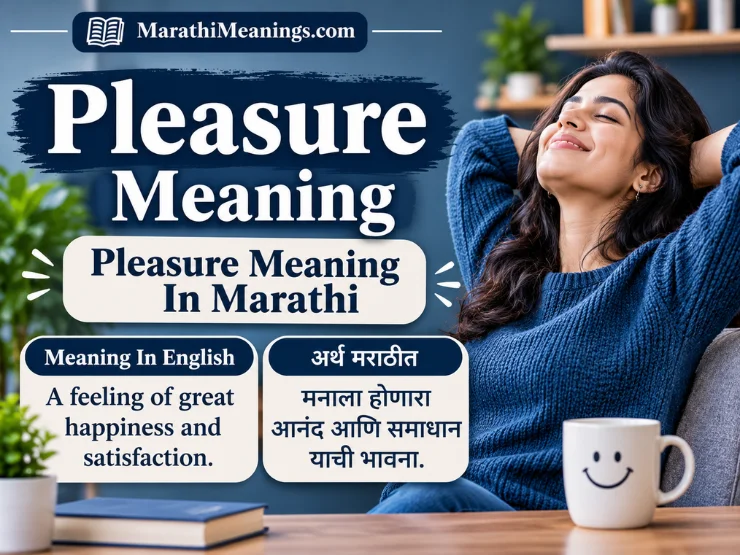
“Pleasure” in Marathi = आनंद (Anand) or सुख (Sukh). “My Pleasure” = माझा आनंद. “Guilty Pleasure” = दोषी आनंद. You get clean Marathi translations, real examples, grammar notes, and even the constitutional Doctrine of Pleasure — all in plain language.
Quick Overview: Pleasure Meaning In Marathi
| Feature | Details |
|---|---|
| English Word | Pleasure |
| Primary Marathi Meaning | आनंद (Anand) / सुख (Sukh) |
| Alternate Meanings | खुशी (Khushi), तृप्ती (Trupti), समाधान (Samadhan) |
| Part of Speech | Noun, Verb, Adjective (context-dependent) |
| Common Usage | Greeting, Emotion, Legal / Constitutional Term |
| Pronunciation | आ-नंद (Aa-nand) / सु-ख (Su-kh) |
| Marathi Script | आनंद / सुख |
| Speakers | 83+ million worldwide |
| Difficulty Level | Easy — perfect for beginners |
What Does “Pleasure” Actually Mean?
You’ve thanked someone, they replied “It’s my pleasure!” — and you just smiled and moved on without knowing what to say back.
Or maybe your friend casually said “guilty pleasure” and you wondered: how do you even say that in Marathi?
Pleasure Meaning In Marathi covers more ground than a single word. The word “pleasure” in English works in three different ways:
- As an emotion — “I find pleasure in cooking.”
- As a polite phrase — “My pleasure!” (after someone thanks you)
- As a legal/constitutional term — “Doctrine of Pleasure”
Marathi has a precise, beautiful word for every single one.
Pleasure Meaning In Marathi — Core Answer
Pleasure = आनंद (Anand) / सुख (Sukh)
Both are correct. Here’s the difference:
- आनंद (Anand) — Active, expressive joy. The kind that makes you want to call someone and share the news. (A surprise gift. A job offer. Your team winning.)
- सुख (Sukh) — Quiet, settled contentment. The peace you feel reading on a Sunday morning. (No notifications. Good tea. Silence.)
Pleasure Meaning In Marathi With Example:
| English Sentence | Marathi Translation | Pronunciation |
|---|---|---|
| I take great pleasure in learning. | मला शिकण्यात खूप आनंद होतो. | Mala shiknyat khup Anand hoto. |
| Helping you is a pleasure. | तुम्हाला मदत करणे हा आनंद आहे. | Tumhala madat karne ha Anand ahe. |
| Life’s simple pleasures matter most. | जीवनातील साध्या आनंदाला सर्वात जास्त महत्त्व आहे. | Jivanatil sadhya anandala sarvat jast mahattva ahe. |
| Reading gives me pleasure. | वाचन मला सुख देते. | Vachan mala sukh dete. |
| It’s a pleasure to meet you. | तुम्हाला भेटून आनंद झाला. | Tumhala bhetun Anand jhala. |
Pleasure vs Happiness vs Joy in Marathi — What’s the Difference?
These words all feel similar in English — but in Marathi, they’re distinct. Here’s the breakdown:
| Feeling | English | Marathi | Marathi Script | When to Use |
|---|---|---|---|---|
| Pleasure | Pleasure | Anand / Sukh | आनंद / सुख | Joy from an experience or activity |
| Happiness | Happiness | Khushi / Anand | खुशी / आनंद | General state of being happy |
| Joy | Joy | Harsha / Ullhas | हर्ष / उल्लास | Deep, overflowing delight (often spiritual or celebratory) |
| Satisfaction | Satisfaction | Trupti / Samadhan | तृप्ती / समाधान | Fulfillment after achieving something |
| Delight | Delight | Anandvibhor | आनंदविभोर | Overwhelmed with joy — formal/literary |
| Contentment | Contentment | Santushti | संतुष्टी | Calm acceptance and peace |
💡 If you’re talking about an activity that brings joy, use आनंद. For inner peace, use सुख. For overwhelming celebration, go with हर्ष or उल्लास.
“Pleasure” in Marathi — Grammar Essentials
Knowing a word’s meaning is step one. Knowing how it behaves in a sentence is what lets you actually use it. Here’s the grammar of आनंद and सुख that most language resources skip entirely.
Parts of Speech: One Root, Many Forms
आनंद doesn’t just sit there as a noun. It changes form depending on how you use it:
| Form | English | Marathi Word | Example |
|---|---|---|---|
| Noun | Pleasure / Joy | आनंद (Anand) | मला आनंद वाटतो. (I feel pleasure.) |
| Adjective — experience | Pleasurable / Pleasant | आनंददायी (Anand-dayi) | हा आनंददायी अनुभव आहे. (This is a pleasurable experience.) |
| Adjective — person | Pleased / Delighted | आनंदित (Anandith) | मी आनंदित आहे. (I am pleased.) |
| Verb phrase | To take pleasure in | आनंद घेणे (Anand ghene) | मी वाचण्यात आनंद घेतो. (I take pleasure in reading.) |
| Verb phrase | To give pleasure | आनंद देणे (Anand dene) | संगीत मला आनंद देते. (Music gives me pleasure.) |
| Adverb | With pleasure / Joyfully | आनंदाने (Anandane) | मी आनंदाने करेन. (I will do it with pleasure.) |
📌 Important distinction: आनंद (noun) = pleasure itself. आनंदित (adjective) = a person who is pleased. These are not interchangeable. Many learners use आनंद where आनंदित is correct, and vice versa.
Gender in Marathi — Why It Changes Your Sentence
Marathi is a gendered language. Every noun has a gender, and it changes how possessives and adjectives attach.
- आनंद (Anand) = Masculine gender (पुल्लिंगी — Pullingi)
- सुख (Sukh) = Neuter gender (नपुंसकलिंगी — Napunsaklingi)
This matters for possessives:
| Whose Pleasure? | Marathi | Note |
|---|---|---|
| My pleasure | माझा आनंद (Majha Anand) | Masculine possessive |
| His pleasure | त्याचा आनंद (Tyacha Anand) | Masculine possessive |
| Her pleasure | तिचा आनंद (Ticha Anand) | Feminine possessive |
| The pleasure of learning | शिकण्याचे सुख (Shiknyache Sukh) | Neuter possessive — note “चे” not “चा” |
| Our pleasure | आमचा आनंद (Amcha Anand) | Plural possessive |
Case Markers (Vibhakti) — How आनंद Changes Its Ending
Marathi uses case suffixes — called Vibhakti — that modify आनंद based on its role in the sentence. This is what makes Marathi sentences sound natural, not like a dictionary entry read aloud.
| Case / Role | Marathi Form | Sentence Example | Meaning |
|---|---|---|---|
| Direct (subject/object) | आनंद | आनंद महत्त्वाचा आहे. | Pleasure is important. |
| To / For (dative) | आनंदाला | आनंदाला महत्त्व द्या. | Give importance to pleasure. |
| Of (possessive genitive) | आनंदाचा / ची / चे | आनंदाचा क्षण | A moment of pleasure |
| With / By (instrumental) | आनंदाने | आनंदाने जगा. | Live with joy. |
| In (locative) | आनंदात | आनंदात राहा. | Stay in happiness. |
SOV Word Order — Why Direct Translation Always Sounds Off
English follows Subject → Verb → Object (SVO). Marathi follows Subject → Object → Verb (SOV).
The verb comes at the end of a Marathi sentence. This is the single biggest reason word-for-word translations from English sound wrong in Marathi.
❌ English word order forced into Marathi: “मी घेतो आनंद वाचण्यात”
✅ Natural Marathi: “मला वाचण्यात आनंद होतो.” (Literally: “To-me in-reading pleasure happens.”)
Once you internalise this flip, Marathi sentences instantly start clicking.
Tense: How “Pleasure” Changes Across Time
| Tense | Marathi | Pronunciation | Meaning |
|---|---|---|---|
| Present | मला आनंद वाटतो | Mala Anand vato | I feel pleasure |
| Past | मला आनंद झाला | Mala Anand jhala | I felt pleasure |
| Future | मला आनंद होईल | Mala Anand hoeel | I will feel pleasure |
| Habitual | मला नेहमी आनंद होतो | Mala nehmi Anand hoto | I always feel pleasure |
My Pleasure Meaning In Marathi
You do something nice. Someone says “Thank you!” And you say “My Pleasure!” — smooth, warm, and far more charming than “No problem.”
My Pleasure Meaning In Marathi = माझा आनंद (Majha Anand)
Formal or heartfelt options:
- माझे सौभाग्य (Majhe Saubhagya) — “My fortune / privilege.” Use with elders or in professional settings.
- माझा सन्मान (Majha Sanman) — “My honour.” Reserved for genuinely meaningful moments.
“Thank you for helping me.” “माझा आनंद!” 😊
Did You Know? The Viral “My Pleasure” Story
Chick-fil-A, the American fast-food chain, famously trained every employee to respond with “My Pleasure” instead of “You’re welcome” or “No problem.” It became so distinctive that people started noticing and posting about it online. Viral Reddit threads, news articles, and social media discussions all tried to explain why hearing “My Pleasure” feels so satisfying.
The psychology is real: the phrase signals the person genuinely wanted to help you, not just that they were obligated. It makes the receiver feel valued, not just served.
“माझा आनंद!” carries that exact same warmth in Marathi. It’s not just politeness — it says “I wanted to do this for you.” That’s a meaningfully different feeling.
It’s My Pleasure Meaning In Marathi
It’s My Pleasure Meaning In Marathi = माझा आनंद आहे (Majha Anand Ahe)
For formal writing or speeches:
“हे माझ्यासाठी आनंदाचे आहे.”
(He majhyasathi anandache ahe.)
The shorter version flows naturally in conversation. The longer version works better in formal introductions, speeches, or professional emails.
“It’s my pleasure to introduce our chief guest.”
“आमच्या मुख्य अतिथींची ओळख करून देणे हे माझ्यासाठी आनंदाचे आहे.”
That’s My Pleasure & It Was My Pleasure In Marathi
These are the emphasis and past-tense versions — usually used to close a conversation warmly.
That’s My Pleasure Meaning In Marathi = हाच माझा आनंद आहे (Hach Majha Anand Ahe)
It Was My Pleasure Meaning In Marathi = हे माझ्यासाठी आनंदाचे होते (He majhyasathi anandache hote)
“It was my pleasure working with your team.”
“तुमच्या टीमसोबत काम करणे हे माझ्यासाठी आनंदाचे होते.”
Use these at the end of a project, a meeting, or a formal favour — they close things out on a genuinely warm note.
Guilty Pleasure Meaning In Marathi
Guilty Pleasure Meaning = Something you enjoy even though you feel you probably shouldn’t. Watching reality TV until 2 AM. Eating an entire packet of chips. Re-reading teen fiction as an adult. We know. We’re not judging. 😂
Guilty Pleasure Meaning In Marathi = दोषी आनंद (Doshi Anand)
The word दोषी means guilty or at fault — which is exactly what you feel when you enjoy something you probably shouldn’t. You can also use “अपराधी सुख (Apradhi Sukh)” — literally “sinful pleasure.” Dramatic, yes. Also accurate.
“Watching reality shows late at night is my guilty pleasure.”
“रात्री उशिरा रिअॅलिटी शो पाहणे हा माझा दोषी आनंद आहे.”
Why Do We Have Guilty Pleasures?
The brain’s dopamine reward system doesn’t distinguish between “refined” pleasure and “junk” pleasure. It just rewards the behaviour. When you binge that show or eat that chocolate, your brain fires the same pleasure circuits as when you finish a marathon.
The “guilt” part? That’s your frontal lobe adding a social-expectation overlay.
दोषी आनंद captures this perfectly — the joy is real, the guilt is real, and both coexist without cancelling each other out.
Self Pleasure Meaning In Marathi
Self Pleasure Meaning In Marathi = स्वतःचा आनंद (Swatahcha Anand) / स्वसुख (Swasukh)
This refers to joy that comes from within — through hobbies, creative work, meditation, solo travel, or simply doing what you love without needing external validation.
स्वसुख (Swasukh) is a genuinely powerful Marathi concept. In a culture that values collective happiness and family approval, claiming your own quiet joy is quietly radical.
“Reading for an hour every morning is my self pleasure.” “रोज सकाळी एक तास वाचणे हे माझे स्वसुख आहे.”
Doctrine Of Pleasure Meaning In Marathi — The Legal One
The Doctrine of Pleasure is a constitutional term. Certain government servants hold their positions at the pleasure of the President or Governor — meaning they can be removed without stating a specific reason.
Doctrine Of Pleasure Meaning In Marathi = मर्जी सिद्धांत (Marji Siddhant)
In legal and constitutional Marathi, “pleasure” is translated as मर्जी (Marji) — meaning discretion or will — not आनंद. The full formal phrase is: “राष्ट्रपतींच्या मर्जीनुसार पद धारण करण्याचा सिद्धांत”
This comes from Article 310 of the Indian Constitution and applies to civil servants, military officers, and certain government appointees.
📌 Expert Insight: Unlike in England — where this doctrine is nearly absolute — India’s version has guardrails. Courts can review dismissals that violate Article 311 (protection against arbitrary dismissal) and Article 16 (equality in public employment). The government has “pleasure,” but it cannot override fundamental rights.
Common Mistakes When Translating “Pleasure” to Marathi
Mistake 1: Using खुशी (Khushi) for everything खुशी is heavily Hindi-influenced. Pure Marathi speakers prefer आनंद or सुख. If you want to sound authentically Marathi, use those instead.
Mistake 2: Saying “No Problem” as “My Pleasure” In English, “No problem” and “My Pleasure” are used interchangeably. In Marathi, they’re not the same. “No problem” = “काही हरकत नाही” (Kahi harkat nahi). “My Pleasure” = “माझा आनंद”. Using the first when you mean the second makes you sound indifferent rather than warm.
Mistake 3: Confusing आनंद (noun) with आनंदित (adjective)
- आनंद = pleasure / joy (the feeling itself)
- आनंदित = pleased / delighted (describing the person feeling it)
✅ “I feel pleasure” = “मला आनंद वाटतो” ✅ “I am pleased” = “मी आनंदित आहे”
Mistake 4: Using आनंद for the Doctrine of Pleasure In everyday Marathi, “pleasure” = आनंद. But in constitutional and legal contexts, “pleasure” means discretion or will — and the correct Marathi word for this is मर्जी (Marji). The proper short term is “मर्जी सिद्धांत”, not “आनंद सिद्धांत.” Using आनंद here makes it sound like a theory of happiness, which is a different thing entirely.
Mistake 5: Forgetting the SOV word order Because Marathi verbs come at the end, translating “I enjoy reading” word-for-word as “मी enjoy करतो वाचन” sounds broken. The natural Marathi is “मला वाचण्यात आनंद होतो” — the verb lands at the end. Always.
Master Reference Table: All Pleasure Phrases In Marathi
| English Phrase | Marathi Meaning | Pronunciation | Context |
|---|---|---|---|
| Pleasure | आनंद / सुख | Anand / Sukh | General |
| My Pleasure | माझा आनंद | Majha Anand | Casual / Formal |
| My Pleasure (formal) | माझे सौभाग्य | Majhe Saubhagya | Respectful |
| It’s My Pleasure | माझा आनंद आहे | Majha Anand Ahe | Conversational |
| It’s My Pleasure (formal) | हे माझ्यासाठी आनंदाचे आहे | He majhyasathi anandache ahe | Speeches / Emails |
| That’s My Pleasure | हाच माझा आनंद | Hach Majha Anand | Emphasis |
| It Was My Pleasure | हे माझ्यासाठी आनंदाचे होते | He majhyasathi anandache hote | Past tense |
| Guilty Pleasure | दोषी आनंद | Doshi Anand | Informal |
| Self Pleasure | स्वतःचा आनंद / स्वसुख | Swatahcha Anand / Swasukh | Personal |
| Your Pleasure | तुमचा आनंद | Tumcha Anand | Formal / Service |
| Our Pleasure | आमचा आनंद | Amcha Anand | Business / Teams |
| Welcome, My Pleasure | स्वागत, माझा आनंद | Swagat, Majha Anand | Hosting / Welcome |
| Wrapped With Pleasure | आनंदाने भरलेले | Anandane Bharalele | Metaphorical |
| With Pleasure (adverb) | आनंदाने | Anandane | Action done joyfully |
| Pleasurable | आनंददायी | Anand-dayi | Describing an experience |
| Pleased (adjective) | आनंदित | Anandith | Describing a person |
| Doctrine of Pleasure | मर्जी सिद्धांत | Marji Siddhant | Legal / Constitutional |
When to Use Which Phrase — Practical Guide
| Situation | Best Marathi Phrase | Why |
|---|---|---|
| Friend thanks you casually | माझा आनंद | Warm, natural, conversational |
| Senior or elder thanks you | माझे सौभाग्य | More respectful, formal weight |
| Closing a professional email | हे माझ्यासाठी आनंदाचे होते | Past tense, polished finish |
| Public speech or introduction | हे माझ्यासाठी आनंदाचे आहे | Full sentence, appropriate for formal settings |
| Hosting guests at an event | स्वागत, माझा आनंद | Welcoming and warm simultaneously |
| Business customer service | आमचा आनंद | Plural — speaks for the team, professional |
| Talking about a personal hobby | स्वसुख / स्वतःचा आनंद | Intrinsic, personal joy |
| Admitting a fun guilty habit | दोषी आनंद | Honest, relatable, conversational |
| Describing a great experience | आनंददायी | Adjective form — “It was a pleasurable experience” |
आनंद in Marathi Culture & Literature
आनंद is not just a translation — it’s woven into the soul of Marathi culture.
📜 In Literature: Sant Dnyaneshwar (13th century), one of Maharashtra’s greatest poet-saints, used आनंद extensively in the Dnyaneshwari — his celebrated Marathi commentary on the Bhagavad Gita. For him, आनंद was the highest spiritual state: pure, selfless bliss that transcended earthly pleasure entirely.
🏛️ In Place Names: Baba Amte’s celebrated Anandvan — the landmark social rehabilitation project in Warora, Chandrapur, Maharashtra — is literally named after आनंद. Across Maharashtra, residential societies, streets, and public spaces bearing names like Anand Nagar and Anand Park reflect how deeply this word is embedded in everyday Marathi life.
👶 As a Name: Anand (आनंद) is one of the most common Marathi and Sanskrit baby names for boys — because Marathi families have long held the belief that naming a child after joy invites more of it into the household.
🗣️ In Everyday Speech: You’ll hear “खूप आनंद झाला!” (Khup Anand jhala — “So much joy!”) at weddings, festivals, reunions, and temple visits. It’s the go-to expression of heartfelt happiness across all ages in Maharashtra.
Conclusion
Pleasure Meaning In Marathi is आनंद (Anand) or सुख (Sukh) at the core — but those two words carry a world of nuance, grammar, culture, and expression inside them.
From the warmth of “माझा आनंद!” that makes people feel genuinely valued, to the honest दोषी आनंद we all carry, to the grammatical elegance of आनंदाने and आनंदित — Marathi captures every shade of pleasure with precision and poetry.
The Doctrine of Pleasure grounds it in law. Sant Dnyaneshwar elevated it to the spiritual. And everyday Marathi speakers carry it in their conversations, their names, and their celebrations.
The next time someone says thank you, don’t just nod. Try “माझा आनंद!” and notice the difference it makes.
Language is a bridge. And आनंद is one of its oldest, most beautiful stones. 🌟
FAQs: Pleasure Meaning In Marathi
Q1. What is the Pleasure Meaning In Marathi?
“Pleasure” in Marathi is आनंद (Anand) or सुख (Sukh). आनंद is active, expressive joy; सुख is quieter, deeper contentment. Both are widely used in everyday Marathi speech.
Q2. How do you say “My Pleasure” in Marathi?
“My Pleasure” in Marathi is माझा आनंद (Majha Anand). For a more respectful version, use माझे सौभाग्य (Majhe Saubhagya) — meaning “my privilege” or “my fortune.”
Q3. What is Guilty Pleasure Meaning In Marathi?
Guilty Pleasure in Marathi is दोषी आनंद (Doshi Anand). The word दोषी means guilty or at fault — exactly the feeling behind a guilty pleasure. You can also say अपराधी सुख (Apradhi Sukh) for a more dramatic version.
Q4. What is Doctrine Of Pleasure Meaning In Marathi?
The Doctrine of Pleasure in Marathi is आनंद सिद्धांत (Anand Siddhant). Under Article 310 of the Indian Constitution, certain government servants hold their positions at the discretion of the President or Governor — but India’s version has judicial safeguards unlike the original English doctrine.
Q5. How do you say “It’s My Pleasure” in Marathi?
In everyday conversation: माझा आनंद आहे (Majha Anand Ahe). In formal settings or speeches: हे माझ्यासाठी आनंदाचे आहे (He majhyasathi anandache ahe).
Q6. What is the difference between आनंद and सुख in Marathi?
आनंद is active, celebratory joy — the kind you express outwardly. सुख is quieter, internal contentment — the kind you feel. Both translate to “pleasure” or “happiness” in English but carry different emotional tones.
🙏 Thank You For Reading!
We hope learning Pleasure Meaning In Marathi was well — a genuine आनंद! 😊 Share it with someone learning Marathi or anyone who loves the beauty of language.
👉 Also Read Our Previous Blog: [Entrepreneur Meaning in Marathi]