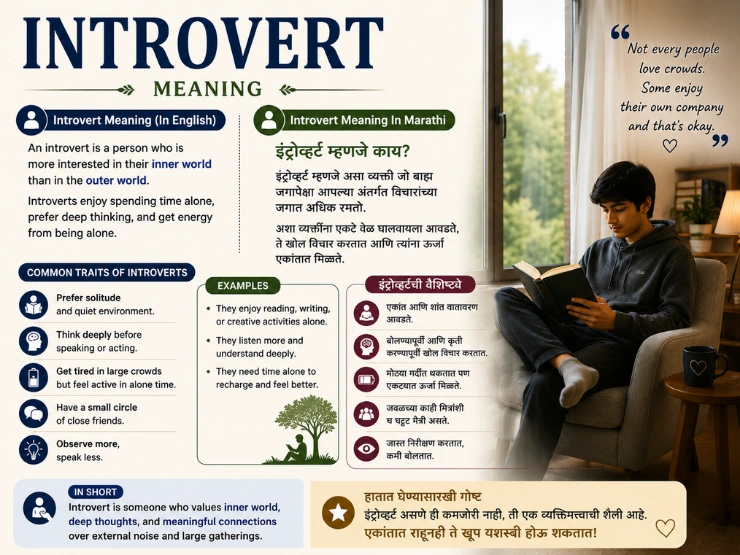
Quick Summary: An introvert is a person who feels more comfortable and energized when they are alone or in quiet, small settings, rather than in large, noisy social situations. In Marathi, the introvert meaning in Marathi is अंतर्मुख (Antarmukh) — literally meaning “one whose face/attention turns inward.” Introverts are not shy or antisocial by nature; they simply recharge through solitude rather than social interaction. The word comes from Latin roots meaning “turned inward.”
Quick Stats: Introvert at a Glance
| Feature | Details |
|---|---|
| Word | Introvert |
| Part of Speech | Noun, Verb, Adjective |
| Marathi Meaning | अंतर्मुख (Antarmukh) |
| Hindi Meaning | अंतर्मुखी (Antarmukhi) |
| Pronunciation | IN-truh-vurt |
| IPA | /ˈɪntrəˌvɜːrt/ |
| Origin | Latin — intro (inward) + vertere (to turn) |
| Opposite | Extrovert (बहिर्मुख / Bahirmukh) |
| First Known Use | Early 20th century (popularized by Carl Jung, 1921) |
| Register | Psychology, Everyday English, Social Context |
Have you ever felt that some people seem to come alive at parties while others prefer a quiet evening at home with a book? That difference often comes down to one famous personality concept: introvert vs extrovert.
The word introvert has become one of the most widely searched personality terms in the world — and for good reason. Understanding what it means, especially the introvert meaning in Marathi and across other Indian languages, helps students, parents, teachers, and professionals recognize and respect different personality types.
Whether you are searching for the introvert meaning in Marathi for a school project, a psychology class, or simply out of curiosity about your own personality, this article gives you the most complete, accurate, and easy-to-understand trilingual reference available.
Introvert Meaning in English
In English, an introvert is a person whose energy, attention, and interest are primarily directed inward — toward their own thoughts, feelings, and inner world — rather than outward toward other people and external activities.
The term was formally introduced into psychological literature by the Swiss psychiatrist Carl Gustav Jung in his 1921 work Psychological Types. Jung used it to describe one of two fundamental personality orientations: introversion (inward focus) and extroversion (outward focus).
Key characteristics of an introvert include:
- Preferring solitude or small-group settings over large crowds
- Feeling drained after prolonged social interaction
- Feeling recharged after spending time alone
- Thinking deeply before speaking
- Enjoying focused, independent work
- Being a careful listener rather than a dominant talker
It is important to note that introversion is not the same as shyness. Shyness involves anxiety or fear around social situations. Introverts may actually enjoy socializing — they simply need quiet time afterward to restore their energy.
Introvert Meaning in Marathi | इंट्रोव्हर्ट चा मराठी अर्थ
Marathi Meaning (Devanagari)
इंट्रोव्हर्ट = अंतर्मुख
Roman Transliteration: Antarmukh
The introvert meaning in Marathi is अंतर्मुख (Antarmukh). This is a Sanskrit-origin Marathi word that perfectly captures the concept. Antar (अंतर) means “inner” or “within,” and mukh (मुख) means “face” or “direction.” So अंतर्मुख literally means “one who faces inward” — a person whose attention and energy are directed toward the inner self.
Simple Explanation in Marathi
मराठीत सोप्या शब्दात: अंतर्मुख व्यक्ती म्हणजे अशी व्यक्ती जी गर्दीपेक्षा एकटेपणाला प्राधान्य देते, जास्त विचार करते, आणि एकट्याने वेळ घालवून ऊर्जा मिळवते.
(An introverted person is someone who prefers solitude over crowds, thinks deeply, and gains energy by spending time alone.)
Marathi Example Sentences
१. राहुल हा एक अंतर्मुख मुलगा आहे; तो मोठ्या पार्ट्यांपेक्षा एकट्याने वाचन करणे पसंत करतो. (Rahul is an introverted boy; he prefers reading alone over big parties.)
२. अंतर्मुख व्यक्ती शांत असतात, पण त्यांचे विचार खूप खोल असतात. (Introverted people are quiet, but their thoughts are very deep.)
३. माझी मैत्रीण अंतर्मुख असल्यामुळे ती फोनवर जास्त वेळ बोलत नाही. (Because my friend is introverted, she does not talk on the phone for long.)
Introvert Meaning in Hindi | इंट्रोवर्ट का हिंदी अर्थ
Hindi Meaning (Devanagari)
इंट्रोवर्ट = अंतर्मुखी
Roman Transliteration: Antarmukhi
The introvert meaning in Hindi is अंतर्मुखी (Antarmukhi). Like the Marathi word, this comes from the Sanskrit roots antar (inner) + mukh (face). It is widely used in Hindi-language psychology, education, and everyday conversation.
Simple Explanation in Hindi
हिंदी में सरल भाषा में: अंतर्मुखी व्यक्ति वह होता है जो भीड़-भाड़ से दूर रहना पसंद करता है, अकेले में ज़्यादा सहज महसूस करता है, और अपने विचारों में खोया रहता है।
(An introverted person is one who prefers to stay away from crowds, feels more comfortable alone, and is absorbed in their own thoughts.)
Hindi Example Sentences
१. अंकित एक अंतर्मुखी इंसान है — वो पार्टी में जाने की बजाय घर पर किताब पढ़ना पसंद करता है। (Ankit is an introverted person — he prefers reading a book at home instead of going to a party.)
२. अंतर्मुखी लोग शर्मीले नहीं होते, बस उन्हें अकेले वक्त चाहिए होता है। (Introverted people are not shy; they just need alone time.)
३. मेरी बहन बहुत अंतर्मुखी है; वो कम बोलती है लेकिन सोचती बहुत है। (My sister is very introverted; she speaks less but thinks a lot.)
Marathi Synonyms for Introvert | अंतर्मुख चे मराठी समानार्थी शब्द
| Marathi Synonym | Transliteration | Meaning in English |
|---|---|---|
| अंतर्मुख | Antarmukh | Turned inward / Introvert |
| एकलकोंडा | Ekalakonda | One who stays alone / Loner |
| स्वतःमध्ये गुंग | Swatahmadhye Gung | Lost in oneself |
| शांत स्वभावाचा | Shant Swabhavcha | Of quiet nature |
| अबोल | Abol | Soft-spoken, quiet |
| विचारी | Vichari | Thoughtful, contemplative |
| एकटेपणाची आवड असलेला | Ekatepanachi Avad Aslelya | One who likes solitude |
Note: No single Marathi word covers every nuance of “introvert” as used in modern psychology. अंतर्मुख (Antarmukh) is the most accurate and widely accepted equivalent.
Pronunciation Guide
Getting the pronunciation right helps when using this word in English, Marathi, or Hindi contexts.
English Pronunciation:
- Phonetic: IN-truh-vurt
- IPA: /ˈɪntrəˌvɜːrt/
- Stress is on the first syllable: IN-truh-vurt
- The final “-vert” rhymes with “hurt”
Marathi Pronunciation of अंतर्मुख:
- Roman: An-tar-mukh
- The “mukh” sounds like “book” but with an “m” at the start — “mukh”
Hindi Pronunciation of अंतर्मुखी:
- Roman: An-tar-mu-khee
- A soft, elongated “ee” sound at the end
Origin & Etymology
The word introvert has a clear and well-documented Latin origin.
- Intro- comes from the Latin intro, meaning “inward” or “within”
- -vert comes from the Latin vertere, meaning “to turn”
Together: introvert = to turn inward
The term entered psychological literature through Carl Gustav Jung (1875–1961), the Swiss psychiatrist, who introduced the concepts of introversion and extroversion in his landmark 1921 work Psychologische Typen (Psychological Types). Before Jung, the word existed in a narrower anatomical sense (referring to a part of the body that can be turned inward), but Jung gave it its modern psychological meaning.
In Sanskrit-rooted Indian languages including Marathi and Hindi, the equivalent अंतर्मुख / अंतर्मुखी is built from:
- अंतर (antar) = within, inner
- मुख (mukh) = face, direction, mouth
This Sanskrit construction independently mirrors the Latin concept almost perfectly — a testament to how universal this personality idea is.
Part of Speech & Grammar
“Introvert” is flexible in its grammatical role:
| Role | Example |
|---|---|
| Noun | “She is an introvert.” |
| Verb | “He tends to introvert his feelings.” (less common) |
| Adjective | “She has an introverted personality.” (adjective form: introverted) |
Related word forms:
- Introvert (noun/verb)
- Introverted (adjective) — more commonly used
- Introversion (noun — the trait or condition)
- Introvertedly (adverb — rare)
In Marathi and Hindi, अंतर्मुख / अंतर्मुखी functions primarily as an adjective and noun.
Introvert vs Extrovert — Key Differences | अंतर्मुख विरुद्ध बहिर्मुख
This is one of the most searched aspects of this topic: introvert and extrovert meaning side by side.
| Feature | Introvert (अंतर्मुख) | Extrovert (बहिर्मुख) |
|---|---|---|
| Energy Source | Alone time, quiet | Social interaction, crowds |
| Social Preference | Small groups, one-on-one | Large groups, parties |
| Communication Style | Listens more, thinks before speaking | Speaks more, thinks aloud |
| Work Style | Focused, independent | Collaborative, interactive |
| Recharging | Needs solitude after socializing | Needs social contact to feel energized |
| Inner World | Rich inner life, deep thinker | Outer-oriented, action-driven |
| Marathi Term | अंतर्मुख (Antarmukh) | बहिर्मुख (Bahirmukh) |
| Hindi Term | अंतर्मुखी (Antarmukhi) | बहिर्मुखी (Bahirmukhi) |
Important: Neither type is superior. Both introverts and extroverts have distinct strengths. Most people fall somewhere on a spectrum between the two extremes — psychologists call the middle ground ambivert.
What is an Ambivert?
An ambivert (उभयमुख / Ubhayamukh in Marathi) is someone who has both introverted and extroverted qualities depending on the situation. Many people identify more as ambiverts than as pure introverts or extroverts.
Introvert in Different Contexts
Psychology Context
In clinical and research psychology, introversion is one of the Big Five personality traits (specifically, the opposite end of the Extraversion dimension). Introverts score lower on extraversion scales. This is a normal, healthy personality variation — not a disorder.
Everyday / Social Context
In everyday conversation, calling someone an introvert usually means they are quiet, reserved, thoughtful, and prefer calm environments. It is generally a neutral or positive description.
Workplace Context
Introverts often excel in roles requiring deep concentration, independent analysis, writing, research, or one-on-one interaction. They may find open-plan offices and constant meetings draining.
Social Media / Gen-Z Usage
“Introvert” has become a widely used self-identifier in Gen-Z culture, often shared through memes, social media bios, and personality quizzes. Phrases like “introvert recharging” or “introvert problems” are popular online.
Introvert Meaning in Other Indian Languages
| Language | Script | Transliteration | Notes |
|---|---|---|---|
| Marathi | अंतर्मुख | Antarmukh | Primary focus of this article |
| Hindi | अंतर्मुखी | Antarmukhi | Most widely used Indian equivalent |
| Telugu | అంతర్ముఖి | Antarmukhi | Derived from Sanskrit; same roots |
| Tamil | உள்முகி / அகமுக | Ul-mughi / Aga-muga | Tamil-origin terms; ul = inside |
| Malayalam | അന്തർമുഖൻ | Antharmukhan | Sanskrit-origin term |
| Bengali | অন্তর্মুখী | Antarmukhi | Same Sanskrit roots as Hindi/Marathi |
| Kannada | ಅಂತರ್ಮುಖಿ | Antarmukhi | Shared Sanskrit base |
| Gujarati | અંતર્મુખ | Antarmukh | Mirrors Marathi usage |
| Punjabi | ਅੰਤਰਮੁਖੀ | Antarmukhi | Common in psychological writing |
| Assamese | অন্তৰ্মুখী | Antormukhi | Slight phonetic variation |
| Urdu | منکسر المزاج / اندرونی | Munkasir-ul-Mizaj / Andruni | Arabic-Persian influenced |
| Odia | ଅନ୍ତର୍ମୁଖୀ | Antarmukhi | Sanskrit-origin |
Observation: Across most Indian languages that use Sanskrit vocabulary, the word for introvert is a close variation of अंतर्मुखी / Antarmukhi — showing the shared linguistic heritage of Indian languages. Dravidian languages (Tamil, Malayalam) may also use indigenous roots.
Synonyms, Antonyms & Related Words
English Synonyms for Introvert
- Reserved
- Introspective
- Withdrawn
- Contemplative
- Inward-looking
- Self-contained
- Reflective
- Quiet
- Solitary
English Antonyms (Extrovert-related)
- Extrovert / Extravert
- Outgoing
- Sociable
- Gregarious
- Talkative
- Expressive
Word Family
| Word | Type | Meaning |
|---|---|---|
| Introvert | Noun/Verb | The person or act of turning inward |
| Introverted | Adjective | Describing the quality of introversion |
| Introversion | Noun | The trait/condition of being an introvert |
| Extrovert | Noun | Opposite personality type |
| Ambivert | Noun | A blend of introvert and extrovert |
| Introspect | Verb | To look inward at one’s own thoughts |
| Introspection | Noun | The act of examining one’s own mind |
Introvert Synonyms in Marathi & Hindi
Marathi Synonyms
- अंतर्मुख (Antarmukh) — most accurate
- एकलकोंडा (Ekalakonda) — loner
- अबोल (Abol) — one who speaks little
- विचारी (Vichari) — thoughtful person
- शांत (Shant) — quiet, calm
Hindi Synonyms
- अंतर्मुखी (Antarmukhi) — most accurate
- शांत स्वभाव वाला (Shant Swabhav Wala) — person of quiet nature
- एकांतप्रिय (Ekantapriya) — one who loves solitude
- आत्मकेंद्रित (Aatmakendrit) — self-centered (in the non-negative sense: focused on the self)
- चुप रहने वाला (Chup Rahne Wala) — one who stays quiet
Common Myths & Misconceptions About Introverts
Myth 1: Introverts are shy
Fact: Shyness is anxiety about social situations. Many introverts are confident and articulate — they simply prefer less social stimulation. The two traits can coexist but are not the same.
Myth 2: Introverts don’t like people
Fact: Introverts enjoy meaningful relationships and conversations. They prefer depth over breadth — a few close friendships over a wide social network.
Myth 3: Introverts are unfriendly
Fact: Introverts often make excellent listeners and deeply empathetic friends. Their quietness is not coldness.
Myth 4: Introversion is a problem to fix
Fact: Introversion is a normal personality trait, not a flaw or disorder. Many highly successful thinkers, artists, scientists, and leaders were/are introverts.
Common Mistake in Usage
Avoid using “introvert” and “shy” interchangeably. In the introvert meaning in Marathi (अंतर्मुख), there is no inherent sense of fear or anxiety — just a preference for inner-directedness.
Famous Introverts in History & Culture
Some of the world’s most influential people are known or believed to have been introverts:
- Albert Einstein — physicist, known for solitary thinking
- Mahatma Gandhi — described as quiet, contemplative, and inner-driven
- APJ Abdul Kalam — India’s “Missile Man,” known for his quiet, bookish nature
- J.K. Rowling — author, self-described introvert
- Warren Buffett — investor known for independent, solitary analysis
This shows that the introvert meaning in Marathi — अंतर्मुख — describes a personality type that has produced some of history’s greatest contributions.
Cultural Significance in Indian Context
In Indian culture, introversion has often been quietly valued — though not always explicitly named. The ideals of मौन (Maun / silence), एकांत (Ekant / solitude), and आत्मचिंतन (Aatmachintan / self-reflection) in Hindu, Buddhist, and Jain traditions align closely with introvert characteristics.
Concepts like अंतर्मुख साधना (inward-directed spiritual practice) in yoga and meditation traditions show that Indian philosophy has long recognized the value of turning one’s attention inward — making the introvert meaning in Marathi (अंतर्मुख) deeply rooted in Indian thought.
In modern Indian families and schools, introverted children are sometimes misunderstood as being “too quiet” or socially underdeveloped. Growing awareness of the introvert and extrovert meaning in psychology is helping parents, teachers, and students appreciate introversion as a valid and valuable personality type.
Conclusion
The introvert meaning in Marathi — अंतर्मुख (Antarmukh) — describes one of the two fundamental human personality orientations: a natural preference for inner reflection, quiet environments, and meaningful depth over surface-level social breadth. Far from being a weakness, introversion is a recognized and celebrated personality type that has shaped some of humanity’s greatest thinkers, artists, and leaders.
Whether you are a student, a parent, a professional, or simply someone trying to better understand yourself or someone you care about, knowing the introvert meaning in Marathi and its equivalents across Indian languages is a small but meaningful step toward greater self-awareness and empathy.
The concept of अंतर्मुख is not foreign to Indian thought — it is woven into the fabric of Indian philosophy through values of silence, solitude, and self-reflection that have been honored for thousands of years.
Read Also: Ceasefire Meaning In Marathi
? Frequently Asked Questions (FAQs)
1. What is the introvert meaning in Marathi?
The introvert meaning in Marathi is अंतर्मुख (Antarmukh). It refers to a person who prefers solitude, thinks deeply, and recharges through quiet alone time rather than social interaction.
2. What is the introvert meaning in Hindi?
The introvert meaning in Hindi is अंतर्मुखी (Antarmukhi). It carries the same meaning as the Marathi equivalent and is widely used in Hindi-language psychology and everyday speech.
3. What is the difference between introvert and extrovert?
An introvert (अंतर्मुख) gains energy from being alone and prefers quiet settings. An extrovert (बहिर्मुख) gains energy from social interaction and prefers active, stimulating environments. Neither is better — they are simply different personality orientations.
4. Is introvert the same as shy?
No. Shyness involves social anxiety or fear. Introversion is about where you draw your energy from. An introvert can be confident and social — they just need time alone to recharge afterward.
5. What is the introvert meaning in Telugu?
The introvert meaning in Telugu is అంతర్ముఖి (Antarmukhi), derived from the same Sanskrit roots as the Marathi and Hindi equivalents.
6. What is the introvert meaning in Tamil?
In Tamil, an introvert is referred to as உள்முகி (Ul-mughi) or அகமுக (Aga-muga). Tamil uses both Sanskrit-derived and indigenous Dravidian roots for this concept.
7. What does ambivert mean?
An ambivert (उभयमुख in Marathi, उभयमुखी in Hindi) is someone who exhibits traits of both introversion and extroversion, shifting between the two depending on the situation.
8. Is introversion permanent or can it change?
Personality research suggests introversion is relatively stable throughout life, though it can shift slightly with age and experience. Most psychologists view introversion as a core trait rather than a phase.
# Get More Grammar Meaning, Definition And Full Forms Updates At Grammar Fortune