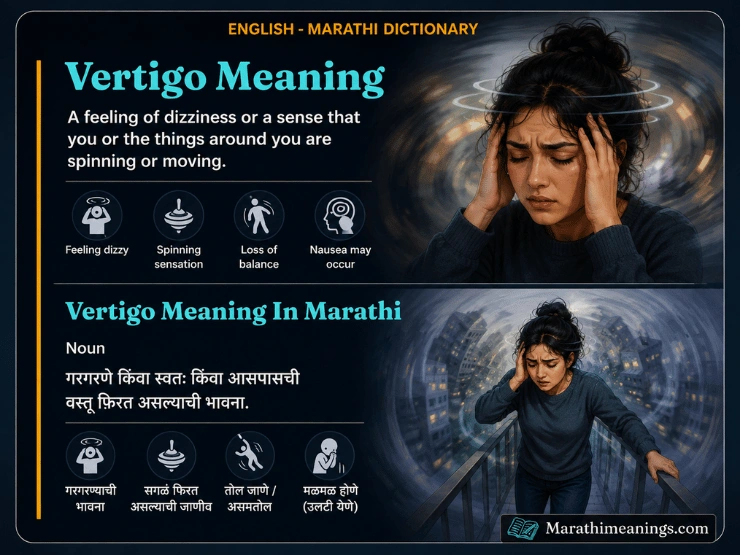
Vertigo Meaning In Marathi is most accurately expressed as चक्कर येणे (Chakkar Yeṇe), भोवळ येणे (Bhovaḷ Yeṇe), or मस्तक-भ्रम (Mastak-Bhram).
The most common everyday term is चक्कर येणे, which directly conveys the sensation of spinning or dizziness. भोवळ येणे is used in Marathi for a sudden spinning or fainting sensation. In a clinical or medical context, मस्तक-भ्रम or simply व्हर्टिगो is also understood.
In simple English, vertigo means a feeling that you or your surroundings are spinning or moving when you are actually still. It is not simply dizziness — it is a specific false sensation of rotation or motion.
Hindi: चक्कर आना (Chakkar Ānā), सिर घूमना (Sir Ghūmnā), भ्रमण (Bhramaṇ)
Quick Stats: Vertigo Meaning
| Feature | Details |
|---|---|
| Word | Vertigo |
| Part of Speech | Noun |
| Pronunciation | VUR-tih-goh |
| IPA | /ˈvɜːrtɪɡoʊ/ |
| Marathi Script | व्हर्टिगो / चक्कर येणे |
| Main Marathi Meanings | चक्कर येणे, भोवळ येणे, मस्तक-भ्रम |
| Main Hindi Meanings | चक्कर आना, सिर घूमना, भ्रमण |
| Plural | Vertigos / Vertigines (medical) |
| Field | Neurology, Otology, General Medicine |
| Origin | Latin vertigo — a whirling motion |
| Medical Category | Symptom / Vestibular Disorder |
Vertigo Meaning: Basic Definition
Vertigo is a medical and everyday term. It describes a specific symptom — the false sensation that you, or the world around you, is spinning, tilting, or moving when no actual movement is occurring.
Vertigo is not a disease in itself. It is a symptom caused by problems in the inner ear or the brain. The sensation can be mild or severe enough to affect daily activities.
Simple Definition
Vertigo = a false sensation of spinning, tilting, or rotating movement that is not actually happening.
Vertigo Meaning In Marathi
Vertigo Meaning In Marathi can be expressed using different words depending on whether you are in a casual conversation or a medical context.
| Marathi | Roman Transliteration | Best Used For |
|---|---|---|
| चक्कर येणे | Chakkar Yeṇe | Everyday use — dizziness/spinning sensation |
| भोवळ येणे | Bhovaḷ Yeṇe | Sudden spinning or near-fainting sensation |
| मस्तक-भ्रम | Mastak-Bhram | Formal or literary usage |
| आवर्त-भ्रम | Āvart-Bhram | Clinical Marathi equivalent |
| व्हर्टिगो | Vharṭigo | Direct transliteration used medically |
चक्कर येणे — Chakkar Yeṇe
चक्कर येणे is the most widely used Marathi expression for vertigo. It conveys the feeling that everything around you is spinning.
English: He had a severe episode of vertigo while standing up.
Marathi: उभे राहताना त्याला तीव्र चक्कर आली.
Hindi: खड़े होते समय उसे तेज़ चक्कर आया।
भोवळ येणे — Bhovaḷ Yeṇe
भोवळ येणे in Marathi often describes a stronger, more sudden experience of vertigo accompanied by a feeling of losing balance.
English: She felt vertigo and had to sit down immediately.
Marathi: तिला भोवळ आली आणि तिला लगेच बसावे लागले.
Hindi: उसे चक्कर आया और उसे तुरंत बैठना पड़ा।
मस्तक-भ्रम — Mastak-Bhram
मस्तक-भ्रम is a formal Marathi compound term combining मस्तक (head) and भ्रम (illusion or confusion). It is used in literary or formal medical writing.
English: Vertigo creates a false perception of motion in the brain.
Marathi: मस्तक-भ्रमामुळे मेंदूत गतीचा खोटा आभास निर्माण होतो.
Hindi: भ्रमण मस्तिष्क में गति का झूठा एहसास पैदा करता है।
Vertigo Meaning In Hindi
Vertigo Meaning In Hindi is most commonly expressed as:
- चक्कर आना — the spinning sensation
- सिर घूमना — the feeling that the head is spinning
- भ्रमण — a whirling or revolving sensation
- चक्कर की बीमारी — the condition of recurrent vertigo
English: The doctor diagnosed him with vertigo after a series of tests.
Marathi: काही चाचण्यांनंतर डॉक्टरांनी त्याला व्हर्टिगोचे निदान केले.
Hindi: कुछ परीक्षणों के बाद डॉक्टर ने उसे चक्कर की बीमारी का निदान दिया।
Pronunciation of Vertigo
Vertigo is pronounced:
VUR-tih-goh
IPA: /ˈvɜːrtɪɡoʊ/
In Marathi and Hindi, the English word is commonly written phonetically as व्हर्टिगो.
The stress falls on the first syllable: VUR-tih-goh.
Part of Speech and Related Forms
Vertigo is a noun.
| Form | Word | Meaning |
|---|---|---|
| Noun | Vertigo | The spinning sensation itself |
| Adjective | Vertiginous | Causing or affected by vertigo |
| Adverb | Vertiginously | In a manner associated with vertigo |
| Medical plural | Vertigines | Used in clinical literature |
English: The patient described a vertiginous sensation when looking down from the stairs.
Marathi: रुग्णाने जिन्यावरून खाली पाहताना चक्कर येण्यासारखी संवेदना असल्याचे सांगितले.
Hindi: रोगी ने सीढ़ियों से नीचे देखते समय चक्कर आने जैसी अनुभूति बताई।
Vertigo Meaning In Medical Context
In medicine, Vertigo Meaning In Medical terms refers specifically to an illusory sensation of movement — most often spinning — caused by dysfunction in the vestibular system (inner ear) or related brain pathways.
Vertigo is classified as a vestibular disorder and is distinct from simple dizziness or light-headedness. Doctors evaluate it through a Vertigo Test, patient history, and sometimes imaging.
English: Vertigo in medical terms is an illusory perception of rotational movement.
Marathi: वैद्यकीय संज्ञेत व्हर्टिगो म्हणजे फिरण्याच्या हालचालीचा खोटा आभास.
Hindi: चिकित्सा में, व्हर्टिगो का अर्थ है घूर्णन गति का भ्रामक एहसास।
Vertigo Types
Understanding Vertigo Types helps identify the correct cause and treatment.
| Vertigo Type | Cause | Common Term |
|---|---|---|
| BPPV (Benign Paroxysmal Positional Vertigo) | Displaced calcium crystals in inner ear | Most common type |
| Peripheral Vertigo | Inner ear problem | चक्कर (inner ear origin) |
| Central Vertigo | Brain or brainstem issue | मेंदू-संबंधित चक्कर |
| Cervicogenic Vertigo | Neck muscle or joint problem | मानेशी संबंधित चक्कर |
| Labyrinthitis | Inner ear inflammation | कर्णावर्ती दाह |
| Ménière’s Disease | Fluid imbalance in inner ear | मेनिएर रोग |
Peripheral Vertigo Meaning
Peripheral Vertigo Meaning refers to vertigo that originates from a problem in the inner ear or the vestibular nerve — not the brain. It is the more common type and usually responds well to exercises and positional maneuvers.
English: Peripheral vertigo is caused by inner ear disorders and is more common than central vertigo.
Marathi: परिधीय व्हर्टिगो आतील कानाच्या विकारांमुळे होतो आणि केंद्रीय व्हर्टिगोपेक्षा अधिक सामान्य आहे.
Hindi: परिधीय चक्कर आंतरिक कान के विकारों के कारण होता है और केंद्रीय चक्कर से अधिक सामान्य है।
Cervicogenic Vertigo
Cervicogenic Vertigo is vertigo that arises from problems in the cervical spine (neck), including tight muscles, nerve irritation, or joint dysfunction. It is also called cervical vertigo.
English: Cervicogenic vertigo is common in people who sit for long hours with poor posture.
Marathi: खराब बसण्याच्या स्थितीत जास्त वेळ काम करणाऱ्यांमध्ये सर्व्हायकोजेनिक व्हर्टिगो सामान्य आहे.
Hindi: खराब मुद्रा में लंबे समय तक बैठने वाले लोगों में सर्वाइकोजेनिक चक्कर सामान्य है।
Vertigo Symptoms
The most reported Vertigo Symptoms include:
| Symptom | Marathi | Hindi |
|---|---|---|
| Spinning sensation | चक्कर येणे | चक्कर आना |
| Loss of balance | तोल जाणे | संतुलन खोना |
| Nausea | मळमळ | जी मिचलाना |
| Vomiting | उलटी होणे | उल्टी आना |
| Abnormal eye movement | डोळ्यांची असामान्य हालचाल | आँखों की असामान्य गतिविधि |
| Hearing problems | ऐकण्यास त्रास | सुनने में कठिनाई |
| Sweating | घाम येणे | पसीना आना |
| Headache | डोकेदुखी | सिरदर्द |
English: Vertigo symptoms include spinning sensations, nausea, and difficulty maintaining balance.
Marathi: व्हर्टिगोच्या लक्षणांमध्ये चक्कर येणे, मळमळ आणि तोल सांभाळण्यात अडचण यांचा समावेश आहे.
Hindi: चक्कर के लक्षणों में घूमने का एहसास, जी मिचलाना और संतुलन बनाए रखने में कठिनाई शामिल है।
Dizziness Vs Vertigo
Many people confuse these two. Dizziness Vs Vertigo is an important distinction in medicine.
| Feature | Dizziness (साधी चक्कर) | Vertigo (व्हर्टिगो) |
|---|---|---|
| Sensation | Light-headedness, unsteadiness | False spinning or rotating sensation |
| Cause | Low blood pressure, dehydration, anxiety | Inner ear or brain dysfunction |
| Movement illusion | Not present | Present — you feel things are spinning |
| Duration | Usually brief | Can last seconds to hours |
| Marathi | साधी गरगरणे / अशक्तपणा | चक्कर येणे / भोवळ येणे |
| Hindi | हल्की चक्कर / बेचैनी | चक्कर आना / सिर घूमना |
English: Dizziness is a general feeling of unsteadiness, while vertigo is the specific false sensation of spinning.
Marathi: साधी गरगरणे ही सामान्य अस्थिरतेची भावना आहे, तर व्हर्टिगो म्हणजे फिरण्याची विशिष्ट खोटी संवेदना.
Hindi: साधारण चक्कर एक सामान्य अस्थिरता की भावना है, जबकि व्हर्टिगो घूमने का एक विशिष्ट भ्रामक एहसास है।
Vertigo Test
A Vertigo Test helps doctors determine the cause and type of vertigo. Common diagnostic tests include:
- Dix-Hallpike Test — most commonly used for BPPV diagnosis
- Roll Test (Supine Roll Test) — for horizontal canal BPPV
- Head Impulse Test — checks vestibular nerve function
- Romberg Test — assesses balance and proprioception
- CT Scan / MRI — rules out central (brain-related) causes
- Caloric Test — checks inner ear function using warm/cool water or air
English: The Dix-Hallpike test is the standard vertigo test used to diagnose BPPV.
Marathi: BPPV चे निदान करण्यासाठी डिक्स-हॉलपाईक चाचणी ही मानक व्हर्टिगो चाचणी आहे.
Hindi: BPPV का निदान करने के लिए Dix-Hallpike परीक्षण एक मानक चक्कर परीक्षण है।
Vertigo Exercises and Exercise Chart
Vertigo Exercises are a key non-medication approach to managing BPPV and peripheral vertigo.
Vertigo Exercise Chart
| Exercise | Purpose | Frequency |
|---|---|---|
| Epley Maneuver | Repositions displaced inner ear crystals (BPPV) | As directed by physiotherapist |
| Brandt-Daroff Exercises | Desensitizes the inner ear to head movements | 3 sets × 2 times daily |
| Semont Maneuver | Alternative repositioning for BPPV | As directed |
| Gaze Stabilization Exercises | Improves vestibular-eye coordination | Daily |
| Balance Training | Improves overall stability | Daily |
| Head Movement Exercises | Gradually reduces sensitivity to head movement | As advised |
English: Vertigo exercises like the Epley Maneuver are highly effective for BPPV and do not require medication.
Marathi: एप्ली मॅन्युव्हरसारखे व्हर्टिगो व्यायाम BPPV साठी अत्यंत प्रभावी आहेत आणि औषधांची गरज नसते.
Hindi: एपली मैन्यूवर जैसे व्हर्टिगो व्यायाम BPPV के लिए अत्यधिक प्रभावी हैं और दवाओं की आवश्यकता नहीं होती।
Vertigo Tablet and Vertigo Tablet Uses
Vertigo Tablet is a general term for medications prescribed to manage vertigo symptoms. These are not all the same — the appropriate medicine depends on the underlying cause.
Common medications associated with vertigo treatment include antihistamines, antiemetics, and vestibular suppressants. Some commonly known names in India include Vertin (Betahistine), Stemetil (Prochlorperazine), and Meclizine-based tablets.
Vertigo Tablet Uses generally include:
- Reducing the intensity of spinning sensations
- Managing nausea and vomiting associated with vertigo
- Suppressing inner ear fluid imbalance (in Ménière’s disease)
- Supporting recovery during acute vertigo episodes
Important: Vertigo tablets should only be taken under a doctor’s prescription. Self-medication without identifying the underlying cause can delay proper treatment.
English: A vertigo tablet may help reduce the spinning sensation but does not treat the underlying cause on its own.
Marathi: व्हर्टिगो टॅब्लेट चक्कर येण्याची संवेदना कमी करू शकते परंतु एकट्याने मूळ कारणावर उपचार करत नाही.
Hindi: व्हर्टिगो टैबलेट घूमने की अनुभूति को कम कर सकती है, लेकिन अकेले मूल कारण का इलाज नहीं करती।
Origin and Etymology of Vertigo
The English word vertigo comes directly from Classical Latin vertigo, meaning a whirling or spinning motion. The Latin root is vertere, meaning to turn.
This Latin root also gives rise to several English words including vertical, invert, divert, revert, and convert — all carrying the core idea of turning or changing direction.
The word entered English medical usage by the 16th century and has retained its Latin form without significant alteration.
Vertigo Meaning In Other Indian Languages
| Language | Common Equivalent | Roman Transliteration |
|---|---|---|
| Marathi | चक्कर येणे / भोवळ येणे | Chakkar Yeṇe / Bhovaḷ Yeṇe |
| Hindi | चक्कर आना / सिर घूमना | Chakkar Ānā / Sir Ghūmnā |
| Telugu | తల తిరగడం | Tala Tiragaḍaṁ |
| Tamil | தலைசுற்றல் | Talaisurral |
| Kannada | ತಲೆ ತಿರುಗುವಿಕೆ | Tale Tiruguvike |
| Gujarati | ચક્કર આવવા | Chakkar Āvavā |
| Malayalam | തലകറക്കം | Talakaṟakkam |
| Bengali | মাথা ঘোরা | Māthā Ghorā |
| Punjabi | ਸਿਰ ਚੱਕਰ ਆਉਣਾ | Sir Chakkar Āuṇā |
| Urdu | چکر آنا | Chakkar Ānā |
| Odia | ମୁଣ୍ଡ ଘୂରିବା | Muṇḍa Ghūribā |
Marathi Synonyms for Vertigo
The main Marathi words and phrases related to vertigo are:
- चक्कर येणे — the spinning sensation
- भोवळ येणे — sudden dizziness/vertigo
- मस्तक-भ्रम — head illusion (formal)
- तोल जाणे — losing balance
- गरगर वाटणे — feeling of whirling
- डोळे जड होणे — heaviness of eyes with dizziness
English: He described a giddy, whirling sensation — a classic case of vertigo.
Marathi: त्याने गरगर वाटण्याची संवेदना सांगितली — व्हर्टिगोचे हे एक सामान्य लक्षण आहे.
Hindi: उसने घूमने जैसी अनुभूति बताई — यह चक्कर का एक सामान्य लक्षण है।
Common Mistakes About Vertigo
1. Treating vertigo as just “dizziness”
Vertigo is not the same as general dizziness. Vertigo specifically involves a false sense of rotation or spinning. Not all dizziness is vertigo.
2. Thinking vertigo is a disease
Vertigo is a symptom, not a standalone disease. It signals an underlying issue — usually in the inner ear or brain — that needs diagnosis.
3. Avoiding all movement during vertigo
For BPPV, targeted Vertigo Exercises like the Epley Maneuver are actually the most effective treatment. Avoiding all movement can prolong recovery.
4. Using Vertigo Tablet without diagnosis
Taking a vertigo tablet without knowing the type — peripheral or central — can mask serious symptoms. Always consult a doctor first.
Final Summary
Vertigo Meaning In Marathi is best expressed as चक्कर येणे (Chakkar Yeṇe) or भोवळ येणे (Bhovaḷ Yeṇe) in everyday speech. In formal or medical Marathi, मस्तक-भ्रम or व्हर्टिगो are used.
Key takeaways:
- Vertigo is the false sensation of spinning or movement, not simple dizziness.
- Dizziness Vs Vertigo: Dizziness is general unsteadiness; vertigo is a specific spinning illusion.
- Vertigo Types include BPPV, Peripheral Vertigo, Central Vertigo, and Cervicogenic Vertigo.
- Vertigo Symptoms include spinning sensation, nausea, loss of balance, and abnormal eye movement.
- Vertigo Exercises like the Epley Maneuver are highly effective for BPPV.
- Vertigo Tablet Uses focus on symptom management but require a doctor’s prescription.
- Vertigo Test such as the Dix-Hallpike test helps confirm the diagnosis.
The simplest overall definition:
“Vertigo Meaning In Marathi is चक्कर येणे — a false sensation of spinning that is not actually happening.”
? Frequently Asked Questions
1. What is Vertigo Meaning In Marathi?
Vertigo Meaning In Marathi is चक्कर येणे (Chakkar Yeṇe) or भोवळ येणे (Bhovaḷ Yeṇe) — the false sensation of spinning.
2. What is Vertigo Meaning In Hindi?
It is commonly expressed as चक्कर आना (Chakkar Ānā) or सिर घूमना (Sir Ghūmnā).
3. What is the difference between Dizziness Vs Vertigo?
Dizziness is general light-headedness or unsteadiness. Vertigo is the specific false sensation that you or your surroundings are spinning.
4. What are the main Vertigo Types?
The main types are BPPV, Peripheral Vertigo, Central Vertigo, Cervicogenic Vertigo, Labyrinthitis, and Ménière’s Disease.
5. What is Peripheral Vertigo Meaning?
Peripheral Vertigo originates from the inner ear or vestibular nerve — not the brain. It is the more common type of vertigo.
6. What is Cervicogenic Vertigo?
Cervicogenic Vertigo is vertigo caused by neck muscle tension, poor posture, or cervical spine problems, not by inner ear dysfunction.
7. What are common Vertigo Symptoms?
Spinning sensation, loss of balance, nausea, vomiting, abnormal eye movement, and sometimes hearing difficulties.
8. What are the best Vertigo Exercises?
The Epley Maneuver is the most effective for BPPV. Brandt-Daroff exercises and gaze stabilization exercises are also commonly recommended.
9. What is a Vertigo Test?
A Vertigo Test like the Dix-Hallpike test helps diagnose the type and cause of vertigo. Other tests include the Head Impulse Test, Roll Test, and MRI for central causes.
📚 Also Read These Word Meanings to Build a Stronger English Vocabulary :
- Fragile Meaning in Marathi
- Nostalgic Meaning In Marathi
- Flaxseed Meaning in Marathi
- Brat Meaning in Marathi
- Gigantic Meaning In Marathi
- Introvert Meaning In Marathi
- Ceasefire Meaning In Marathi
- Domicile Meaning In Marathi
- Carpediem Meaning In Marathi
- Narcissist Meaning In Marathi
- Pookie Meaning In Marathi
- Audacity Meaning In Marathi
- Manifestation Meaning In Marathi
- Consent Meaning In Marathi
- Nephew Meaning In Marathi
- Harmony Meaning In Marathi
- Overwhelmed Meaning in Marathi