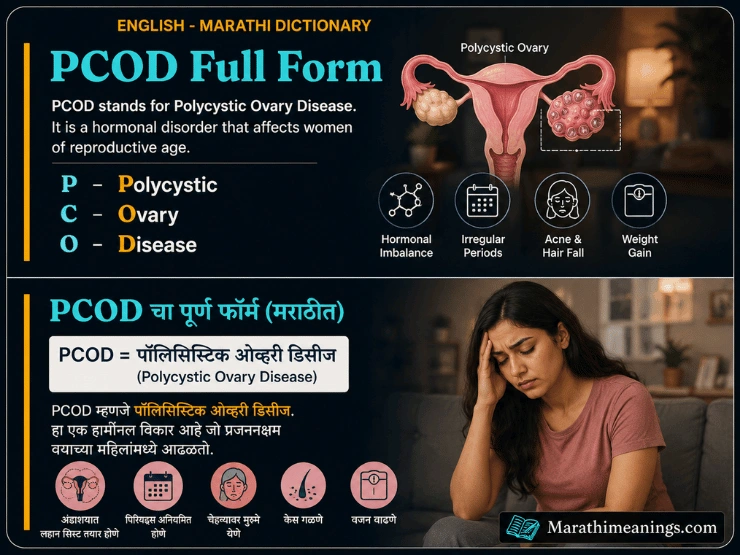
PCOD Full Form is commonly expanded as Polycystic Ovarian Disease. The term is commonly used in health discussions to describe hormonal and reproductive changes associated with irregular ovulation and menstrual cycles.
PCOD Full Form in Marathi can be written as पॉलीसिस्टिक ओव्हेरियन डिसीज. In simple Marathi, it can be explained as अंडाशयांच्या कार्याशी संबंधित हार्मोनल समस्या.
Roman Marathi: Polycystic Ovarian Disease / Andashayanchya karyashi sambandhit hormonal samasya
PCOD is commonly discussed in connection with irregular periods, irregular ovulation, acne, increased facial or body hair, scalp hair thinning, and some metabolic changes. However, these symptoms can have several causes and do not by themselves confirm a diagnosis.
It is also important to understand the difference between PCOD and PCOS. PCOS, or Polycystic Ovary Syndrome, is the established clinical term used for the syndrome involving reproductive, hormonal, and metabolic features. The term PCOD continues to be widely used in everyday health discussions, particularly in South Asia.
Medical note: This article provides general educational information. Symptoms, laboratory results, and ultrasound findings should be interpreted by a qualified healthcare professional. Do not use this article for self-diagnosis or treatment decisions.
Quick Overview of PCOD Meaning
| Feature | Details |
|---|---|
| Abbreviation | PCOD |
| Common Full Form | Polycystic Ovarian Disease |
| Marathi | पॉलीसिस्टिक ओव्हेरियन डिसीज |
| Simple Marathi Meaning | अंडाशयांच्या कार्याशी संबंधित हार्मोनल समस्या |
| Roman Marathi | Andashayanchya karyashi sambandhit hormonal samasya |
| Pronunciation | P-C-O-D |
| Related Clinical Term | PCOS – Polycystic Ovary Syndrome |
| Medical Area | Reproductive and hormonal health |
| Commonly Associated Features | Irregular periods, irregular ovulation, acne, increased hair growth |
PCOD Meaning In Grammar and Word Information
PCOD is an abbreviation, not a regular English word. It is formed from the initial letters of Polycystic Ovarian Disease.
- P – Poly
- C – Cystic
- O – Ovarian
- D – Disease
The abbreviation is generally pronounced letter by letter:
P-C-O-D
The complete term may be pronounced approximately as:
Pol-ee-sis-tik Oh-vair-ee-an Di-zeez
Pronunciation can vary according to accent and region.
What Does PCOD Stand For?
PCOD commonly stands for Polycystic Ovarian Disease.
The term is frequently used in general health conversations, online searches, and discussions about menstrual or hormonal problems.
However, there is an important terminology point. PCOS (Polycystic Ovary Syndrome) is the established clinical term for the syndrome recognized in contemporary medical practice. PCOD may still be used informally or in some healthcare settings, particularly in South Asia.
Therefore, the term written on a medical report should be understood in the context of the individual’s symptoms, examination, test results, and the terminology used by the healthcare professional.
PCOD Meaning in Marathi
The PCOD Meaning in Marathi is:
पॉलीसिस्टिक ओव्हेरियन डिसीज
In simple Marathi, it can be explained as:
अंडाशयांच्या कार्याशी संबंधित हार्मोनल समस्या
Important Marathi Words
| English Term | Marathi Meaning |
|---|---|
| Ovary | अंडाशय |
| Ovaries | अंडाशय |
| Ovulation | अंडोत्सर्जन |
| Menstrual Period | मासिक पाळी |
| Hormone | हार्मोन / संप्रेरक |
| Hormonal Changes | हार्मोन्समधील बदल |
| Follicle | अंडपुटिका |
| Fertility | प्रजननक्षमता |
The English medical term is often retained when discussing the condition with doctors. The Marathi explanation helps readers understand the general meaning more easily.
What Is PCOD Meaning?
PCOD is a term commonly used to describe a condition associated with changes in ovarian function and hormonal activity.
One commonly discussed feature is irregular ovulation. When ovulation does not occur regularly, menstrual periods may also become irregular.
Some individuals may experience signs associated with increased androgen activity, including:
- Acne
- Increased facial or body hair
- Scalp hair thinning
- Irregular periods
- Irregular ovulation
Some people may also experience metabolic changes, although these are not present in everyone.
The word “polycystic” can sometimes create confusion. Ovarian follicles and ovarian cysts are not necessarily the same thing. The appearance of multiple follicles on an ultrasound does not, by itself, establish a diagnosis of PCOS.
PCOD Symptoms
Symptoms associated with PCOD or PCOS can vary considerably from one person to another.
Commonly reported features include:
1. Irregular Periods
Menstrual periods may occur less frequently, farther apart, or at unpredictable times when ovulation is irregular.
English: Her menstrual periods became irregular over several months.
Marathi: काही महिन्यांपासून तिची मासिक पाळी अनियमित झाली होती.
2. Irregular Ovulation
Ovulation may occur irregularly or less frequently. This can affect the regularity of menstrual cycles.
English: Irregular ovulation can affect the timing of menstrual periods.
Marathi: अनियमित अंडोत्सर्जनामुळे मासिक पाळीच्या वेळेत बदल होऊ शकतो.
3. Acne
Hormonal changes and increased androgen activity may contribute to acne or oily skin in some individuals.
English: Hormonal changes may contribute to persistent acne in some people.
Marathi: काही व्यक्तींमध्ये हार्मोन्समधील बदलांमुळे सतत मुरुमांचा त्रास होऊ शकतो.
4. Increased Facial or Body Hair
Some individuals may develop more coarse hair on areas such as the face, chest, or abdomen.
English: She noticed increased facial hair and discussed it with her doctor.
Marathi: तिच्या चेहऱ्यावर केसांची वाढ जाणवली आणि तिने डॉक्टरांशी त्याबद्दल चर्चा केली.
5. Scalp Hair Thinning
Changes in androgen activity can sometimes be associated with thinning of scalp hair.
English: Some hormonal conditions can be associated with thinning scalp hair.
Marathi: काही हार्मोनल परिस्थितींमध्ये डोक्यावरील केस पातळ होऊ शकतात.
6. Weight or Metabolic Changes
Some people with PCOS may experience weight gain or difficulty managing weight. However, weight changes are not present in everyone.
English: Weight changes can occur in some people with hormonal and metabolic problems.
Marathi: काही व्यक्तींमध्ये हार्मोनल आणि चयापचयाशी संबंधित समस्यांमुळे वजनामध्ये बदल होऊ शकतो.
7. Skin Changes
Some individuals may develop darker or thicker-looking skin in areas such as the neck or body folds. Such changes can have multiple causes.
English: Darkened skin around the neck can have several possible causes.
Marathi: मानेभोवती त्वचा काळसर होण्यामागे अनेक संभाव्य कारणे असू शकतात.
Having one or more of these symptoms does not automatically mean that a person has PCOD or PCOS.
PCOD Causes and Associated Factors
There is no single cause that explains every case associated with PCOD or PCOS.
Several biological and metabolic factors may be involved.
Hormonal Changes
Androgens are hormones found in everyone. Higher androgen activity can be associated with symptoms such as acne, increased facial hair, and changes in ovulation.
Insulin Resistance
Some people with PCOS have insulin resistance. This means that the body’s cells do not respond to insulin as effectively as they normally should.
Insulin resistance can be associated with higher insulin levels and may influence hormonal function.
Family History
Genetic factors may contribute to susceptibility to PCOS. Having a family member with PCOS may be relevant, although it does not mean that another family member will necessarily develop the condition.
Metabolic and Lifestyle Factors
Body weight, metabolic health, physical activity, diet, and other biological factors may interact with hormonal function. These factors vary from person to person.
Therefore, it is not accurate to say that PCOD or PCOS is caused by one particular food or one specific lifestyle habit.
PCOD and the Menstrual Cycle
The menstrual cycle involves a complex interaction between hormones, the brain, ovaries, and reproductive organs.
Ovulation normally occurs during the menstrual cycle. When ovulation becomes irregular, periods may also become irregular.
A person may notice:
- Periods occurring farther apart
- Unpredictable menstrual dates
- Fewer periods than expected
- Occasionally missed periods
However, irregular periods can have many causes. Stress, thyroid problems, changes in body weight, certain medications, pregnancy, and other medical conditions can also affect menstrual cycles.
Therefore, irregular periods should not automatically be labelled as PCOD.
PCOD and Ovulation
Ovulation means the release of an egg from an ovary.
When ovulation becomes irregular, menstrual periods may become irregular as well. Irregular ovulation can also make conception more difficult for some individuals.
However, having PCOD or PCOS does not automatically mean that a person cannot become pregnant.
Fertility depends on several factors, and the underlying reason for difficulty conceiving should be evaluated medically.
PCOD and Fertility
Fertility is one of the common reasons people search for information about PCOD.
If ovulation does not occur regularly, there may be fewer opportunities for an egg to be released and fertilized. This can make conception more difficult for some people.
However:
PCOD or PCOS does not automatically mean infertility.
Many factors can influence fertility, and treatment or management depends on the individual’s medical circumstances.
Anyone experiencing persistent difficulty conceiving should consult a gynecologist or another qualified healthcare professional.
PCOD vs PCOS: What Is the Difference?
One of the most common questions is whether PCOD and PCOS are the same.
| Term | Common Expansion | Explanation |
|---|---|---|
| PCOD | Polycystic Ovarian Disease | A term commonly used in general health discussions |
| PCOS | Polycystic Ovary Syndrome | The established clinical term for the syndrome |
PCOS refers to a syndrome involving a combination of reproductive, hormonal, and metabolic features.
The term PCOD is widely used in everyday conversations and online searches, particularly in South Asia. In practice, the terminology used can vary.
It is therefore better to focus on the individual’s actual symptoms, medical history, examination, laboratory findings, and other relevant assessments rather than assuming that the two terms represent completely separate diseases.
Is PCOD the Same as PCOS?
The terms are often used interchangeably in everyday conversation, but PCOS is the established clinical terminology for the syndrome.
A person should not determine whether they have PCOD or PCOS simply by reading an online symptom list or looking at an ultrasound result.
Bilateral PCOD Meaning
The word bilateral means involving both sides.
Therefore, when an ultrasound or medical report describes relevant ovarian findings as bilateral, it generally means that the findings have been reported in both ovaries.
Bilateral PCOD Meaning in Marathi
दोन्ही अंडाशयांमध्ये संबंधित बदल
Roman Marathi: Donhi andashayamadhye sambandhit badal
For example, an ultrasound report may describe follicles or other findings in both the right and left ovaries.
However, findings in both ovaries alone do not automatically establish PCOD or PCOS. They need to be interpreted together with menstrual history, symptoms, examination, and other relevant medical information.
Common Medical Terms Related to PCOD Meaning
| Medical Term | Marathi Meaning |
|---|---|
| Ovary | अंडाशय |
| Ovulation | अंडोत्सर्जन |
| Menstrual Cycle | मासिक पाळीचे चक्र |
| Hormone | हार्मोन / संप्रेरक |
| Hormonal Imbalance | हार्मोनल असंतुलन |
| Androgen | अँड्रोजन हार्मोन |
| Follicle | अंडपुटिका |
| Fertility | प्रजननक्षमता |
| Infertility | वंध्यत्व |
| Ultrasound | अल्ट्रासाऊंड / सोनोग्राफी |
| Gynecologist | स्त्रीरोगतज्ज्ञ |
| Insulin Resistance | इन्सुलिन प्रतिरोध |
Common Misunderstandings About PCOD Meaning
PCOD Does Not Simply Mean “Many Cysts”
The word “polycystic” can be misleading. Ovarian follicles are not necessarily the same as conventional ovarian cysts.
One Symptom Cannot Confirm PCOD
Irregular periods, acne, increased hair growth, or weight changes can occur for many different reasons.
Therefore, one symptom alone cannot establish a diagnosis.
Ultrasound Alone Does Not Diagnose PCOS
An ultrasound may provide useful information, but ovarian appearance is only one part of clinical assessment.
A healthcare professional considers the overall medical picture.
PCOD Does Not Automatically Mean Infertility
Irregular ovulation can affect fertility for some individuals, but it does not mean that pregnancy is impossible.
Symptoms Are Different for Different People
Not everyone experiences the same combination of symptoms. One person may mainly have menstrual irregularity, while another may experience acne or increased hair growth.
When Should You Consult a Doctor?
Medical evaluation may be appropriate if menstrual irregularities continue or if symptoms such as significant acne, unusual hair growth, or fertility concerns persist.
A healthcare professional may consider:
- Menstrual history
- Physical symptoms
- Medical history
- Family history
- Hormone-related laboratory tests when appropriate
- Metabolic assessment when appropriate
- Ultrasound when clinically indicated
These assessments can help distinguish PCOS or other hormonal conditions from other possible causes of similar symptoms.
Self-diagnosis based only on an online article or ultrasound report is not recommended.
PCOD Full Form in Hindi
The PCOD Full Form in Hindi is commonly written as:
पॉलीसिस्टिक ओवेरियन डिजीज
A simple Hindi explanation is:
अंडाशय से संबंधित हार्मोनल समस्या
The abbreviation PCOD remains the same in Hindi. The explanation can be expressed in Hindi for easier understanding.
PCOD Full Form in Other Indian Languages
The abbreviation PCOD generally remains unchanged across Indian languages. The English medical term is also often retained, while its explanation is translated into the local language.
| Language | Common Explanation |
|---|---|
| Marathi | अंडाशयांच्या कार्याशी संबंधित हार्मोनल समस्या |
| Hindi | अंडाशय से संबंधित हार्मोनल समस्या |
| Kannada | ಅಂಡಾಶಯಕ್ಕೆ ಸಂಬಂಧಿಸಿದ ಹಾರ್ಮೋನ್ ಸಮಸ್ಯೆ |
| Telugu | అండాశయాలకు సంబంధించిన హార్మోన్ల సమస్య |
| Tamil | கருப்பை முட்டைப்பையுடன் தொடர்புடைய ஹார்மோன் பிரச்சனை |
| Gujarati | અંડાશય સાથે સંબંધિત હોર્મોનલ સમસ્યા |
| Bengali | ডিম্বাশয়ের সঙ্গে সম্পর্কিত হরমোনজনিত সমস্যা |
| Punjabi | ਅੰਡਾਸ਼ਿਆਂ ਨਾਲ ਸੰਬੰਧਿਤ ਹਾਰਮੋਨਲ ਸਮੱਸਿਆ |
These are explanatory translations rather than different abbreviations.
PCOD Meaning Examples in English and Marathi
Example 1
English: Her menstrual cycles had become unpredictable, so she consulted a gynecologist.
Marathi: तिची मासिक पाळी अनियमित झाली होती, म्हणून तिने स्त्रीरोगतज्ज्ञांचा सल्ला घेतला.
Example 2
English: Hormonal changes can contribute to acne in some individuals.
Marathi: काही व्यक्तींमध्ये हार्मोन्समधील बदलांमुळे मुरुमांचा त्रास होऊ शकतो.
Example 3
English: Irregular ovulation may affect the chances of conception.
Marathi: अनियमित अंडोत्सर्जनामुळे गर्भधारणेच्या शक्यतेवर परिणाम होऊ शकतो.
Example 4
English: The report mentioned findings in both ovaries and required clinical interpretation.
Marathi: अहवालात दोन्ही अंडाशयांमध्ये काही निष्कर्ष नमूद केले होते आणि त्यांचे वैद्यकीय संदर्भात परीक्षण आवश्यक होते.
Example 5
English: PCOS is the established clinical term for the syndrome associated with these features.
Marathi: या वैशिष्ट्यांशी संबंधित सिंड्रोमसाठी PCOS हा प्रस्थापित वैद्यकीय शब्द आहे.
Conclusion
PCOD Full Form is commonly given as Polycystic Ovarian Disease. The PCOD Full Form in Marathi can be written as पॉलीसिस्टिक ओव्हेरियन डिसीज, with a simple explanation of अंडाशयांच्या कार्याशी संबंधित हार्मोनल समस्या.
PCOD is commonly discussed in relation to irregular periods, irregular ovulation, acne, increased facial or body hair, scalp hair thinning, and some metabolic changes. However, these features can have different causes and should not be used alone for self-diagnosis.
It is also important to understand PCOD vs PCOS. PCOS, meaning Polycystic Ovary Syndrome, is the established clinical term for the syndrome involving reproductive, hormonal, and metabolic features. The term PCOD continues to be widely used in everyday health discussions.
Understanding the PCOD Meaning in Marathi, its symptoms, related medical terms, and the difference between PCOD and PCOS can make health information easier to understand. For personal symptoms, diagnosis, or treatment, a qualified healthcare professional should evaluate the individual medical situation.
FAQs About PCOD Meaning
1. What is the PCOD Full Form?
PCOD is commonly expanded as Polycystic Ovarian Disease.
2. What is PCOD Full Form in Marathi?
It is written as पॉलीसिस्टिक ओव्हेरियन डिसीज. A simple Marathi explanation is अंडाशयांच्या कार्याशी संबंधित हार्मोनल समस्या.
3. What is PCOD Full Form in Medical Terms?
The commonly used expansion is Polycystic Ovarian Disease. However, PCOS (Polycystic Ovary Syndrome) is the established clinical term for the syndrome in contemporary medical practice.
4. What are the common symptoms associated with PCOD?
Commonly associated features include irregular periods, irregular ovulation, acne, increased facial or body hair, and scalp hair thinning. Symptoms can vary from person to person.
5. What is the PCOD Meaning in Marathi?
The Marathi form is पॉलीसिस्टिक ओव्हेरियन डिसीज, which can be simply explained as अंडाशयांच्या कार्याशी संबंधित हार्मोनल समस्या.
6. What is the difference between PCOD and PCOS?
PCOD is a term commonly used in general health discussions, while PCOS (Polycystic Ovary Syndrome) is the established clinical term for the syndrome.
7. What does bilateral PCOD mean?
Bilateral means involving both sides. In an ovarian context, it generally means that relevant findings have been reported in both ovaries. This finding alone does not establish a PCOS diagnosis.
8. Can PCOD cause infertility?
Irregular ovulation may make conception more difficult for some individuals, but having PCOD or PCOS does not automatically mean infertility.
9. Can an ultrasound alone confirm PCOS?
No. Ultrasound findings are interpreted along with symptoms, menstrual history, examination, and other relevant medical information.
10. When should someone consult a doctor?
Persistent irregular periods, significant hormonal symptoms, or difficulty conceiving can be reasons to seek medical evaluation from a qualified healthcare professional.
 Also Read These Word Meanings to Build a Stronger English Vocabulary :
- Fragile Meaning in Marathi
- Nostalgic Meaning In Marathi
- Flaxseed Meaning in Marathi
- Brat Meaning in Marathi
- Gigantic Meaning In Marathi
- Introvert Meaning In Marathi
- Ceasefire Meaning In Marathi
- Domicile Meaning In Marathi
- Carpediem Meaning In Marathi
- Narcissist Meaning In Marathi
- Pookie Meaning In Marathi
- Audacity Meaning In Marathi
- Manifestation Meaning In Marathi
- Consent Meaning In Marathi
- Nephew Meaning In Marathi
- Harmony Meaning In Marathi
- Overwhelmed Meaning in Marathi
- Migraine Meaning in Marathi
- Antonyms Meaning In Marathi