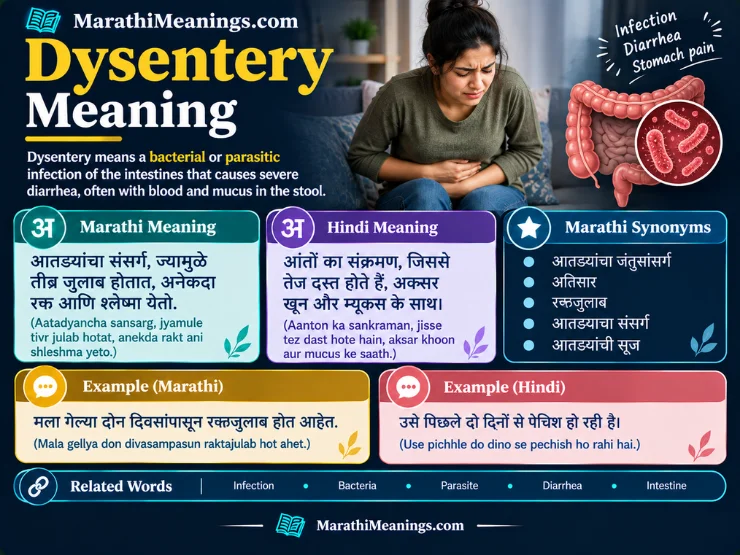
Dysentery Meaning refers to a gastrointestinal illness in which a person may have frequent diarrhea, often with blood or mucus in the stool, along with symptoms such as abdominal cramps and a frequent urge to pass stool.
Dysentery Meaning In Marathi is आमांश (Aamansh).
In simple Marathi, आमांश म्हणजे आतड्यांशी संबंधित असा आजार ज्यामध्ये वारंवार जुलाब होऊ शकतात आणि शौचामध्ये रक्त किंवा चिकट पदार्थ दिसू शकतो. पोटात मुरडा येणे आणि वारंवार शौचाला लागणे अशी लक्षणेही दिसू शकतात.
Roman Marathi: Aamansh
Hindi Meaning: पेचिश (Pechish)
The term जुलाब (Julaab) means diarrhea and is related to dysentery, but the two words do not have exactly the same meaning. Dysentery generally refers to a more specific type of intestinal illness, particularly when blood or mucus is present in the stool.
Quick Overview: Dysentery Meaning
| Feature | Details |
|---|---|
| Word | Dysentery |
| Part of Speech | Noun |
| Pronunciation | DIS-en-ter-ee |
| IPA | /ˈdɪsəntri/ |
| Marathi Meaning | आमांश |
| Roman Transliteration | Aamansh |
| Hindi Meaning | पेचिश |
| Roman Hindi | Pechish |
| Meaning in English | An intestinal illness associated with diarrhea, often involving blood or mucus in stool |
| Related Terms | Diarrhea, amoebic dysentery, bacillary dysentery |
| Plural Form | Dysenteries |
Part of Speech and Grammar
Dysentery is a noun. It names a medical condition rather than an action or a person.
The word is generally used as an uncountable noun when referring to the illness in general.
Common grammatical uses
- have dysentery
- develop dysentery
- suffer from dysentery
- symptoms of dysentery
- treatment for dysentery
- amoebic dysentery
- bacillary dysentery
Examples
English: The patient was diagnosed with dysentery after experiencing bloody diarrhea.
Marathi: रक्तमिश्रित जुलाब झाल्यानंतर रुग्णाला आमांश असल्याचे निदान झाले.
English: The doctor asked about the patient’s symptoms before deciding whether further testing was needed.
Marathi: पुढील तपासणी आवश्यक आहे का हे ठरवण्यापूर्वी डॉक्टरांनी रुग्णाच्या लक्षणांबद्दल विचारले.
Pronunciation of Dysentery
The English word dysentery is pronounced approximately as:
DIS-en-ter-ee
IPA: /ˈdɪsəntri/
The pronunciation may sound different from its Marathi equivalent आमांश, because the two words come from different linguistic traditions.
What Is Dysentery?
Dysentery is a gastrointestinal illness that affects the digestive system, particularly the intestines. It is commonly associated with frequent diarrhea and blood or mucus in the stool.
Other symptoms may include abdominal cramps, fever, weakness, nausea, and a repeated urge to pass stool.
The condition can have different causes. Some cases are associated with bacteria, while others are caused by parasites. Two important categories are bacillary dysentery and amoebic dysentery.
The symptoms of different intestinal infections can overlap. Therefore, symptoms alone cannot always identify the exact cause.
Dysentery Meaning In Marathi: Simple Explanation
For Marathi readers, the easiest way to understand Dysentery Meaning In Marathi is:
आमांश म्हणजे वारंवार जुलाब होण्याची अशी आतड्यांची समस्या ज्यामध्ये शौचामध्ये रक्त किंवा श्लेष्मा दिसू शकतो.
Here:
- आमांश = Dysentery
- जुलाब = Diarrhea
- रक्त = Blood
- श्लेष्मा = Mucus
- पोटात मुरडा = Abdominal cramps
However, these related words should not be treated as exact synonyms. For example, जुलाब describes diarrhea more broadly, while आमांश refers to dysentery.
Dysentery Symptoms
Dysentery Symptoms can vary depending on the cause and severity of the illness.
Common symptoms may include:
- Frequent loose stools
- Blood in the stool
- Mucus in the stool
- Abdominal pain or cramps
- Frequent urge to pass stool
- Fever
- Weakness or tiredness
- Nausea
- Loss of fluids and electrolytes
- Dehydration in more severe cases
Not every person will experience all of these symptoms.
Blood or Mucus in Stool
Blood or mucus in stool is an important feature associated with dysentery, but it can also occur in other gastrointestinal conditions. Therefore, the presence of blood should not be used to determine the cause without proper medical assessment.
Abdominal Cramps
Some people with dysentery experience abdominal pain or cramping. The discomfort may occur along with frequent bowel movements.
Dehydration
Frequent diarrhea can cause the body to lose water and electrolytes. If the person cannot replace these fluids adequately, dehydration can develop.
Dysentery Is Caused By What?
The question Dysentery Is Caused By what has more than one answer because different organisms can cause dysentery.
Bacterial Causes
Some cases are caused by bacteria. Shigella is an important bacterial cause of dysentery. Certain other bacterial infections can also cause bloody diarrhea.
This form is commonly referred to as bacillary dysentery.
Amoebic Cause
Amoebic dysentery is associated with the intestinal parasite Entamoeba histolytica.
The infection can affect the large intestine and may result in diarrhea, abdominal symptoms, and blood in stool.
How Infection Can Spread
Depending on the organism involved, infectious dysentery can spread through contaminated food or water or through poor hand hygiene.
For example, microscopic amounts of infected stool can contaminate hands, food, water, or surfaces and then enter another person’s mouth.
Good sanitation, safe drinking water, proper food handling, and regular handwashing can reduce the risk of transmission.
Types of Dysentery
There are two commonly discussed types of dysentery.
1. Amoebic Dysentery
Amoebic dysentery is caused by the parasite Entamoeba histolytica.
Marathi: अमीबामुळे होणारा आमांश
Roman Marathi: Amibamule honara Aamansh
Hindi: अमीबिक पेचिश
Roman Hindi: Amoebic Pechish
It can cause diarrhea, abdominal discomfort, and blood in the stool. Diagnosis and treatment depend on the clinical situation and may require laboratory testing.
2. Bacillary Dysentery
Bacillary dysentery refers to dysentery caused by bacteria.
Marathi: जिवाणूंमुळे होणारा आमांश
Roman Marathi: Jivanunmule honara Aamansh
Hindi: जीवाणुजनित पेचिश
Roman Hindi: Jeevanujanit Pechish
Shigella is an important bacterial cause. Other bacteria can also cause intestinal infections with similar symptoms.
Because different infections require different management, identifying the cause can be important.
Amoebic Dysentery Meaning
Amoebic Dysentery Meaning is dysentery caused by the parasite Entamoeba histolytica.
In simple terms, it is an intestinal infection caused by a particular parasite.
English: Amoebic dysentery is associated with an infection caused by Entamoeba histolytica.
Marathi: अमीबामुळे होणाऱ्या आतड्यांच्या संसर्गाला अमीबिक आमांश म्हणतात.
Hindi: एंटअमीबा हिस्टोलिटिका या परजीवीमुळे होणाऱ्या संसर्गाला अमीबिक पेचिश म्हणतात.
The term should not be used for every case of bloody diarrhea because other organisms can cause similar symptoms.
Bacillary Dysentery Meaning
Bacillary Dysentery Meaning refers to dysentery caused by bacteria.
One important bacterial cause is Shigella. Such infections can produce frequent diarrhea, abdominal cramps, fever, and blood or mucus in stool.
English: Bacillary dysentery is a bacterial form of dysentery.
Marathi: जिवाणूंमुळे होणाऱ्या आमांशाला बॅसिलरी आमांश म्हणतात.
The exact bacterial cause may require medical evaluation and, in some cases, laboratory testing.
Diarrhea Vs Dysentery
Diarrhea Vs Dysentery is an important distinction because the terms are often used incorrectly as if they mean exactly the same thing.
| Feature | Diarrhea | Dysentery |
|---|---|---|
| Basic meaning | Frequent loose or watery stools | Intestinal illness commonly associated with diarrhea and blood or mucus |
| Blood in stool | Not a defining feature | May be present |
| Mucus | May occur in some conditions | May occur |
| Abdominal cramps | Can occur | Can occur |
| Causes | Many possible causes | Often associated with specific bacterial or parasitic infections |
| Medical concern | Depends on duration and severity | Blood in stool generally deserves medical attention |
In short, dysentery is not simply another word for diarrhea.
Diarrhea And Dysentery Meaning
Diarrhea and dysentery are connected concepts.
Diarrhea means passing loose or watery stools more frequently than usual.
Dysentery is a more specific intestinal illness traditionally associated with diarrhea containing blood and/or mucus.
Simple Example
English: A person can have diarrhea without having dysentery.
Marathi: एखाद्या व्यक्तीला आमांश नसतानाही जुलाब होऊ शकतात.
This distinction is useful when understanding medical information and describing symptoms accurately.
Dysentery Treatment
Dysentery Treatment depends on the underlying cause, severity of symptoms, age, general health, and risk of complications.
1. Fluid and Electrolyte Replacement
Frequent diarrhea can cause loss of water and electrolytes. Oral rehydration solution (ORS) can help replace fluids and electrolytes.
If dehydration becomes severe, medical treatment may be necessary.
2. Treatment Based on the Cause
Specific treatment may be required when a bacterial or parasitic infection is identified.
Antibiotics are not appropriate for every case of diarrhea or dysentery. The choice of medicine depends on the organism and clinical circumstances.
For this reason, self-treatment with leftover antibiotics is not advisable.
3. Medical Assessment
A healthcare professional may consider the symptoms, duration, medical history, physical findings, and, when appropriate, laboratory tests.
A stool test may sometimes be used to help identify the infectious organism.
Dysentery Tablet and Dysentery Medicine
Many people search for Dysentery Tablet or Dysentery Medicine because they want a quick treatment.
However, there is no single medicine that is suitable for every case of dysentery.
The correct treatment depends on whether the condition is caused by bacteria, a parasite, or another problem. Some infections may require prescription treatment, while unnecessary medicines can create additional problems.
Antidiarrheal medicines are also not appropriate in every situation, particularly when there is blood in the stool or certain infections are suspected.
Therefore, people with suspected dysentery should obtain appropriate medical advice rather than choosing a tablet solely from the name of the condition.
When Should Medical Attention Be Sought?
Medical attention is particularly important when a person has:
- Blood in the stool
- Severe or persistent diarrhea
- Severe abdominal pain
- Significant fever
- Repeated vomiting
- Signs of dehydration
- Difficulty drinking enough fluids
- Marked weakness or dizziness
Extra care may be needed for young children, older adults, pregnant people, and individuals with certain underlying health conditions.
Prevention of Dysentery
Because infectious causes can spread through contaminated food, water, and hands, basic hygiene is important.
Helpful preventive habits
- Wash hands with soap and water after using the toilet.
- Wash hands before preparing or eating food.
- Drink safe water.
- Handle food carefully.
- Keep food preparation areas clean.
- Wash produce appropriately.
- Follow good sanitation practices.
- Avoid preparing food for others while experiencing infectious diarrhea.
These measures can reduce exposure to organisms that cause intestinal infections.
Dysentery Meaning In Hindi
The Dysentery Meaning In Hindi is:
पेचिश — Pechish
Dysentery Meaning In Hindi With Example
Hindi: पेचिश में मल के साथ खून या बलगम आ सकता है।
English: Blood or mucus may occur in the stool during dysentery.
Dysentery Meaning In Hindi And Treatment
In Hindi, dysentery is called पेचिश. Treatment depends on the cause. Maintaining hydration is important, while specific medicines may be prescribed by a healthcare professional when a particular infection requires them.
Dysentery Meaning In Other Indian Languages
| Language | Meaning |
|---|---|
| Hindi | पेचिश |
| Tamil | சீதபேதி |
| Bengali | আমাশয় |
| Punjabi | ਪੇਚਿਸ |
| Gujarati | મરડો |
| Malayalam | അതിസാരം / രക്താതിസാരം |
| Urdu | پیچش |
| Assamese | আমাশয় |
| Telugu | రక్త విరేచనాలు |
| Kannada | ರಕ್ತಭೇದಿ |
Regional terminology can vary, and some terms may also be used for related digestive conditions. Therefore, these translations should be understood in their medical context rather than treated as exact word-for-word equivalents in every situation.
Marathi Words Related to Dysentery
Understanding related Marathi vocabulary can make the meaning easier to remember.
| Marathi Word | English Meaning |
|---|---|
| आमांश | Dysentery |
| जुलाब | Diarrhea |
| अतिसार | Diarrhea / excessive bowel movements |
| रक्त | Blood |
| श्लेष्मा | Mucus |
| पोटात मुरडा | Abdominal cramps |
| निर्जलीकरण | Dehydration |
| आतड्यांचा संसर्ग | Intestinal infection |
These words describe different aspects of the condition and should not automatically be considered synonyms.
Examples of Dysentery
Example 1
English: The child had frequent bowel movements and was taken to a doctor after blood appeared in the stool.
Marathi: मुलाला वारंवार शौचाला होत होते आणि शौचामध्ये रक्त दिसल्यानंतर त्याला डॉक्टरांकडे नेण्यात आले.
Example 2
English: The doctor recommended oral rehydration to help replace fluids lost through diarrhea.
Marathi: जुलाबामुळे कमी झालेली शरीरातील द्रवपातळी भरून काढण्यासाठी डॉक्टरांनी तोंडावाटे द्रवपदार्थ घेण्याचा सल्ला दिला.
Example 3
English: Laboratory testing can help determine the cause of some intestinal infections.
Marathi: प्रयोगशाळेतील तपासणीमुळे काही आतड्यांच्या संसर्गाचे कारण ओळखण्यास मदत होऊ शकते.
Example 4
English: She experienced abdominal cramps along with frequent stools.
Marathi: तिला वारंवार शौचासोबत पोटात मुरडा येत होता.
Example 5
English: Safe drinking water and good hand hygiene can help reduce the spread of infectious diarrhea.
Marathi: सुरक्षित पिण्याचे पाणी आणि हातांची योग्य स्वच्छता संसर्गजन्य जुलाबाचा प्रसार कमी करण्यास मदत करू शकते.
Common Mistakes About Dysentery
1. Calling every case of diarrhea dysentery
Diarrhea has many causes, and not every case is dysentery.
2. Assuming blood always means one particular infection
Blood in stool can occur for several reasons. The underlying cause needs appropriate medical assessment.
3. Taking antibiotics without medical advice
Different infections respond to different treatments. Antibiotics should not be taken automatically.
4. Ignoring dehydration
Repeated loose stools can cause substantial fluid loss. Hydration is an important part of care during diarrheal illness.
5. Using Dysentery and Diarrhea as exact synonyms
The two terms are related but have different meanings. This distinction is particularly important in medical communication.
Conclusion
Dysentery Meaning refers to an intestinal illness associated with diarrhea, particularly when blood or mucus may be present in the stool. The Dysentery Meaning In Marathi is आमांश (Aamansh), while its Hindi meaning is पेचिश (Pechish).
Dysentery can have different causes, including bacterial infections such as Shigella and parasitic infection caused by Entamoeba histolytica. The two commonly discussed forms are bacillary dysentery and amoebic dysentery.
It is also important to remember the difference between diarrhea and dysentery. Diarrhea is a broad term for frequent loose or watery stools, while dysentery is a more specific intestinal illness that can involve blood or mucus.
There is no single Dysentery Medicine or Dysentery Tablet that is suitable for every case. Treatment depends on the cause and severity. Maintaining hydration is important, and symptoms such as blood in stool, severe abdominal pain, persistent diarrhea, significant fever, or signs of dehydration should receive appropriate medical attention.
? FAQs About Dysentery Meaning
1. What is Dysentery Meaning In Marathi?
Dysentery Meaning In Marathi is आमांश (Aamansh). It refers to an intestinal illness commonly associated with diarrhea and may involve blood or mucus in the stool.
2. What is Dysentery Meaning in Hindi?
The Dysentery Meaning In Hindi is पेचिश (Pechish).
3. What is dysentery caused by?
Dysentery can be caused by different infectious organisms. Important causes include bacteria such as Shigella and the parasite Entamoeba histolytica.
4. What is the difference between diarrhea and dysentery?
Diarrhea refers to frequent loose or watery stools. Dysentery is a more specific intestinal illness generally associated with diarrhea and may involve blood or mucus in the stool.
5. What is amoebic dysentery?
Amoebic dysentery is an intestinal infection associated with Entamoeba histolytica, a parasite that can cause diarrhea and other intestinal symptoms.
6. What is bacillary dysentery?
Bacillary dysentery refers to dysentery caused by bacteria. Shigella is an important bacterial cause.
7. Is there a specific Dysentery Tablet?
There is no universal Dysentery Tablet for every case. Treatment depends on the underlying cause and should be determined with appropriate medical advice.
8. Can dysentery cause dehydration?
Yes. Frequent diarrhea can result in loss of water and electrolytes, which may lead to dehydration. Severe dehydration requires medical attention.
📚 Also Read These Word Meanings to Build a Stronger English-Marathi Vocabulary :
- Carpediem Meaning In Marathi
- Narcissist Meaning In Marathi
- Pookie Meaning In Marathi
- Audacity Meaning In Marathi
- Manifestation Meaning In Marathi
- Consent Meaning In Marathi
- Nephew Meaning In Marathi
- Harmony Meaning In Marathi
- Overwhelmed Meaning in Marathi
- Migraine Meaning in Marathi
- Antonyms Meaning In Marathi
- Pcod Full Form In Marathi
- Prosperity Meaning in Marathi
- Aura Meaning In Marathi
- Bloating Meaning In Marathi
- Soulmate Meaning In Marathi
- Dignity Meaning in Marathi
- Precious Meaning in Marathi
- Possessive Meaning in Marathi
- Body Count Meaning in Marathi
- Fetched Meaning In Marathi
- Desire Meaning In Marathi
- Virtual Meaning In Marathi
- Committed Meaning In Marathi
- Loyal Meaning In Marathi
- Annoying Meaning in Marathi
- Algorithm Meaning In Marathi
- Clumsy Meaning In Marathi