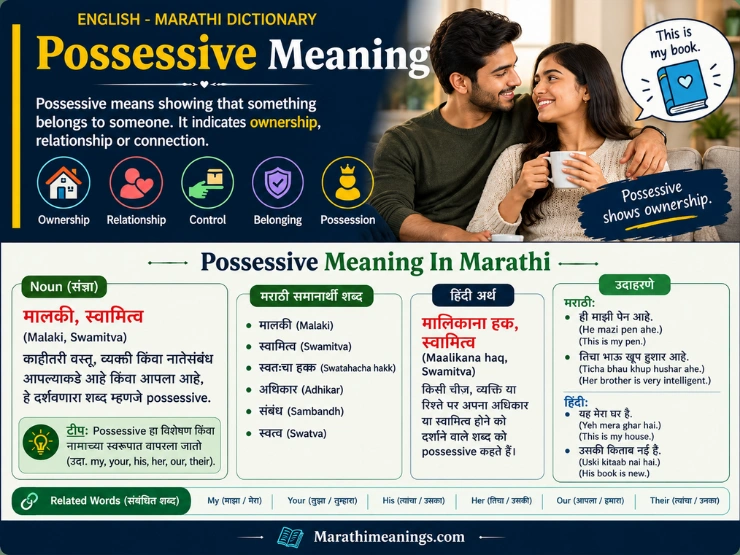
The English word “possessive” carries two distinct lives — one grammatical, one emotional and understanding both is essential to using it correctly.
In grammar, possessive refers to a word form that shows ownership or belonging. In everyday life, it describes a person who is overly controlling or clingy in relationships — someone who treats another person as their exclusive property.
Possessive meaning in Marathi: स्वामित्ववाचक (Swamitvaachak) — for the grammatical sense; and मालकी भावना असलेला / अती जपणारा (Maalaki bhaavna asalela / Ati japnara) — for the emotional or relational sense.
Hindi meaning: स्वामित्वबोधक (Swamitvabodhak) — grammatical; अधिकार जताने वाला (Adhikar jatane wala) — relational.
Quick Overview: Possessive Meaning
| Feature | Details |
|---|---|
| Word | Possessive |
| Part of Speech | Adjective, Noun |
| Pronunciation | /pəˈzɛsɪv/ |
| Marathi Meaning | स्वामित्ववाचक (grammatical); मालकी भावना असलेला (emotional) |
| Roman Transliteration | Swamitvaachak; Maalaki bhaavna asalela |
| Hindi Meaning | स्वामित्वबोधक; अधिकार जताने वाला |
| Root Word | Latin possessivus, from possidere (to possess) |
| Related Forms | Possess (verb), Possession (noun), Possessively (adverb), Possessiveness (noun) |
| Synonyms (relational) | Controlling, Jealous, Clingy, Overbearing |
| Antonyms (relational) | Trusting, Independent, Secure, Detached |
Marathi Meaning of Possessive
The Marathi translation of possessive depends on context.
Grammatical sense:
- स्वामित्ववाचक (Swamitvaachak) — used in grammar to describe words that indicate ownership, such as possessive pronouns or possessive nouns.
Relational / emotional sense:
- मालकी भावना असलेला (Maalaki bhaavna asalela) — describing a person who feels excessive ownership over another.
- अती जपणारा / अती आग्रही (Ati japnara / Ati aagrahi) — someone who is excessively protective or demanding in a relationship.
The word “possessive” in Marathi grammar textbooks is commonly rendered as स्वामित्ववाचक or संबंधवाचक (Sambandhawaachak) depending on the grammatical category being discussed.
Hindi Meaning of Possessive
| Sense | Hindi | Transliteration |
|---|---|---|
| Grammatical | स्वामित्वबोधक / संबंधवाचक | Swamitvabodhak / Sambandhawaachak |
| Emotional / Relational | अधिकार जताने वाला / अत्यधिक अधिकारी | Adhikar jatane wala / Atyadhik adhikari |
Pronunciation
- English IPA: /pəˈzɛsɪv/
- Syllable break: pos-ses-sive
- Approximate Marathi pronunciation: पझेसिव्ह (Pazhesivh)
The stress falls on the second syllable: pos-ZES-sive.
Origin and Etymology
The word possessive comes from the Latin possessivus, derived from possidere — meaning “to have” or “to hold.” The root breaks into pot- (able, powerful) and sedere (to sit), suggesting the sense of “sitting firmly upon something” — i.e., claiming and holding it.
In English grammar, the possessive case has been formally recognized since at least the 16th century. The relational or psychological use of “possessive” — describing jealous, controlling behavior — emerged much later in common usage.
Possessive in Grammar — Types and Explanation
This is where most grammar learners search for the word. Possessive forms appear in four major grammatical categories.
Possessive Noun (स्वामित्ववाचक नाम)
A possessive noun shows that something belongs to a person, animal, or thing. In English, it is formed by adding an apostrophe + s (‘s) to a noun.
Examples:
English:
- Rahul’s book — the book belonging to Rahul
- The team’s victory — the victory of the team
Marathi:
- राहुलचे पुस्तक (Rahulache pustak)
- संघाचा विजय (Sanghacha vijay)
Hindi:
- राहुल की किताब
- टीम की जीत
In Marathi, ownership is expressed through षष्ठी विभक्ती (Shashthee Vibhakti) — the genitive case — using suffixes like -चा, -ची, -चे, -च्या depending on the gender and number of the object.
Possessive Pronoun (स्वामित्ववाचक सर्वनाम)
A possessive pronoun replaces a noun to show ownership without repeating the noun.
| English Possessive Pronoun | Marathi Equivalent | Hindi Equivalent |
|---|---|---|
| Mine | माझे / माझा / माझी (Majhe / Majha / Majhi) | मेरा / मेरी / मेरे |
| Yours | तुझे / तुमचे (Tujhe / Tumache) | तेरा / तुम्हारा |
| His | त्याचे (Tyache) | उसका |
| Hers | तिचे (Tiche) | उसकी |
| Ours | आमचे / आपले (Aamache / Aapale) | हमारा |
| Theirs | त्यांचे (Tyanche) | उनका |
Possessive pronouns examples:
English:
- This pen is mine.
- That bag is hers.
Marathi:
- हे पेन माझे आहे. (He pen majhe aahe.)
- ती पिशवी तिची आहे. (Ti pishvi tichi aahe.)
Hindi:
- यह पेन मेरा है।
- वह बैग उसकी है।
Possessive Adjective (स्वामित्व दर्शक विशेषण)
A possessive adjective modifies a noun and shows who it belongs to. Unlike possessive pronouns, it always appears before a noun.
| English | Marathi | Hindi |
|---|---|---|
| My | माझा / माझी / माझे | मेरा / मेरी / मेरे |
| Your | तुझा / तुमचा | तेरा / तुम्हारा |
| His / Her / Its | त्याचा / तिचा / त्याचे | उसका / उसकी |
| Our | आमचा / आपला | हमारा |
| Their | त्यांचा | उनका |
Examples:
English:
- My brother is a doctor.
- Their house is near the river.
Marathi:
- माझा भाऊ डॉक्टर आहे. (Majha bhaau doctor aahe.)
- त्यांचे घर नदीजवळ आहे. (Tyanche ghar nadijawaj aahe.)
Hindi:
- मेरा भाई डॉक्टर है।
- उनका घर नदी के पास है।
Note: Marathi possessive adjectives change form based on the gender (masculine, feminine, neuter) and number (singular, plural) of the noun they modify — unlike English, where “my” stays “my” regardless.
Possessive Meaning in Relationship
In relationships, someone described as possessive (मालकी भावना असलेला) displays a need to control or monopolize another person’s time, attention, and affections. This behavior is rooted in insecurity, fear of loss, or an inability to trust.
Common signs of a possessive person in a relationship:
- Constant monitoring of a partner’s whereabouts
- Jealousy over friendships with others
- Discouraging independence or outside social life
- Demanding exclusive emotional and physical availability
Possessive meaning in Marathi in relationship context:
A possessive partner is described in Marathi as मालकी वृत्तीचा / मालकी वृत्तीची (Maalki vritticha / Maalki vrittichi) or अती जपणारा / अती जपणारी (Ati japnara / Ati japnari).
Examples:
English:
- He becomes very possessive whenever she talks to her friends.
Marathi:
- जेव्हा ती तिच्या मित्रांशी बोलते, तेव्हा तो खूप मालकी वृत्तीचा होतो. (Jewha ti tichya mitrashi bolate, tewha to khup maalki vritticha hoto.)
Hindi:
- जब वह अपने दोस्तों से बात करती है, तो वह बहुत अधिकारी हो जाता है।
Over Possessive Meaning
Over possessive intensifies this: it describes someone whose controlling behavior has crossed reasonable boundaries and becomes unhealthy or harmful.
Marathi: अत्यंत मालकी वृत्तीचा / अती हक्क गाजवणारा (Atyant maalki vritticha / Ati hakk gajavnara)
This is distinct from care or protectiveness. Over-possessiveness often damages trust and restricts the other person’s freedom.
Possessive Meaning in Other Indian Languages
| Language | Grammatical Meaning | Relational Meaning |
|---|---|---|
| Telugu | స్వాధీనపరచుకునే (Swadheenaparachukune) | అధికారంగా ప్రవర్తించే (Adhikaramga pravartinche) |
| Bengali | অধিকারবোধক (Adhikarbodhok) | অতিরিক্ত দখলদার (Atirikto dokholdaar) |
| Punjabi | ਮਾਲਕੀਅਤ ਵਾਲਾ (Maalkeeat wala) | ਹੱਦੋਂ ਵੱਧ ਅਧਿਕਾਰ ਜਤਾਉਣ ਵਾਲਾ (Haddon vadh adhikar jataun wala) |
| Kannada | ಸ್ವಾಮ್ಯಸೂಚಕ (Swaamyasuchaka) | ಅತಿಯಾದ ಒಡೆತನ ತೋರುವ (Atiyaada odethana toruva) |
| Malayalam | ഉടമസ്ഥതാ സൂചകം (Udamasthatha suchakam) | അമിതമായ ആധിപത്യം (Amithamaya aadhipathyam) |
| Tamil | உரிமை காட்டும் (Urimai kaattum) | அதீத சொந்தமாக நடந்துகொள்பவர் (Atheeta sondhamaaga nadanthukolpavar) |
| Gujarati | માલિકીવાચક (Maalikeevaachak) | વધુ પડતો અધિકાર જમાવનાર (Vadhu padto adhikar jamaavnaar) |
| Urdu | ملکیتی (Milkiyati) | ضرورت سے زیادہ قابض (Zaroorat se zyada qaabiz) |
Synonyms and Antonyms
Synonyms for Possessive (Relational)
| English | Marathi | Hindi |
|---|---|---|
| Controlling | ताब्यात ठेवणारा (Tabyat thevnara) | नियंत्रण करने वाला |
| Jealous | मत्सरी (Matsari) | ईर्ष्यालु |
| Clingy | चिकटून राहणारा (Chiktiun rahnara) | चिपकने वाला |
| Domineering | वर्चस्व गाजवणारा (Varchasva gajavnara) | दबदबा जमाने वाला |
Antonyms
| English | Marathi | Hindi |
|---|---|---|
| Trusting | विश्वास ठेवणारा (Vishwas thevnara) | भरोसा करने वाला |
| Independent | स्वतंत्र (Swatantra) | स्वतंत्र |
| Secure | आत्मविश्वासू (Aatmaviswaasu) | आश्वस्त |
| Detached | अनासक्त (Anasakta) | अनासक्त |
Word Family and Related Expressions
| Word | Form | Marathi |
|---|---|---|
| Possess | Verb | बाळगणे / ताब्यात असणे (Baalgane / Tabyat asne) |
| Possession | Noun | मालमत्ता / ताबा (Maalmatta / Taaba) |
| Possessiveness | Noun | मालकी वृत्ती (Maalki vritti) |
| Possessively | Adverb | मालकी भावनेने (Maalki bhaavnene) |
| Possessed | Adjective/Past Participle | ताब्यात असलेला / झपाटलेला (Tabyat asalela / Jhapatlelela) |
Common Mistakes
1. Confusing possessive adjective with possessive pronoun
Possessive adjective: “This is my book.” — modifies the noun book.
Possessive pronoun: “This book is mine.” — stands alone, replaces the noun phrase.
In Marathi, both forms use the same root words but with different sentence placement, so learners sometimes mix them up.
2. Using apostrophe-s for pronouns
A common error in English: writing “her’s” or “your’s.” Possessive pronouns — his, hers, its, ours, theirs, yours — never take an apostrophe.
3. Treating possessiveness as care
In relationship discussions, “possessive” carries a negative connotation. It should not be confused with protective (संरक्षण करणारा / Sanrakshan karnara) or caring (काळजी घेणारा / Kaalji ghenary), which describe healthy concern.
Conclusion
The word possessive operates meaningfully in two very different domains. In grammar, it is a precise term describing स्वामित्ववाचक forms — possessive nouns, possessive pronouns, possessive adjectives — all of which express ownership or belonging. In everyday life, it describes an emotional pattern of control and jealousy in relationships, rendered in Marathi as मालकी वृत्तीचा.
Understanding the Possessive meaning in Marathi across both these contexts — grammatical and relational — allows learners to use the word accurately and interpret it correctly when they encounter it in language study or real-life conversation.
? Frequently Asked Questions
1. What is possessive meaning in Marathi?
The grammatical meaning is स्वामित्ववाचक (Swamitvaachak). In relationship or emotional contexts, it translates as मालकी वृत्तीचा (Maalki vritticha) — describing someone with an excessive sense of ownership over another person.
2. What is a possessive noun?
A possessive noun shows ownership by adding ‘s (apostrophe + s) to a noun in English — for example, Priya’s bag. In Marathi, ownership is shown through genitive case suffixes: -चा, -ची, -चे, -च्या.
3. What are possessive pronouns? Give examples.
Possessive pronouns replace nouns to show ownership. Examples: mine, yours, his, hers, ours, theirs. In Marathi: माझे, तुझे, त्याचे, तिचे, आमचे, त्यांचे.
4. What is the difference between a possessive adjective and a possessive pronoun?
A possessive adjective comes before a noun (my car), while a possessive pronoun stands alone and replaces the noun (the car is mine). In Marathi, both use the same root forms but occupy different positions in the sentence.
5. What does over possessive mean in Marathi?
Over possessive means अत्यंत मालकी वृत्तीचा (Atyant maalki vritticha) — describing someone whose sense of ownership over another person has become unhealthy, controlling, or oppressive.
6. Is being possessive always negative?
In grammar, it is simply descriptive — neither positive nor negative. In relationships, however, possessive usually carries a negative meaning, suggesting controlling or jealous behavior that undermines the other person’s freedom. It is different from genuine care or protectiveness.
7. What is possessive meaning in Hindi?
Grammatically: स्वामित्वबोधक (Swamitvabodhak). In relationship context: अधिकार जताने वाला (Adhikar jatane wala).
8. How do Marathi possessive adjectives differ from English ones?
English possessive adjectives (my, your, his) do not change form based on the noun. Marathi possessive adjectives change according to the gender and number of the noun being modified — for example, माझा (masculine singular), माझी (feminine singular), माझे (neuter singular / plural).
 Also Read These Word Meanings to Build a Stronger English Vocabulary :
- Fragile Meaning in Marathi
- Nostalgic Meaning In Marathi
- Flaxseed Meaning in Marathi
- Brat Meaning in Marathi
- Gigantic Meaning In Marathi
- Introvert Meaning In Marathi
- Ceasefire Meaning In Marathi
- Domicile Meaning In Marathi
- Carpediem Meaning In Marathi
- Narcissist Meaning In Marathi
- Pookie Meaning In Marathi
- Audacity Meaning In Marathi
- Manifestation Meaning In Marathi
- Consent Meaning In Marathi
- Nephew Meaning In Marathi
- Harmony Meaning In Marathi
- Overwhelmed Meaning in Marathi
- Migraine Meaning in Marathi
- Antonyms Meaning In Marathi
- Pcod Full Form In Marathi
- Prosperity Meaning in Marathi
- Aura Meaning In Marathi
- Bloating Meaning In Marathi
- Soulmate Meaning In Marathi
- Dignity Meaning in Marathi
- Precious Meaning in Marathi