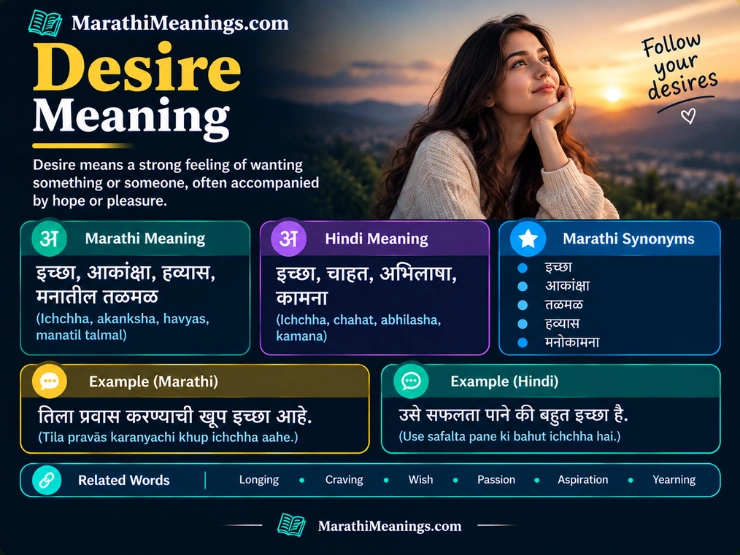
Desire means a strong feeling of wanting something, wishing for something, or wanting a particular situation to happen.
The most useful Desire Meaning In Marathi are:
- इच्छा — Ichha
- आकांक्षा — Akanksha
- अभिलाषा — Abhilasha
- कामना — Kamana
- ओढ — Odh
- तळमळ — Talmal
The appropriate Marathi meaning depends on the context. इच्छा is a general translation, while आकांक्षा is more suitable for an aspiration or important goal. ओढ and तळमळ can express a deeper emotional longing.
Desire Meaning: a strong wish or want for something.
Desire Meaning In Hindi: इच्छा, कामना, आकांक्षा, अभिलाषा
Quick Overview: Desire Meaning
| Feature | Details |
|---|---|
| Word | Desire |
| Part of Speech | Noun, Verb |
| Pronunciation | dih-ZY-er |
| IPA | /dɪˈzaɪər/ |
| Marathi Meaning | इच्छा, आकांक्षा, अभिलाषा, कामना |
| Roman Transliteration | Ichha, Akanksha, Abhilasha, Kamana |
| Hindi Meaning | इच्छा, कामना, आकांक्षा |
| Root Word | Desire |
| Related Forms | Desires, desired, desiring |
| Common Synonyms | Wish, want, longing, aspiration, yearning |
| Common Antonyms | Reluctance, unwillingness, indifference |
Meaning Of Desire
The meaning of desire is a feeling of wanting something strongly. The object of a desire can be a physical thing, an experience, a relationship, an achievement, a change, or a particular state of life.
For example, a person can have a desire for success, freedom, happiness, knowledge, companionship, or financial security.
The word desire can be used as both a noun and a verb.
- As a noun, it means a strong wish or want.
- As a verb, it means to want or wish for something.
The intensity of desire can vary. A casual wish may be relatively weak, whereas a deepest desire, ardent desire, or overwhelming desire indicates a much stronger feeling.
Desire Meaning In Marathi
There is no single Marathi word that perfectly represents every use of desire. Marathi has several natural equivalents, and the best choice depends on the intended sense.
1. इच्छा — Ichha
इच्छा is the most direct general equivalent when someone wants something or wants to do something.
English: I have a desire to learn a new language.
Marathi: मला नवीन भाषा शिकण्याची इच्छा आहे.
Here, इच्छा simply communicates the person’s wish.
2. आकांक्षा — Akanksha
आकांक्षा refers to a strong aspiration, ambition, or important personal goal.
English: Her desire to become a writer remained strong.
Marathi: लेखिका होण्याची तिची आकांक्षा कायम राहिली.
This translation works particularly well when desire is connected with achievement.
3. अभिलाषा — Abhilasha
अभिलाषा expresses a strong wish, aspiration, or heartfelt longing. It can sound more formal or literary than इच्छा.
English: He has a sincere desire to serve society.
Marathi: समाजाची सेवा करण्याची त्याची मनापासून अभिलाषा आहे.
4. कामना — Kamana
कामना can mean a wish, aspiration, or heartfelt desire. It appears naturally in formal, literary, and ceremonial contexts.
English: Everyone has a desire for peace.
Marathi: प्रत्येकाच्या मनात शांततेची कामना असते.
5. ओढ — Odh
ओढ describes an emotional pull, attraction, or longing toward someone or something.
English: She has a strong desire to return to her village.
Marathi: तिला आपल्या गावाकडे परतण्याची खूप ओढ आहे.
6. तळमळ — Talmal
तळमळ expresses intense emotional longing or a strong inner yearning.
English: His desire to see his children again was intense.
Marathi: आपल्या मुलांना पुन्हा पाहण्याची त्याला तीव्र तळमळ होती.
Desire Meaning In Hindi
The common Hindi equivalents of desire include:
- इच्छा — Ichha
- कामना — Kamna
- आकांक्षा — Aakanksha
- अभिलाषा — Abhilasha
- तमन्ना — Tamanna
The choice depends on context and tone.
For example:
Desire for success → सफलता की इच्छा / सफलता की आकांक्षा
Deep desire → गहरी इच्छा
Heart’s desire → दिल की इच्छा
Sexual desire → यौन इच्छा
Desire as a Noun
When desire is a noun, it refers to the feeling itself.
Common structures include:
Desire for + Noun
This structure identifies what a person wants.
English: His desire for independence grew stronger.
Marathi: स्वावलंबनाची त्याची इच्छा अधिक तीव्र झाली.
Desire to + Verb
This structure identifies an action someone wishes to perform.
English: She has a strong desire to travel.
Marathi: तिला प्रवास करण्याची तीव्र इच्छा आहे.
A Strong Desire
This means an intense wish.
English: There was a strong desire for change among the employees.
Marathi: कर्मचाऱ्यांमध्ये बदलाची तीव्र इच्छा होती.
Desire as a Verb
As a verb, desire means to want something strongly.
It is generally more formal than want in ordinary English.
English: The community desires better public services.
Marathi: त्या समुदायाला चांगल्या सार्वजनिक सेवांची इच्छा आहे.
Another example:
English: She desires a peaceful and meaningful life.
Marathi: तिला शांततापूर्ण आणि अर्थपूर्ण जीवन हवे आहे.
In everyday conversation, people often use want, whereas desire may sound more formal, deliberate, literary, or emotionally emphatic.
Meanings of Desire by Context
Desire for Success
A desire for success refers to a strong wish to achieve a goal or perform well.
Marathi: यशाची इच्छा / यश मिळवण्याची आकांक्षा
English: His desire for success encouraged him to work consistently.
Marathi: यश मिळवण्याच्या त्याच्या आकांक्षेमुळे त्याला सातत्याने काम करण्याची प्रेरणा मिळाली.
Desire for Freedom
A desire for freedom means wanting independence or the ability to make one’s own choices.
Marathi: स्वातंत्र्याची इच्छा
English: The desire for freedom influenced her decision.
Marathi: स्वातंत्र्याच्या इच्छेचा तिच्या निर्णयावर परिणाम झाला.
Human Desire
Human desire refers broadly to the wants, wishes, ambitions, needs, and longings that people experience.
Human desire can concern relationships, security, achievement, comfort, recognition, knowledge, belonging, or personal fulfillment.
English: Human desire can influence the choices people make.
Marathi: मानवी इच्छा लोकांच्या निवडींवर प्रभाव टाकू शकते.
Innate Desire
Innate desire refers to a desire that is naturally present rather than deliberately acquired.
Marathi: उपजत इच्छा / नैसर्गिक इच्छा
The expression should be interpreted according to the context because not every natural human tendency is necessarily called an innate desire.
Deepest Desire
A deepest desire is a person’s most strongly felt or personally important wish.
Marathi: अंतर्मनातील सर्वात खोल इच्छा
English: Her deepest desire was to see her family together again.
Marathi: आपल्या कुटुंबाला पुन्हा एकत्र पाहणे ही तिच्या अंतर्मनातील सर्वात खोल इच्छा होती.
Overwhelming Desire
An overwhelming desire is an extremely strong feeling of wanting something.
Marathi: अनावर इच्छा / अत्यंत तीव्र इच्छा
English: He experienced an overwhelming desire to return home.
Marathi: त्याला घरी परतण्याची अनावर इच्छा झाली.
Ardent Desire
Ardent desire means a passionate and very strong wish.
Marathi: उत्कट इच्छा / प्रबळ आकांक्षा
English: She had an ardent desire to contribute to education.
Marathi: शिक्षणाच्या क्षेत्रात योगदान देण्याची तिची उत्कट इच्छा होती.
Keen Desire
Keen desire means a strong and eager wish to have, achieve, or do something.
Marathi: तीव्र इच्छा / प्रबळ आकांक्षा
English: The student showed a keen desire to improve her writing.
Marathi: त्या विद्यार्थिनीने आपले लेखन सुधारण्याची तीव्र इच्छा दाखवली.
Carnal Desire Meaning
Carnal desire refers to a desire associated with the body, particularly sexual desire or sexual attraction.
Possible Marathi equivalents include:
- शारीरिक इच्छा
- लैंगिक इच्छा
- कामवासना, when that stronger and more specific sense is intended
The phrase is much more specific than the ordinary word desire.
English: The story portrays the character’s carnal desire.
Marathi: कथेमध्ये त्या पात्राच्या शारीरिक इच्छेचे चित्रण केले आहे.
Because carnal has a bodily or sexual sense in this expression, it should not automatically be translated as an ordinary wish.
Sexual Desire Meaning
Sexual desire means a feeling of wanting sexual intimacy or sexual activity.
Marathi Meaning
लैंगिक इच्छा
Roman: Laingik Ichha
Hindi Meaning
यौन इच्छा
Roman: Yaun Ichha
English: Sexual desire is a specific type of desire related to sexual attraction or intimacy.
Marathi: लैंगिक इच्छा ही लैंगिक आकर्षण किंवा जवळिकीशी संबंधित विशिष्ट प्रकारची इच्छा आहे.
This term should be distinguished from general emotional, social, or romantic interest.
Physical Desire Meaning
Physical desire can have slightly different meanings depending on the context.
It may refer to a desire connected with:
- bodily pleasure,
- physical attraction,
- physical closeness,
- or, in some contexts, sexual attraction.
A natural Marathi translation is शारीरिक इच्छा (Sharirik Ichha).
Because the phrase can be ambiguous, the surrounding sentence should be considered before selecting a more specific translation.
Low Desire Meaning
Low desire means a reduced or relatively weak level of wanting or interest.
Its meaning depends on what follows it.
For example:
- low desire to work — काम करण्याची कमी इच्छा
- low desire for food — अन्न खाण्याची कमी इच्छा
- low sexual desire — लैंगिक इच्छेची कमी पातळी
The phrase low desire on its own does not identify a particular condition or cause. Context is necessary to understand what type of desire is being discussed.
Heart Desire Meaning
The natural English expression is usually “heart’s desire.”
It means something that a person deeply and sincerely wishes for.
Marathi Meaning
- मनातील इच्छा
- मनापासूनची इच्छा
- अंतःकरणातील इच्छा
English: Owning a small home was her heart’s desire.
Marathi: स्वतःचे छोटेसे घर असावे ही तिच्या मनातील इच्छा होती.
The expression has an emotional tone and is often used when discussing an especially meaningful personal wish.
Desire You Meaning
The phrase “desire you” means to want you strongly, but the exact meaning depends on the situation.
For example, “I desire you” can communicate romantic or sexual attraction. In a different context, it could have a more literary meaning of strongly wanting someone’s presence or attention.
Therefore, desire you should not automatically be translated as a simple Marathi इच्छा without considering the context.
Dark Desire Meaning
Dark desire is not a fixed expression with one universal dictionary definition.
In fiction, dramatic writing, or discussions of hidden motivations, dark desire can refer to a secret, troubling, forbidden, or morally questionable wish.
Possible Marathi expressions include:
- गुप्त इच्छा
- मनातील काळी इच्छा
- अंधकारमय इच्छा
The exact translation depends on the writer’s intended meaning.
Darkest Desire Meaning
Darkest desire intensifies the idea expressed by dark desire.
It can refer to a person’s most hidden, disturbing, forbidden, or morally troubling wish, particularly in fictional or dramatic contexts.
A natural Marathi rendering may be:
मनातील सर्वात गुप्त इच्छा
or, when a negative sense is clearly intended:
मनातील सर्वात काळी इच्छा
It is not a standard clinical term and should not be treated as one.
Freed From Desire Meaning
“Freed from desire” means being free from attachment to wanting or craving something.
The expression may occur in philosophical, spiritual, or literary contexts. It can describe a state in which a person is no longer controlled by persistent wants.
Marathi Meaning
इच्छांपासून मुक्त होणे
Roman: Ichhampasun mukta hone
The expression does not necessarily mean that the person has no goals. It can instead emphasize freedom from excessive attachment to desires.
Mimetic Desire Meaning
Mimetic desire is a specific concept associated with the idea that people can develop desires by imitating the desires of others.
In simple terms, a person may want something partly because another person wants it, values it, or appears to value it.
The concept is particularly associated with the work of René Girard.
Simple Illustration
Suppose two students see the same book. Neither initially shows much interest. One student begins praising the book, and the other then becomes interested in owning it. The second student’s desire is influenced by another person’s desire.
A natural Marathi explanation is:
इतरांच्या इच्छेचे अनुकरण करून निर्माण होणारी इच्छा
Mimetic desire is therefore more specific than the everyday meaning of desire.
Desire Synonyms
The best synonym depends on the intensity and context.
| Synonym | Meaning |
|---|---|
| Wish | A want or hope for something |
| Want | To wish to have or experience something |
| Longing | A strong emotional wish |
| Yearning | A deep and intense longing |
| Aspiration | A strong wish to achieve something |
| Ambition | A strong desire for achievement |
| Craving | An especially strong desire |
| Urge | A strong impulse to do something |
| Hope | A wish connected with a future possibility |
Not all these words are interchangeable in every sentence. For example, ambition usually concerns achievement, while longing often carries an emotional sense.
Marathi Synonyms for Desire
Common Marathi words related to desire include:
| Marathi | Roman Transliteration | General Sense |
|---|---|---|
| इच्छा | Ichha | Wish or want |
| आकांक्षा | Akanksha | Aspiration |
| अभिलाषा | Abhilasha | Strong wish or aspiration |
| कामना | Kamana | Wish or heartfelt desire |
| ओढ | Odh | Emotional pull or longing |
| तळमळ | Talmal | Intense longing |
| मनोकामना | Manokamana | Cherished wish |
These words have related meanings, but they should not be treated as exact equivalents in every situation.
Desire Antonyms
Possible opposites of desire include:
- Reluctance
- Unwillingness
- Indifference
- Apathy
- Aversion
In Marathi, contextually related opposites include:
- अनिच्छा — Anichha
- उदासीनता — Udasinata
- नावड — Navad
- तिटकारा — Titkara
For example, अनिच्छा is a suitable opposite when the intended meaning is a lack of willingness or desire to do something.
English-Marathi Examples of Desire
Example 1
English: I desire a life filled with peace and purpose.
Marathi: मला शांतता आणि उद्देशाने भरलेले जीवन हवे आहे.
Hindi: मैं शांति और उद्देश्य से भरा जीवन चाहता हूँ।
Example 2
English: His desire for knowledge led him to read widely.
Marathi: ज्ञान मिळवण्याच्या त्याच्या इच्छेमुळे त्याने विविध विषयांवर भरपूर वाचन केले.
Hindi: ज्ञान प्राप्त करने की उसकी इच्छा ने उसे विभिन्न विषयों पर बहुत पढ़ने के लिए प्रेरित किया।
Example 3
English: They expressed a desire for greater independence.
Marathi: त्यांनी अधिक स्वावलंबनाची इच्छा व्यक्त केली.
Hindi: उन्होंने अधिक स्वतंत्रता की इच्छा व्यक्त की।
Example 4
English: My desire to help my community has grown over the years.
Marathi: माझ्या समुदायाला मदत करण्याची माझी इच्छा गेल्या काही वर्षांत वाढली आहे.
Hindi: अपने समुदाय की मदद करने की मेरी इच्छा वर्षों में बढ़ी है।
Example 5
English: The athlete has a powerful desire to win the championship.
Marathi: त्या खेळाडूला अजिंक्यपद जिंकण्याची प्रबळ इच्छा आहे.
Hindi: उस खिलाड़ी में चैंपियनशिप जीतने की प्रबल इच्छा है।
Example 6
English: She never gave up her desire to create something meaningful.
Marathi: अर्थपूर्ण काहीतरी निर्माण करण्याची तिची इच्छा तिने कधीही सोडली नाही.
Hindi: अर्थपूर्ण कुछ बनाने की उसकी इच्छा उसने कभी नहीं छोड़ी।
Example 7
English: A desire for recognition sometimes affects professional decisions.
Marathi: मान्यता मिळवण्याची इच्छा कधीकधी व्यावसायिक निर्णयांवर परिणाम करते.
Hindi: मान्यता पाने की इच्छा कभी-कभी पेशेवर निर्णयों को प्रभावित करती है।
Desire Meaning In English and Other Indian Languages
| Language | Meaning of Desire |
|---|---|
| English | Wish, want, longing, aspiration |
| Hindi | इच्छा, कामना, आकांक्षा |
| Tamil | ஆசை |
| Telugu | కోరిక |
| Kannada | ಆಸೆ |
| Malayalam | ആഗ്രഹം |
| Bengali | ইচ্ছা |
| Gujarati | ઈચ્છા |
| Punjabi | ਇੱਛਾ |
| Urdu | خواہش |
These are general language equivalents. The exact translation may change according to whether desire refers to an ordinary wish, ambition, emotional longing, or physical attraction.
Desire vs Want
Desire and want have closely related meanings, but their usage can differ.
Want is extremely common in everyday English:
I want a cup of tea.
Desire can sound more formal or expressive:
I desire a peaceful future.
Both communicate wanting something, but the second sentence has a more formal tone.
Desire vs Wish
Wish often expresses a hope or want, particularly regarding something that may be difficult, uncertain, or hypothetical.
Desire focuses more directly on the feeling of wanting.
Compare:
I wish to speak with the manager.
This can sound like a formal request.
I desire success.
This expresses a strong wish for success.
The distinction is not absolute, and context determines the natural choice.
Is Desire Always a Sexual Word?
No. Desire is a broad word and does not inherently refer to sexuality.
A person may desire:
- knowledge,
- success,
- freedom,
- friendship,
- peace,
- travel,
- recognition,
- security,
- or personal achievement.
The sexual sense appears when the context specifically indicates it, as in sexual desire, carnal desire, or certain intimate uses of desire you.
Is Desire Positive or Negative?
The word desire itself is neutral.
Whether a particular desire is viewed positively or negatively depends on:
- what is being desired,
- why it is desired,
- how strongly it influences behavior, and
- the consequences of pursuing it.
For example, a desire to help others may be regarded positively, while an unhealthy or harmful desire may be viewed negatively. The word alone does not determine the moral value of the underlying wish.
Common Mistakes About Desire Meaning
Mistake 1: Using आकांक्षा for Every Situation
आकांक्षा generally works well for aspiration or an important goal, but इच्छा is often more suitable for an ordinary wish.
Mistake 2: Assuming Desire Always Means Sexual Attraction
General desire has a much wider meaning. Sexual meaning comes from the surrounding context or a phrase such as sexual desire.
Mistake 3: Treating All Synonyms as Identical
इच्छा, आकांक्षा, ओढ, तळमळ, and अभिलाषा overlap in meaning, but their emotional intensity and usage can differ.
Mistake 4: Confusing Desire With Need
A desire is something a person wants, whereas a need refers to something necessary or required. The two concepts should not automatically be treated as synonyms.
Conclusion
The Desire Meaning In Marathi is primarily expressed through इच्छा (Ichha), but Marathi provides several contextual equivalents, including आकांक्षा, अभिलाषा, कामना, ओढ, and तळमळ. The right word depends on whether the English sentence expresses an ordinary wish, an aspiration, emotional longing, or another specific type of desire.
The meaning of desire in English is a feeling of wanting something strongly. It can function as both a noun and a verb and can describe everything from a simple personal wish to a deeply important ambition. Expressions such as deepest desire, ardent desire, keen desire, overwhelming desire, human desire, and innate desire add different shades of meaning.
More specific expressions require additional attention. Sexual desire, physical desire, and carnal desire can refer to physical or sexual feelings, whereas mimetic desire describes a more specialized concept involving the influence of other people’s desires. Similarly, heart’s desire refers to something a person deeply wishes for, while freed from desire emphasizes freedom from attachment to wanting.
Understanding the context is the key to choosing the most natural Marathi translation. For general situations, इच्छा is a useful equivalent, while words such as आकांक्षा, ओढ, तळमळ, and अभिलाषा can communicate more specific meanings and emotional shades.
? FAQs About Desire Meaning
1. What is Desire Meaning In Marathi?
Desire Meaning In Marathi can be इच्छा (Ichha), आकांक्षा (Akanksha), अभिलाषा (Abhilasha), कामना (Kamana), ओढ (Odh), or तळमळ (Talmal) depending on context.
2. What is the simple Desire Meaning?
The simple desire meaning is a strong feeling of wanting something or wishing for something.
3. What is the Meaning Of Desire in Hindi?
The meaning of desire in Hindi is commonly इच्छा, कामना, आकांक्षा, or अभिलाषा.
4. What is Carnal Desire Meaning?
Carnal desire refers to bodily, particularly sexual, desire. Marathi expressions such as शारीरिक इच्छा or लैंगिक इच्छा may be appropriate depending on the context.
5. What is Sexual Desire Meaning?
Sexual desire means a feeling of wanting sexual intimacy or sexual activity. In Marathi, it is लैंगिक इच्छा (Laingik Ichha).
6. What does Deepest Desire Mean?
Deepest desire means a person’s most strongly felt or personally significant wish. A natural Marathi expression is अंतर्मनातील सर्वात खोल इच्छा.
7. What does Heart’s Desire Mean?
Heart’s desire means something a person deeply and sincerely wishes for. In Marathi, it can be expressed as मनातील इच्छा or मनापासूनची इच्छा.
8. Is Desire the same as Want?
They are closely related, but want is more common in everyday English, while desire can sound more formal, literary, or intense depending on the context.
 Also Read These Word Meanings to Build a Stronger English-Marathi Vocabulary :
- Carpediem Meaning In Marathi
- Narcissist Meaning In Marathi
- Pookie Meaning In Marathi
- Audacity Meaning In Marathi
- Manifestation Meaning In Marathi
- Consent Meaning In Marathi
- Nephew Meaning In Marathi
- Harmony Meaning In Marathi
- Overwhelmed Meaning in Marathi
- Migraine Meaning in Marathi
- Antonyms Meaning In Marathi
- Pcod Full Form In Marathi
- Prosperity Meaning in Marathi
- Aura Meaning In Marathi
- Bloating Meaning In Marathi
- Soulmate Meaning In Marathi
- Dignity Meaning in Marathi
- Precious Meaning in Marathi
- Possessive Meaning in Marathi
- Body Count Meaning in Marathi