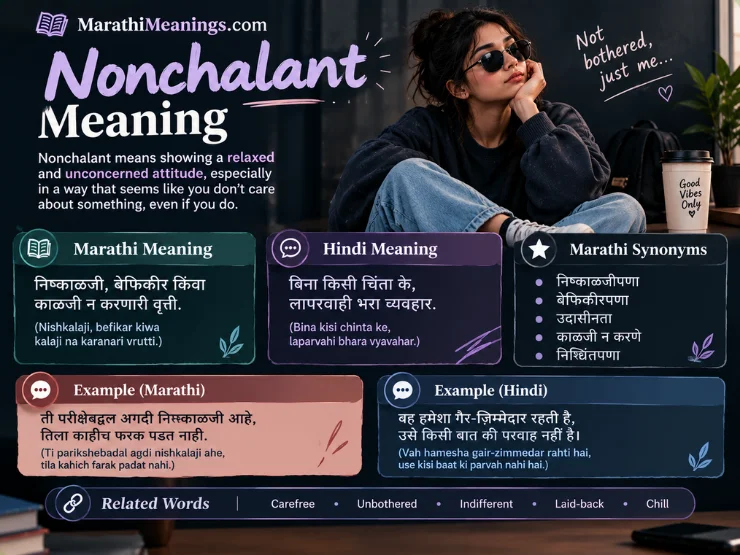
Nonchalant means appearing calm, relaxed, and unconcerned, even when a situation might make other people nervous, worried, or excited.
Nonchalant Meaning in Marathi: बेफिकीर, निर्विकार, निश्चिंत किंवा काळजी नसल्यासारखा वागणारा.
Roman Marathi: Befikir, nirvikar, nishchint.
Nonchalant Meaning in Hindi: बेफिक्र, निश्चिंत, निर्विकार।
The word is used to describe someone’s attitude, expression, reaction, or behavior. Depending on the context, it can suggest confidence and composure or make someone appear uninterested.
Quick Overview: Nonchalant Meaning
| Feature | Details |
|---|---|
| Word | Nonchalant |
| Part of Speech | Adjective |
| Pronunciation | non-shuh-LAHNT |
| IPA | /ˌnɒn.ʃəˈlɑːnt/ |
| Marathi Meaning | बेफिकीर, निर्विकार, निश्चिंत |
| Roman Marathi | Befikir, nirvikar, nishchint |
| Hindi Meaning | बेफिक्र, निश्चिंत, निर्विकार |
| Related Noun | Nonchalance |
| Related Adverb | Nonchalantly |
| Synonyms | Calm, composed, unconcerned, casual |
| Antonyms | Anxious, nervous, worried, concerned |
What Is Nonchalant? English Definition
Nonchalant is an adjective that describes a person who appears relaxed and unconcerned about something. A nonchalant person usually does not show much visible worry, nervousness, excitement, or emotional reaction.
For example, a student who enters an examination hall calmly may appear nonchalant. Similarly, someone who receives unexpected news without showing much emotion may be described as nonchalant.
However, appearing nonchalant does not necessarily mean that someone has no feelings or concerns. A person might be nervous internally but choose to maintain a calm expression.
The Nonchalant Meaning therefore depends on what the person is doing and how others interpret that behavior.
Nonchalant Meaning in Marathi
The Marathi meaning of nonchalant varies according to the situation. The following words and expressions communicate its main shades of meaning.
| Marathi Meaning | Explanation |
|---|---|
| बेफिकीर | एखाद्या गोष्टीची फारशी काळजी नसल्यासारखा |
| निर्विकार | चेहऱ्यावर किंवा वागण्यात विशेष भाव न दाखवणारा |
| निश्चिंत | काळजी किंवा चिंता नसलेला |
| शांत | घाबरून किंवा अस्वस्थ होऊन प्रतिक्रिया न देणारा |
| सहजपणे वागणारा | एखाद्या परिस्थितीत तणाव न दाखवता वागणारा |
| काळजी नसल्यासारखा | एखादी गोष्ट महत्त्वाची वाटत नसल्याप्रमाणे वागणारा |
These Marathi equivalents are not identical.
- बेफिकीर may suggest that someone does not care enough about a situation.
- निर्विकार emphasizes the absence of a visible emotional reaction.
- निश्चिंत emphasizes being free from worry.
- शांत describes calmness and may not imply indifference.
For example, a person who remains calm during a difficult interview can be described as शांत. If that person shows no visible reaction to surprising news, निर्विकार may be more appropriate.
Examples of Nonchalant Meaning in Marathi
Example 1
English: He gave a nonchalant answer to the unexpected question.
Marathi: त्याने अनपेक्षित प्रश्नाचे उत्तर सहजपणे आणि निर्विकारपणे दिले.
Example 2
English: She looked nonchalant before the important examination.
Marathi: महत्त्वाच्या परीक्षेपूर्वी ती शांत आणि निश्चिंत दिसत होती.
Example 3
English: His nonchalant attitude made his parents worried.
Marathi: त्याच्या बेफिकीर वृत्तीमुळे त्याच्या आई-वडिलांना काळजी वाटली.
Pronunciation and Grammar
How to Pronounce Nonchalant
Nonchalant is pronounced approximately as non-shuh-LAHNT, with the main stress on the final syllable.
It has three syllables:
- Non
- Shuh
- Lahnt
The final syllable receives the strongest stress. The exact vowel sounds can vary slightly between English accents.
Part of Speech
Nonchalant is an adjective. It describes a noun or pronoun, especially a person’s attitude, behavior, expression, or reaction.
Common sentence patterns include:
- Subject + be + nonchalant: He is nonchalant.
- Subject + seem/look + nonchalant: She looks nonchalant.
- Nonchalant + noun: A nonchalant response.
- Remain + nonchalant: They remained nonchalant.
Examples:
English: The manager remained nonchalant during the difficult meeting.
Marathi: कठीण बैठकीदरम्यान व्यवस्थापक शांत आणि स्थिर राहिला.
English: Her nonchalant expression surprised everyone.
Marathi: तिच्या निर्विकार चेहऱ्यावरील भावांनी सर्वांना आश्चर्य वाटले.
Nonchalant Meaning in Different Contexts
The word can communicate calmness, emotional distance, or apparent indifference. Understanding the context helps you select the correct Marathi translation.
1. Nonchalant Meaning in Attitude
When used to describe an attitude, nonchalant means behaving as though something does not cause much concern.
This may be positive when a person remains composed under pressure. It may be negative when someone seems careless about a responsibility.
English: Despite receiving criticism, Rohan maintained a nonchalant attitude.
Marathi: टीका होऊनही रोहनने बेफिकीर वृत्ती कायम ठेवली.
2. Nonchalant Meaning in a Relationship
In relationships, nonchalant describes someone who appears emotionally distant, casual, or unconcerned about a situation involving their partner.
It does not automatically mean that the person lacks love or affection. Their behavior might reflect discomfort with expressing emotions, uncertainty, or genuine disinterest.
English: He acted nonchalant when his partner asked him about their future.
Marathi: जोडीदाराने त्यांच्या भविष्याबद्दल विचारले तेव्हा तो बेफिकीरपणे वागला.
In this context, the word can suggest that a person is not showing the emotional involvement another person expects.
3. Nonchalant Meaning in Chat
In online conversations, nonchalant describes a casual response that shows little visible excitement, worry, or emotional involvement.
For instance, someone might receive a lengthy message and reply with a short, matter-of-fact answer. The response could appear nonchalant, depending on the relationship and conversation.
English: She gave a nonchalant reply to his heartfelt message.
Marathi: त्याच्या मनापासून लिहिलेल्या संदेशाला तिने सहज आणि विशेष भावनिक प्रतिक्रिया न देता उत्तर दिले.
A short message alone does not prove that someone is uninterested. The relationship, tone, and circumstances all influence its interpretation.
4. Nonchalant Meaning on Instagram
On Instagram, the word is used informally to describe someone who appears effortlessly relaxed, emotionally unaffected, or unconcerned with other people’s opinions.
It may describe a person’s expression in a photograph, a casual caption, or an apparently effortless response to attention.
English: Her nonchalant style makes her photographs look natural.
Marathi: तिच्या सहज आणि बेफिकीर शैलीमुळे तिची छायाचित्रे नैसर्गिक दिसतात.
Here, nonchalant is an ordinary English adjective used in a social media context, not a special Instagram feature or technical term.
5. Nonchalant Meaning in Professional Situations
At work, nonchalant may describe a person who stays calm during a meeting, interview, negotiation, or presentation.
Such behavior can communicate composure. However, appearing unconcerned about a serious workplace issue may give the impression that the person is not taking it seriously.
English: The candidate remained nonchalant throughout the job interview.
Marathi: नोकरीच्या मुलाखतीदरम्यान उमेदवार शांत आणि निश्चिंत राहिला.
6. Nonchalant Meaning in Everyday Conversation
In daily communication, the word often describes a casual reaction to an event that others consider surprising or important.
English: Everyone celebrated the victory, but he remained nonchalant.
Marathi: सर्वजण विजयाचा आनंद साजरा करत होते, पण तो मात्र निर्विकार राहिला.
This sentence emphasizes the contrast between other people’s excitement and his lack of visible reaction.
Word Forms of Nonchalant
Nonchalant has related noun and adverb forms. Each serves a different grammatical purpose.
| Word | Part of Speech | Marathi Meaning |
|---|---|---|
| Nonchalant | Adjective | बेफिकीर, निर्विकार |
| Nonchalance | Noun | बेफिकिरी, निर्विकारपणा |
| Nonchalantly | Adverb | बेफिकीरपणे, निर्विकारपणे |
Nonchalant
Use this form to describe a person, attitude, or expression.
English: She gave a nonchalant smile.
Marathi: तिने सहज आणि निर्विकार भाव असलेले स्मित केले.
Nonchalance
Use this noun when referring to the quality or manner of appearing unconcerned.
English: His nonchalance during the discussion annoyed his colleagues.
Marathi: चर्चेदरम्यान त्याच्या बेफिकीरपणामुळे त्याचे सहकारी नाराज झाले.
Nonchalantly
Use this adverb to explain how someone performs an action.
English: He nonchalantly walked out of the room.
Marathi: तो सहजपणे आणि कोणतीही विशेष प्रतिक्रिया न देता खोलीबाहेर गेला.
Nonchalant does not have regular comparative and superlative forms that are generally needed in everyday usage. Expressions such as more nonchalant and most nonchalant are possible when comparing degrees of apparent unconcern.
Nonchalant Synonyms With Marathi Meanings
Synonyms are words with similar meanings, but the best choice depends on the intended meaning.
| Synonym | Marathi Meaning | Appropriate Use |
|---|---|---|
| Calm | शांत | Not agitated or upset |
| Composed | संयमी, स्थिरचित्त | Controlling one’s reactions |
| Relaxed | निवांत | Free from tension |
| Casual | सहज, अनौपचारिक | Informal or unconstrained behavior |
| Unconcerned | काळजी नसलेला | Showing little worry |
| Unruffled | विचलित न झालेला | Remaining calm despite disturbance |
| Unperturbed | विचलित न झालेला | Not visibly affected by an event |
| Indifferent | उदासीन | Showing little interest or concern |
| Cool | शांत, स्थिर | Informally describing composure |
Important distinction: Indifferent is often more negative than nonchalant. Someone can appear nonchalant while caring deeply about an outcome. Indifference more directly suggests a lack of interest, preference, or concern.
Nonchalant Opposite: Antonyms
Antonyms are words that express contrasting meanings.
| Antonym | Marathi Meaning | Usage |
|---|---|---|
| Anxious | चिंताग्रस्त | Feeling worry or uneasiness |
| Nervous | घाबरलेला, अस्वस्थ | Feeling tense or apprehensive |
| Worried | काळजीत असलेला | Concerned about a problem |
| Concerned | काळजी करणारा | Showing care or interest |
| Agitated | अस्वस्थ, उत्तेजित | Emotionally disturbed |
| Disturbed | विचलित | Emotionally unsettled |
| Attentive | लक्ष देणारा | Giving attention to something |
English: While Meera looked nonchalant, her brother was visibly nervous.
Marathi: मीरा शांत दिसत असताना तिचा भाऊ मात्र स्पष्टपणे घाबरलेला होता.
The antonym should match the intended contrast. Anxious contrasts with calmness, while concerned contrasts more directly with a lack of concern.
Nonchalant vs Similar Words
Some English words are close in meaning but cannot always replace nonchalant.
| Word | Marathi Meaning | Main Difference |
|---|---|---|
| Nonchalant | बेफिकीर, निर्विकार | Appearing relaxed or unconcerned |
| Careless | निष्काळजी | Failing to take proper care |
| Confident | आत्मविश्वास असलेला | Believing in one’s abilities |
| Indifferent | उदासीन | Showing little interest or concern |
| Calm | शांत | Not showing agitation |
| Casual | सहज, अनौपचारिक | Relaxed or not formal |
Nonchalant vs Careless
Nonchalant describes an attitude or appearance. Careless describes a lack of proper attention or caution.
English: The driver remained nonchalant while waiting for the inspection.
Marathi: तपासणीची वाट पाहताना चालक शांत राहिला.
English: The careless driver ignored the warning sign.
Marathi: निष्काळजी चालकाने इशाऱ्याच्या फलकाकडे दुर्लक्ष केले.
The first sentence describes an attitude; the second identifies irresponsible behavior.
Nonchalant vs Confident
Confidence concerns belief in oneself or one’s abilities. Nonchalant concerns how unconcerned or relaxed someone appears.
English: She was confident about her presentation but appeared nonchalant while answering questions.
Marathi: तिला स्वतःच्या सादरीकरणाबद्दल आत्मविश्वास होता, पण प्रश्नांची उत्तरे देताना ती सहज आणि निर्विकार दिसत होती.
Nonchalant vs Indifferent
Nonchalant may describe someone who hides their emotions or remains composed. Indifferent more directly suggests that the person does not care much about the matter.
English: He seemed nonchalant about the result, although he had prepared for weeks.
Marathi: त्याने अनेक आठवडे तयारी केली होती, तरी निकालाबद्दल तो काळजी नसल्यासारखा दिसत होता.
Nonchalant vs Calm
Calm simply means peaceful or not agitated. Nonchalant adds the sense that someone appears unconcerned.
English: The teacher remained calm while explaining the difficult lesson.
Marathi: कठीण धडा समजावताना शिक्षक शांत राहिले.
Use calm when you mean peaceful behavior. Use nonchalant when the apparent lack of concern is also important.
Common Expressions With Nonchalant
These phrases are useful in everyday speech and writing.
Nonchalant Attitude
A relaxed or apparently unconcerned way of behaving.
English: His nonchalant attitude toward deadlines frustrated the team.
Marathi: अंतिम मुदतींबद्दलच्या त्याच्या बेफिकीर वृत्तीमुळे संघातील सदस्य त्रस्त झाले.
Nonchalant Smile
A casual smile that does not reveal strong emotion.
English: He offered a nonchalant smile and returned to his work.
Marathi: त्याने सहजपणे स्मित केले आणि पुन्हा कामाला सुरुवात केली.
Act Nonchalant
To behave as though something does not worry or affect you.
English: She tried to act nonchalant when her name was announced.
Marathi: तिचे नाव जाहीर झाले तेव्हा तिने काहीच विशेष फरक पडला नाही अशा पद्धतीने वागण्याचा प्रयत्न केला.
Nonchalant Response
An answer that appears casual or unconcerned.
English: His nonchalant response did not satisfy the concerned customers.
Marathi: त्याच्या बेफिकीर उत्तरामुळे काळजीत असलेल्या ग्राहकांचे समाधान झाले नाही.
With Nonchalance
In a relaxed or unconcerned manner.
English: She handled the unexpected change with nonchalance.
Marathi: तिने अनपेक्षित बदल शांतपणे आणि सहजतेने हाताळला.
These expressions can be used in casual conversation, storytelling, workplace discussions, and general writing. In formal communication, choose the word carefully so that calmness is not mistaken for a lack of responsibility.
Common Mistakes When Using Nonchalant
1. Assuming It Always Means Careless
Nonchalant does not automatically mean irresponsible. Someone may remain composed while still taking a situation seriously.
2. Assuming a Person Has No Feelings
The word describes visible behavior or an apparent attitude. It cannot establish whether someone genuinely feels worried, happy, or disappointed.
3. Using Nonchalant as a Noun
Nonchalant is an adjective. Use nonchalance when a noun is needed.
- Correct: His nonchalant manner surprised me.
- Correct: His nonchalance surprised me.
- Incorrect: His nonchalant surprised me.
4. Confusing Calmness With Indifference
A calm person can be deeply concerned. An indifferent person may lack interest in the matter itself. Consider the surrounding sentence before choosing a Marathi translation.
5. Assuming It Is Always a Compliment
Calling someone nonchalant can be positive when describing composure, but negative when their behavior seems dismissive. The context and tone determine the implication.
Conclusion
Nonchalant Meaning in Marathi is expressed through words such as बेफिकीर, निर्विकार, and निश्चिंत. The word describes someone who appears relaxed or unconcerned in a situation that might otherwise cause worry or excitement.
Its exact meaning depends on the context. It can communicate composure and confidence, or it can suggest indifference when a person seems not to care about something important. Choosing the right Marathi equivalent makes the meaning clearer in everyday conversations, relationships, professional situations, and social media posts.
? FAQs About Nonchalant Meaning
1. What is the Nonchalant Meaning in Marathi?
Nonchalant means बेफिकीर, निर्विकार, or निश्चिंत in Marathi. The correct translation depends on whether the sentence describes calmness, freedom from worry, or apparent indifference.
2. What does nonchalant mean in simple English?
It means appearing calm, relaxed, or unconcerned, especially when others might expect a stronger emotional reaction.
3. What is the Nonchalant Meaning in Hindi with an example?
Nonchalant means बेफिक्र, निश्चिंत, or निर्विकार.
English: He remained nonchalant during the argument.
Hindi: बहस के दौरान भी वह बेफिक्र रहा।
4. What does nonchalant mean in a relationship?
It describes a person who appears casual or emotionally unconcerned about a relationship or a particular issue. It does not necessarily mean that the person has no feelings.
5. Is nonchalant positive or negative?
It can be either. It may describe someone who stays composed under pressure or someone who appears not to care about an important issue.
6. What are the synonyms of nonchalant?
Common synonyms include calm, composed, relaxed, casual, unconcerned, and unruffled. Indifferent may also fit when a lack of interest is intended.
7. What is the opposite of nonchalant?
Common antonyms include anxious, nervous, worried, concerned, and agitated. Their Marathi equivalents include चिंताग्रस्त, घाबरलेला, काळजीत असलेला, and अस्वस्थ.
8. What is the difference between nonchalant and nonchalance?
Nonchalant is an adjective describing a person or behavior. Nonchalance is a noun describing the quality or state of appearing unconcerned.
📚 Also Read These Word Meanings to Build a Stronger English-Marathi Vocabulary :
- Carpediem Meaning In Marathi
- Narcissist Meaning In Marathi
- Pookie Meaning In Marathi
- Audacity Meaning In Marathi
- Manifestation Meaning In Marathi
- Consent Meaning In Marathi
- Nephew Meaning In Marathi
- Harmony Meaning In Marathi
- Overwhelmed Meaning in Marathi
- Migraine Meaning in Marathi
- Antonyms Meaning In Marathi
- Pcod Full Form In Marathi
- Prosperity Meaning in Marathi
- Aura Meaning In Marathi
- Bloating Meaning In Marathi
- Soulmate Meaning In Marathi
- Dignity Meaning in Marathi
- Precious Meaning in Marathi
- Possessive Meaning in Marathi
- Body Count Meaning in Marathi
- Fetched Meaning In Marathi
- Desire Meaning In Marathi
- Virtual Meaning In Marathi
- Committed Meaning In Marathi
- Loyal Meaning In Marathi
- Annoying Meaning in Marathi
- Algorithm Meaning In Marathi
- Clumsy Meaning In Marathi
- Dysentery Meaning In Marathi
- Lesbian Meaning In Marathi
- Devastated Meaning In Marathi
- Vibes Meaning In Marathi
- Felicitation Meaning In Marathi
- Occupation Meaning in Marathi