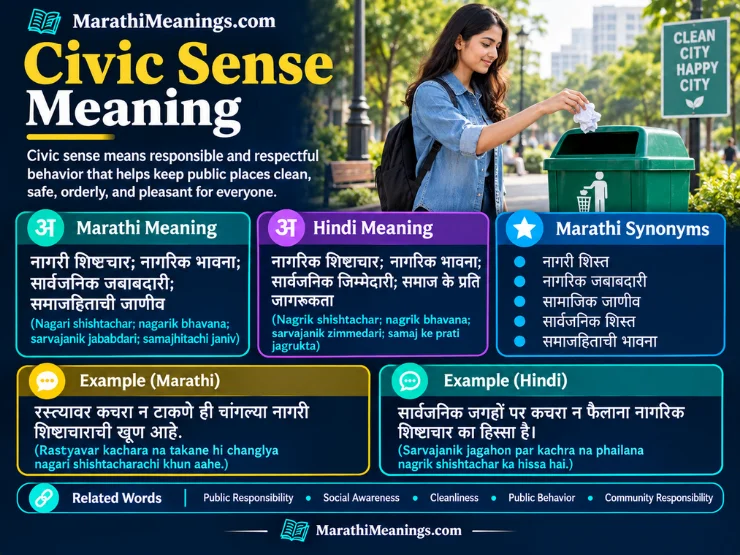
Civic sense means the awareness of how a person’s behavior affects other people, public places, and the community, along with the habit of behaving responsibly in shared spaces.
The Civic Sense Meaning In Marathi can be expressed as नागरी शिस्त, नागरिकत्वाची जाणीव, सामाजिक जबाबदारीची जाणीव, or सार्वजनिक ठिकाणी जबाबदारीने वागण्याची जाणीव.
Roman Marathi: Nagari shist, nagariktvachi janiv, samajik jababdari chi janiv, sarvajanik thikani jababdari ne vagnyachi janiv
In simple Marathi, सार्वजनिक ठिकाणी इतरांचा विचार करून शिस्तीने आणि जबाबदारीने वागणे म्हणजे नागरी शिस्त किंवा civic sense.
Hindi Meaning: नागरिक भावना, नागरिक जिम्मेदारी की भावना, नागरिक शिष्टाचार
For example, throwing waste into a dustbin, following traffic rules, waiting for your turn in a queue, and protecting public property are all connected with civic sense.
Quick Overview: Civic Sense Meaning
| Feature | Details |
|---|---|
| Phrase | Civic Sense |
| Part of Speech | Noun phrase |
| Pronunciation | SIV-ik sens |
| Marathi Meaning | नागरी शिस्त / नागरिकत्वाची जाणीव |
| Roman Marathi | Nagari shist / Nagariktvachi janiv |
| Hindi Meaning | नागरिक भावना / नागरिक जिम्मेदारी की भावना |
| Simple Meaning | Public and responsible behavior toward others and shared spaces |
| Related Terms | Civic responsibility, civic awareness, public responsibility |
| Opposite Idea | Lack of civic sense / नागरी शिस्तीचा अभाव |
What Is Civic Sense?
Civic sense is the understanding that people share public spaces and resources with others, so their behavior should take other people’s needs and rights into account.
It is not limited to one particular action. It can include cleanliness, traffic discipline, public manners, respect for shared property, responsible use of public facilities, and consideration for people around us.
A simple way to understand what is civic sense is:
Civic sense is the habit of behaving responsibly, respectfully, and considerately in public and community life.
For instance, a person may have a personal preference about where to throw a piece of paper, but in a public place, using the available dustbin is responsible behavior because the space belongs to or is shared by the wider community.
Civic sense therefore connects individual behavior with community well-being.
Civic Sense Pronunciation and Grammar
Pronunciation
Civic sense: SIV-ik sens
The phrase is pronounced as two words: civic + sense.
Part of Speech
Civic sense is a noun phrase.
- Civic is an adjective.
- Sense is a noun.
The adjective civic relates to citizens, communities, or public life. In this phrase, sense refers to awareness or understanding.
Related Expressions
Some closely related expressions include:
- Civic responsibility
- Civic awareness
- Civic duty
- Civic behavior
- Civic engagement
- Civic-minded
- Public responsibility
- Social responsibility
These expressions have related meanings but should be used according to their specific context.
Civic Sense Meaning In Marathi
There is no single Marathi word that perfectly covers every meaning of the English phrase civic sense. The most suitable expression depends on the context.
1. नागरी शिस्त
Roman Marathi: Nagari shist
This refers to disciplined and appropriate behavior in public places and civic life.
English: Following public rules shows civic sense.
Marathi: सार्वजनिक नियमांचे पालन करणे ही नागरी शिस्त दर्शवते.
2. नागरिकत्वाची जाणीव
Roman Marathi: Nagariktvachi janiv
This focuses on a person’s awareness of their responsibilities as a member of society.
English: Civic sense makes people aware of their responsibilities toward the community.
Marathi: नागरिकत्वाची जाणीव लोकांना समाजाप्रती असलेल्या त्यांच्या जबाबदाऱ्यांची जाणीव करून देते.
3. सामाजिक जबाबदारीची जाणीव
Roman Marathi: Samajik jababdari chi janiv
This expression is useful when civic sense is being discussed in relation to responsibility toward other people.
English: Respecting shared facilities reflects social responsibility.
Marathi: सामायिक सुविधांचा योग्य वापर करणे ही सामाजिक जबाबदारीची जाणीव दर्शवते.
4. सार्वजनिक ठिकाणी जबाबदारीने वागण्याची जाणीव
Roman Marathi: Sarvajanik thikani jababdari ne vagnyachi janiv
English: Keeping the public park clean and respecting other visitors shows awareness of responsible behavior in public places.
Marathi: सार्वजनिक उद्यान स्वच्छ ठेवणे आणि इतर नागरिकांचा विचार करणे ही सार्वजनिक ठिकाणी जबाबदारीने वागण्याची जाणीव दर्शवते.
This is a longer explanation rather than a direct one-word translation. It is useful when explaining the concept in simple Marathi.
Simple Marathi Explanation of Civic Sense
Civic sense म्हणजे फक्त रस्त्यावर कचरा न टाकणे एवढेच नाही.
एखादी व्यक्ती सार्वजनिक ठिकाणी इतर लोकांचाही विचार करते, नियम पाळते, सार्वजनिक वस्तूंचे नुकसान करत नाही, आपली जबाबदारी ओळखते आणि सामायिक जागा योग्य पद्धतीने वापरते, तेव्हा त्या वर्तनात civic sense दिसून येतो.
सोप्या भाषेत:
“मी ज्या जागेचा किंवा सुविधेचा वापर करतो, त्याचा इतर लोकांवरही परिणाम होतो” ही जाणीव म्हणजे civic sense.
यामध्ये वैयक्तिक शिस्त आणि सामाजिक जबाबदारी या दोन्हींचा संबंध असतो.
Civic Sense in Different Situations
The Meaning Of Civic Sense becomes clearer when we look at the situations in which the phrase is commonly used.
1. Civic Sense and Cleanliness
Keeping public places clean is one important part of civic behavior. Roads, parks, railway stations, schools, hospitals, markets, and other shared places are used by many people.
Throwing waste carelessly can make these places unpleasant for others. Using a dustbin and disposing of waste appropriately demonstrates consideration for the shared environment.
English: She used the dustbin instead of leaving the plastic wrapper on the bench.
Marathi: तिने प्लास्टिकचे आवरण बाकावर न ठेवता कचरापेटीचा वापर केला.
Here, civic sense is connected with responsible use of a shared place.
2. Civic Sense and Traffic Rules
Roads are shared by drivers, passengers, cyclists, and pedestrians. Following traffic rules helps people use these spaces in an orderly manner.
Traffic signals, designated crossings, lane discipline, and other road rules are part of responsible public behavior.
English: The driver stopped at the red signal even though the road was empty.
Marathi: रस्ता रिकामा असूनही चालक लाल सिग्नलवर थांबला.
This demonstrates respect for traffic rules rather than simply acting according to personal convenience.
3. Civic Sense and Public Property
Public property is provided for community use. Benches, buses, streetlights, signs, public toilets, parks, and other facilities are examples of resources that people may share.
Damaging such property can inconvenience many other people.
English: The students made sure not to damage the seats in the public library.
Marathi: विद्यार्थ्यांनी सार्वजनिक वाचनालयातील आसनांचे नुकसान होणार नाही याची काळजी घेतली.
4. Civic Sense and Queues
Waiting for one’s turn is another everyday example. A queue allows people to receive a service in an organized manner.
English: Meera waited for her turn at the ticket counter instead of standing ahead of everyone.
Marathi: मीरा तिकीट खिडकीवर सर्वांच्या पुढे न जाता आपल्या क्रमाची वाट पाहत होती.
This behavior shows consideration for other people who are also waiting.
5. Civic Sense and Public Noise
People share residential and public environments. Excessive or unnecessary noise can disturb others.
Being mindful of the surroundings is therefore another aspect of civic behavior.
English: The residents lowered the music during the late hours so that nearby families could rest.
Marathi: जवळच्या कुटुंबांना विश्रांती घेता यावी म्हणून रहिवाशांनी रात्री उशिरा संगीताचा आवाज कमी केला.
6. Civic Sense and Public Transport
Public transport is shared by many passengers. Giving appropriate space, following boarding arrangements, and behaving respectfully can make the experience better for everyone.
English: The passenger moved inside the bus to leave room for people waiting at the stop.
Marathi: थांब्यावर वाट पाहणाऱ्या लोकांसाठी जागा मिळावी म्हणून प्रवासी बसच्या आत सरकला.
Examples of Civic Sense in Daily Life
Civic sense can be seen through many small actions. It is not something limited to government offices or formal civic activities.
| Situation | Example of Responsible Behavior |
|---|---|
| Waste disposal | Putting waste in an appropriate bin |
| Traffic | Following signals and road regulations |
| Queue | Waiting for one’s turn |
| Public property | Using shared facilities carefully |
| Public transport | Respecting fellow passengers |
| Noise | Avoiding unnecessary disturbance |
| Parking | Keeping entrances and access routes clear |
| Public spaces | Leaving shared areas reasonably clean |
| Water use | Avoiding unnecessary wastage |
| Community life | Considering the needs of other people |
These behaviors show that civic sense is largely about awareness, responsibility, and consideration.
Civic Sense in India
The phrase Civic Sense In India is often used in discussions about public behavior, cleanliness, traffic discipline, public infrastructure, waste disposal, and the responsible use of shared spaces.
In the Indian context, examples can include following road rules, keeping public areas clean, respecting queues, using public facilities carefully, and avoiding behavior that unnecessarily inconveniences other people.
However, civic sense should not be understood as only a cleanliness issue.
For example, a person may avoid littering but still block a public entrance, damage public property, or ignore a queue. These behaviors can also be inconsistent with responsible civic conduct.
Therefore, Civic Sense In India can be understood more broadly as responsible and considerate behavior in community and public life.
Zero Civic Sense Meaning In Marathi
Zero civic sense is an informal phrase used when someone wants to strongly criticize behavior that appears to show little or no consideration for public rules, shared spaces, or other people.
The Zero Civic Sense Meaning In Marathi can be expressed as:
- नागरी शिस्तीचा पूर्ण अभाव
- नागरिकत्वाच्या जाणीवेचा अभाव
- सार्वजनिक जबाबदारीची अजिबात जाणीव नसणे
- सार्वजनिक ठिकाणी जबाबदारीने न वागणे
Roman Marathi: Nagari shisticha purna abhav, nagariktvachya janivecha abhav, sarvajanik jababdari chi ajibat janiv nasne
English: Calling a person’s behavior “zero civic sense” means criticizing it as showing almost no consideration for responsible public conduct.
Marathi: सार्वजनिक जागेत इतरांना त्रास होईल अशा पद्धतीने वागणे हे नागरी शिस्तीचा अभाव दर्शवू शकते.
The expression is informal. It is not a formal legal or technical classification.
No Civic Sense Meaning
No civic sense has a similar meaning to zero civic sense. It is generally used when someone wants to say that a particular action shows a lack of responsible public behavior.
Marathi Meaning
- नागरी शिस्तीचा अभाव
- नागरिकत्वाच्या जाणीवेचा अभाव
- सार्वजनिक जबाबदारीची जाणीव नसणे
English: Leaving a public facility damaged after using it may be described as showing no civic sense.
Marathi: सार्वजनिक सुविधा वापरल्यानंतर तिचे नुकसान करून ठेवणे हे नागरी शिस्तीचा अभाव दर्शवू शकते.
The phrase usually describes behavior, rather than defining a person permanently.
Civic Sense and Civic Responsibility
Civic sense and civic responsibility are closely connected, but they are not exactly the same.
Civic sense focuses more on awareness, attitude, consideration, and appropriate behavior.
Civic responsibility focuses more directly on the responsibilities a person has toward the community.
For example, understanding that public property belongs to the wider community reflects civic awareness. Taking care not to damage that property is an example of responsible civic behavior.
Both concepts overlap in everyday language, but civic sense often emphasizes the mindset behind responsible conduct.
Civic Sense Synonyms and Related Words
There is no perfect single-word synonym for civic sense in every situation. The following expressions are related:
- Civic awareness
- Civic responsibility
- Public responsibility
- Social responsibility
- Civic-mindedness
- Public etiquette
- Community responsibility
- Responsible public behavior
- Consideration for others
Marathi Related Terms
- नागरी शिस्त
- नागरिकत्वाची जाणीव
- सामाजिक जबाबदारीची जाणीव
- सार्वजनिक जबाबदारी
- सामाजिक भान
- सार्वजनिक शिष्टाचार
These terms should not always be treated as exact synonyms. For example, सामाजिक जबाबदारी has a broader meaning than civic sense, while सार्वजनिक शिष्टाचार focuses more specifically on manners and behavior in public.
Antonym of Civic Sense
The opposite idea of civic sense can be expressed in English as:
- Lack of civic sense
- Civic irresponsibility
- Irresponsible public behavior
- Lack of civic awareness
- Disregard for shared spaces
In Marathi:
- नागरी शिस्तीचा अभाव
- नागरिकत्वाच्या जाणीवेचा अभाव
- सार्वजनिक जबाबदारीचा अभाव
- बेजबाबदार सार्वजनिक वर्तन
The exact opposite expression depends on the behavior being discussed.
Civic Sense Meaning in Hindi
The Civic Sense Meaning In Hindi can be expressed as:
- नागरिक भावना
- नागरिक जिम्मेदारी की भावना
- नागरिक शिष्टाचार
- सार्वजनिक जिम्मेदारी की समझ
Roman Hindi: Nagrik bhavna, nagrik zimmedari ki bhavna, nagrik shishtachar
English: Civic sense means awareness and responsible behavior toward society, other people, and public spaces.
Hindi: सार्वजनिक स्थानों और समाज के प्रति जिम्मेदारी से व्यवहार करने की समझ को नागरिक भावना या नागरिक जिम्मेदारी की भावना कहा जा सकता है।
Zero Civic Sense Meaning In Hindi
Zero civic sense can be expressed as:
नागरिक जिम्मेदारी की भावना का पूर्ण अभाव or नागरिक शिष्टाचार का पूरी तरह अभाव.
The exact wording may change depending on the context.
Civic Sense Meaning in Other Indian Languages
The phrase can be expressed through different natural terms depending on the language and context.
| Language | Meaning |
|---|---|
| Marathi | नागरी शिस्त / नागरिकत्वाची जाणीव |
| Hindi | नागरिक भावना / नागरिक जिम्मेदारी की भावना |
| Malayalam | പൗരബോധം / സാമൂഹിക ഉത്തരവാദിത്വബോധം |
| Tamil | குடிமை உணர்வு / சமூகப் பொறுப்புணர்வு |
| Telugu | పౌర స్పృహ / సామాజిక బాధ్యతా భావం |
| Gujarati | નાગરિક ભાવના / નાગરિક જવાબદારીની ભાવના |
| English | Responsible awareness and behavior in public and community life |
These are contextual equivalents rather than claims that every language has one exact translation for the English phrase.
Common Mistakes About Civic Sense
Mistake 1: Thinking Civic Sense Means Only Cleanliness
Cleanliness is an important part of civic behavior, but it is not the entire meaning.
Traffic discipline, public manners, protecting shared property, respecting queues, and considering other people are also related to civic sense.
Mistake 2: Treating Civic Sense as a Legal Term
The phrase is commonly used in everyday discussion to describe responsible public behavior. Not every action described as a lack of civic sense is necessarily a legal violation.
Mistake 3: Using Zero Civic Sense as a Formal Classification
Zero civic sense is an informal and emphatic expression. It is generally used to criticize a particular behavior.
Mistake 4: Assuming One Marathi Translation Works Everywhere
नागरी शिस्त may work well when discussing disciplined public conduct. नागरिकत्वाची जाणीव is more suitable when the emphasis is on awareness of citizenship and responsibility.
Mistake 5: Confusing Civic Sense With Social Responsibility
The concepts overlap, but social responsibility is broader. Civic sense is particularly associated with responsible conduct in public and community settings.
Why Civic Sense Is Important
People constantly share roads, parks, transport systems, buildings, public services, and other spaces. Because these resources are shared, one person’s behavior can affect many others.
A person who uses public facilities carefully helps preserve them for other users. A person who respects queues reduces unnecessary conflict. A person who follows traffic rules contributes to orderly road use. A person who considers noise levels shows awareness of nearby people.
These examples illustrate an important idea behind civic sense:
Public spaces are shared, so responsible behavior should consider the people who share them.
Civic sense therefore connects personal behavior with the wider community.
It also begins with ordinary actions. A person does not need to participate in a large civic activity to demonstrate civic awareness. Everyday decisions can reflect the same principle.
How to Use “Civic Sense” in Sentences
Example 1
English: Good civic sense encourages people to respect shared public spaces.
Marathi: चांगली नागरी शिस्त लोकांना सामायिक सार्वजनिक जागांचा आदर करण्यास प्रवृत्त करते.
Example 2
English: The residents worked together to keep their community area orderly.
Marathi: परिसरातील जागा व्यवस्थित ठेवण्यासाठी रहिवाशांनी एकत्रितपणे काम केले.
Example 3
English: Students were taught to treat public facilities with care.
Marathi: विद्यार्थ्यांना सार्वजनिक सुविधांचा काळजीपूर्वक वापर करण्यास शिकवले गेले.
Example 4
English: Respecting pedestrians is an important aspect of responsible road behavior.
Marathi: पादचाऱ्यांचा आदर करणे हे जबाबदार रस्ते-वर्तनाचे महत्त्वाचे अंग आहे.
Example 5
English: She reminded everyone to leave the community hall clean after the event.
Marathi: कार्यक्रमानंतर सामुदायिक सभागृह स्वच्छ ठेवण्याची तिने सर्वांना आठवण करून दिली.
Each example illustrates a different aspect of civic behavior without repeating the same situation.
Conclusion
Civic Sense Meaning In Marathi can be understood through expressions such as नागरी शिस्त, नागरिकत्वाची जाणीव, and सामाजिक जबाबदारीची जाणीव. The best expression depends on the context in which the phrase is used.
In simple terms, civic sense means behaving responsibly and respectfully in public and community life while considering how one’s actions affect other people and shared spaces.
It includes more than cleanliness. Following traffic rules, respecting queues, protecting public property, using shared facilities carefully, avoiding unnecessary disturbance, and considering the needs of others are all connected with civic behavior.
Similarly, zero civic sense and no civic sense are informal expressions used to describe behavior that appears to show a lack of such awareness or responsibility. Understanding these contextual differences makes the Meaning Of Civic Sense clearer in both English and Marathi.
? FAQs About Civic Sense Meaning
1. What is Civic Sense?
Civic sense means being aware of one’s effect on other people and behaving responsibly in public and community settings.
2. What is Civic Sense Meaning In Marathi?
The Civic Sense Meaning In Marathi includes नागरी शिस्त, नागरिकत्वाची जाणीव, and सामाजिक जबाबदारीची जाणीव. The appropriate expression depends on the context.
3. What is the simple meaning of civic sense?
In simple English, civic sense means behaving responsibly and respectfully in shared public spaces while considering other people.
4. What is Zero Civic Sense Meaning In Marathi?
It means नागरी शिस्तीचा पूर्ण अभाव or सार्वजनिक जबाबदारीची अजिबात जाणीव नसणे. It is an informal expression used to criticize irresponsible public behavior.
5. What is No Civic Sense Meaning?
No civic sense means that a person’s behavior shows little or no consideration for responsible public conduct, shared spaces, or other people.
6. What is Civic Sense Meaning in Hindi?
It can be expressed as नागरिक भावना, नागरिक जिम्मेदारी की भावना, or नागरिक शिष्टाचार, depending on the context.
7. Is civic sense the same as civic responsibility?
They are closely related but not identical. Civic sense emphasizes awareness and considerate behavior, while civic responsibility focuses more directly on responsibilities toward the community.
8. What are some examples of civic sense?
Using public facilities carefully, disposing of waste appropriately, following traffic rules, waiting for one’s turn, respecting shared spaces, and considering other people are examples of civic sense.
 Also Read These Word Meanings to Build a Stronger English-Marathi Vocabulary :
- Carpediem Meaning In Marathi
- Narcissist Meaning In Marathi
- Pookie Meaning In Marathi
- Audacity Meaning In Marathi
- Manifestation Meaning In Marathi
- Consent Meaning In Marathi
- Nephew Meaning In Marathi
- Harmony Meaning In Marathi
- Overwhelmed Meaning in Marathi
- Migraine Meaning in Marathi
- Antonyms Meaning In Marathi
- Pcod Full Form In Marathi
- Prosperity Meaning in Marathi
- Aura Meaning In Marathi
- Bloating Meaning In Marathi
- Soulmate Meaning In Marathi
- Dignity Meaning in Marathi
- Precious Meaning in Marathi
- Possessive Meaning in Marathi
- Body Count Meaning in Marathi
- Fetched Meaning In Marathi
- Desire Meaning In Marathi
- Virtual Meaning In Marathi
- Committed Meaning In Marathi
- Annoying Meaning in Marathi