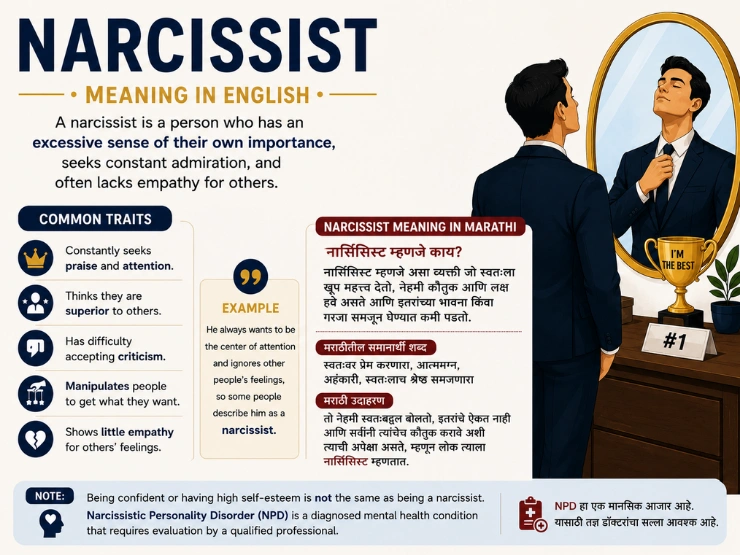
Quick Summary:
Narcissist meaning in Marathi: स्वत:प्रेमी / आत्मकेंद्रित व्यक्ती / अहंकारी माणूस (Swatahpremi / Atmakendrit Vyakti / Ahamkari Manus)
In simple words, a narcissist is a person who is excessively obsessed with themselves (their looks, achievements, and importance) while showing little or no genuine concern for others. In Marathi, we call such a person “स्वत:प्रेमी” or “मी-मी करणारा”. In Hindi, the term “आत्ममुग्ध व्यक्ति” (Atmamugdha Vyakti) is widely used.
Introduction
Have you ever met someone who constantly talks about themselves, craves attention from everyone around them, and never seems to care about anyone else’s feelings? Chances are, you may have encountered a narcissist.
The word narcissist is one of the most searched psychological and behavioral terms on the internet today, and for good reason. It touches on relationships, family dynamics, workplaces, and even social media culture. For Marathi and Hindi speakers, understanding the narcissist meaning in Marathi can help make sense of toxic relationships, difficult family members, or confusing coworkers.
This article gives you a complete, accurate, and practical understanding of the term in English, Marathi, and Hindi, with real-life examples, types, synonyms, and frequently asked questions.
Narcissist Meaning in English
A narcissist (noun) is a person who has an inflated sense of their own importance, a deep need for admiration, and a lack of empathy for others. The term comes from Narcissistic Personality Disorder (NPD), a recognized psychological condition, but in everyday language, “narcissist” is used more broadly to describe anyone who displays self-centered, arrogant, or attention-seeking behavior.
Narcissist meaning in simple words: A person who loves themselves too much and treats others poorly because of it.
Part of Speech: Noun (adjective form: narcissistic)
Key Traits of a Narcissist
| Trait | Description |
|---|---|
| Grandiosity | Believes they are superior to others |
| Lack of empathy | Cannot or does not feel others’ pain |
| Entitlement | Expects special treatment always |
| Attention-seeking | Constantly craves admiration and validation |
| Manipulation | Uses others to meet their own needs |
| Arrogance | Looks down on people they consider inferior |
Narcissist Meaning in Marathi (मराठी अर्थ)
Narcissist meaning in Marathi: स्वत:प्रेमी व्यक्ती / आत्मकेंद्रित माणूस / अहंकारी व्यक्ती
| Marathi (Devanagari) | Roman Transliteration | Meaning |
|---|---|---|
| स्वत:प्रेमी | Swatahpremi | One who loves only themselves |
| आत्मकेंद्रित | Atmakendrit | Self-centered person |
| अहंकारी | Ahamkari | Arrogant / Ego-driven |
| मी-मी करणारा | Mi-Mi Karanara | One who only talks about “I, I, I” |
| स्वार्थी | Svarthi | Selfish person |
| नार्सिसिस्ट | Narsisist | Direct transliteration used in modern Marathi |
मराठीत सोप्या शब्दात सांगायचं तर: नार्सिसिस्ट म्हणजे अशी व्यक्ती जी नेहमी स्वतःबद्दलच विचार करते, इतरांची काळजी करत नाही आणि सगळ्यांकडून कौतुक आणि प्रशंसा मिळवण्यासाठी सतत प्रयत्न करते.
(Marathi mein sopya sabdat samgayacam tar: Narsisist mhanje asi vyakti ji nehemi swatahbaddalaca vicar karate, itaramci kalaji karat nahi ani sagalyamkadun kautuka ani prasamsa milavanyasathi satat prayatn karate.)
Narcissist Meaning in Hindi (हिंदी अर्थ)
Narcissist meaning in Hindi: आत्ममुग्ध व्यक्ति / आत्म-प्रेमी / अहंकारी इंसान
| Hindi (Devanagari) | Roman Transliteration | Meaning |
|---|---|---|
| आत्ममुग्ध | Atmamugdha | Infatuated with oneself |
| स्वार्थी | Svarthi | Selfish |
| अहंकारी | Ahamkari | Arrogant |
| आत्म-प्रेमी | Atma-Premi | Self-lover |
| घमंडी | Ghamamdi | Full of ego/pride |
| नार्सिसिस्ट | Narsisist | Direct loanword used in modern Hindi |
हिंदी में सरल शब्दों में: नार्सिसिस्ट वह इंसान होता है जो हमेशा खुद के बारे में सोचता है, दूसरों की परवाह नहीं करता और हर जगह तारीफ और ध्यान पाने की कोशिश करता है।
(Hindi mem saral sabdom mem: Narsisist vah insan hota hai jo hamesa khud ke bare mem socta hai, dusrom ki parwah nahim karta aur har jagah tarif aur dhyan pane ki koshis karta hai.)
Pronunciation Guide
| Language | Pronunciation | Easy Guide |
|---|---|---|
| English | /ˈnɑːr.sɪ.sɪst/ | NAR-si-sist |
| Marathi | नार-सि-सिस्ट | Nar-si-sist |
| Hindi | नार-सि-सिस्ट | Nar-si-sist |
The stress falls on the first syllable: NAR-si-sist.
Origin & Etymology
The word narcissist comes from the ancient Greek myth of Narcissus (Νάρκισσος), a beautiful young man who fell so deeply in love with his own reflection in a pool of water that he could not stop staring at it. According to the myth, he eventually wasted away and died there.
The Greek word narkissos is itself possibly derived from narke (νάρκη), meaning “numbness” or “sleep,” referring to the numbing, trance-like state Narcissus fell into upon seeing himself.
- The clinical term Narcissistic Personality Disorder (NPD) was formally introduced in the DSM-III (1980) by the American Psychiatric Association.
- The word narcissism entered English in the late 19th century through the work of psychologist Havelock Ellis, and later became central to Sigmund Freud’s psychoanalytic theory.
- The noun form narcissist emerged in widespread use in the 20th century.
Types of Narcissists (With Marathi & Hindi Explanations)
Understanding the different types helps decode real behavior patterns. Here are the main types:
1. Grandiose Narcissist (स्पष्ट अहंकारी / Spashta Ahamkari)
The most visible type: openly boastful, arrogant, and domineering. They believe they are special and deserve the best of everything.
Example in English: “He walked into every meeting expecting everyone to acknowledge his ideas first.”
मराठी: तो नेहमी सगळ्यांपेक्षा श्रेष्ठ असल्यासारखं वागतो आणि सतत स्वतःचं कौतुक करतो.
हिंदी: वह हमेशा खुद को सबसे बेहतर समझता है और हर जगह तारीफ चाहता है।
2. Covert Narcissist (छुपा नार्सिसिस्ट / Chupa Narsisist)
The covert narcissist is harder to identify. They appear shy, sensitive, or even humble on the outside, but internally hold the same entitled, self-absorbed beliefs. They play the victim frequently.
Covert narcissist meaning in Marathi: छुपा अहंकारी / Chupa Ahamkari: बाहेरून शांत पण आतून अहंकारी असणारी व्यक्ती.
हिंदी: बाहर से विनम्र दिखने वाला लेकिन अंदर से खुद को सबसे ऊपर मानने वाला इंसान।
3. Malignant Narcissist (घातक नार्सिसिस्ट / Ghatak Narsisist)
The most dangerous type. Combines narcissistic traits with antisocial behavior, aggression, and sometimes sadism. Can cause serious psychological and emotional harm to those around them.
4. Communal Narcissist (सामाजिक नार्सिसिस्ट / Samajik Narsisist)
They appear generous and helpful, but only to gain admiration and praise. Their “giving” is never truly selfless.
5. Vulnerable / Fragile Narcissist
Extremely sensitive to criticism, they react with rage, withdrawal, or tears when they feel their self-image is threatened.
Narcissist Personality Disorder (NPD): What Is It?
Narcissistic Personality Disorder (NPD) is a recognized mental health condition listed in the Diagnostic and Statistical Manual of Mental Disorders (DSM-5). It is not just “being selfish.” It is a deep-rooted pattern of thinking and behavior that causes significant problems in a person’s relationships and daily life.
Diagnostic traits (as per DSM-5) include:
- Grandiose sense of self-importance
- Preoccupation with fantasies of unlimited success or power
- Belief that one is “special” and can only be understood by other high-status people
- Need for excessive admiration
- Strong sense of entitlement
- Exploitation of others
- Lack of empathy
- Envy of others, or belief that others envy them
- Arrogant, haughty behavior
NPD Marathi Meaning: आत्ममुग्ध व्यक्तिमत्व विकार (Atmamugdha Vyaktimattva Vikar)
NPD Hindi Meaning: आत्ममुग्ध व्यक्तित्व विकार (Atmamugdha Vyaktitva Vikar)
It is important to note that not every narcissist has NPD. NPD is a clinical diagnosis made by a qualified mental health professional. The everyday use of “narcissist” refers more loosely to self-centered, egotistical behavior.
Narcissist in Relationships: What Does It Mean?
Narcissist meaning in a relationship refers to a partner who prioritizes their own needs, feelings, and desires entirely above their partner’s. They may display charm and love early on (a phase called “love bombing”), only to later become controlling, dismissive, or emotionally abusive.
Common Patterns in a Narcissistic Relationship:
| Phase | What Happens |
|---|---|
| Love Bombing | Overwhelming affection, compliments, gifts early on |
| Idealization | Making you feel perfect and special |
| Devaluation | Gradually criticizing, belittling, withdrawing |
| Discard | Abandoning or replacing the partner |
| Hoovering | Returning to draw you back in |
मराठी: नार्सिसिस्ट व्यक्ती नात्यात सुरुवातीला खूप प्रेम दाखवते, पण नंतर आपला जोडीदाराला हळूहळू कमी लेखायला सुरुवात करते.
हिंदी: नार्सिसिस्ट व्यक्ति रिश्ते में शुरू में बहुत प्यार दिखाते हैं, लेकिन बाद में साथी को भावनात्मक रूप से तोड़ने लगते हैं।
Narcissist Abuse: What Does It Mean?
Narcissist abuse (also called narcissistic abuse) refers to the pattern of emotional, psychological, and sometimes physical manipulation inflicted by a narcissist on those around them: partners, children, family members, or colleagues.
Common forms of narcissistic abuse include:
- Gaslighting: Making you question your own reality (“That never happened,” “You’re imagining things.”)
- Silent treatment: Withdrawing communication as punishment
- Triangulation: Bringing a third person into the dynamic to create jealousy or insecurity
- Emotional manipulation: Using guilt, shame, or fear to control behavior
- Smear campaigns: Spreading false information about you to others
Narcissist abuse meaning in Marathi: नार्सिसिस्टिक अत्याचार / Narsisistik Atyacar: एखाद्या स्वार्थी, अहंकारी व्यक्तीकडून भावनिक आणि मानसिक यातना सहन करणे.
हिंदी: नार्सिसिस्टिक दुर्व्यवहार: एक अहंकारी या आत्ममुग्ध व्यक्ति द्वारा भावनात्मक और मनोवैज्ञानिक रूप से पीड़ित करना।
Female Narcissist: What Makes It Different?
A female narcissist shares the core traits of narcissism but often expresses them differently than males due to social and cultural conditioning.
Female narcissist meaning in Marathi: स्त्री नार्सिसिस्ट / Stri Narsisist: स्वतःवर अतिप्रेम करणारी, इतरांचा वापर करणारी स्त्री.
Common behaviors unique to female narcissists:
- Using appearance and social status as tools of power
- Victimhood as manipulation (“I always suffer the most”)
- Passive-aggressive behavior and indirect aggression
- Intense jealousy disguised as concern
- Using children as extensions of their own ego
Narcissist Mother / Narcissist Parents: What It Means
A narcissist mother or narcissist parent is one who uses their child primarily to fulfill their own emotional needs, rather than nurturing the child’s development.
Narcissist mother meaning in Marathi: नार्सिसिस्ट आई / Narsisist Ai: आपल्या मुलाला स्वतःच्या अहंकाराची पूर्तता करण्यासाठी वापरणारी आई.
Narcissist parents meaning in Hindi: आत्ममुग्ध माता-पिता: जो बच्चे की भावनाओं की परवाह न करके अपनी ही ज़रूरतों को पूरा करने में लगे रहते हैं।
Signs of a narcissistic parent:
- The child’s achievements are “their” achievements
- Constant comparison with other children
- Conditional love: affection only when the child performs well
- Emotional unavailability
- Inability to respect the child’s boundaries
- Using guilt as a control mechanism
Narcissist Meaning in Other Indian Languages
| Language | Word / Phrase | Transliteration |
|---|---|---|
| Marathi | स्वत:प्रेमी / आत्मकेंद्रित | Swatahpremi / Atmakendrit |
| Hindi | आत्ममुग्ध व्यक्ति | Atmamugdha Vyakti |
| Tamil | சுயநலவாதி | Suyanalavati |
| Telugu | స్వార్థపరుడు / నార్సిసిస్ట్ | Svarthaparudu |
| Kannada | ಸ್ವಯಂ-ಪ್ರೇಮಿ | Svayam-Premi |
| Malayalam | സ്വയംഭോഗി / ആത്മരതി | Svayambhogi / Atmarati |
| Bengali | আত্মকেন্দ্রিক ব্যক্তি | Atmakendrik Byakti |
| Gujarati | આત્મ-પ્રેમી / અહંકારી | Atma-Premi / Ahamkari |
| Punjabi | ਆਪ-ਪ੍ਰੇਮੀ / ਹੰਕਾਰੀ | Ap-Premi / Hamkari |
Note on Farsi: In Farsi (Persian), narcissist is referred to as “خودشیفته” (Xodshifte), meaning one who is infatuated with themselves. The concept is well-recognized in Persian psychological literature.
Marathi Synonyms for Narcissist
| Marathi Synonym | Roman Transliteration | Meaning |
|---|---|---|
| स्वत:प्रेमी | Swatahpremi | Self-lover |
| अहंकारी | Ahamkari | Arrogant, egotistical |
| आत्मकेंद्रित | Atmakendrit | Self-centered |
| स्वार्थी | Svarthi | Selfish |
| मी-मी करणारा | Mi-Mi Karanara | One who always says “I, I, I” |
| घमेंडखोर | Ghamemdakhor | Full of pride/ego |
| स्वतःच कौतुक करणारा | Swatahca Kautuka Karanara | Self-praising person |
| इतरांना कमी लेखणारा | Itaramna Kami Lekhanara | One who belittles others |
Synonyms & Antonyms in English
English Synonyms:
- Self-absorbed
- Egotist
- Egomaniac
- Self-centered
- Vain
- Conceited
- Pompous
- Arrogant
- Self-important
English Antonyms:
- Empathetic
- Humble
- Selfless
- Altruistic
- Compassionate
- Modest
Real-Life Usage & Example Sentences
In English:
- “My ex was a complete narcissist; he never once asked how I was feeling.”
- “It’s hard to maintain a friendship with a narcissist because every conversation always comes back to them.”
- “Understanding the narcissist meaning helped me see why my manager’s behavior felt so toxic.”
In Marathi (मराठी उदाहरणे):
- “माझा माजी बॉस एक पक्का नार्सिसिस्ट होता, त्याला नेहमी फक्त स्वतःचीच चिंता असायची.” (Majha majhi bॉs ek pakka Narsisist hota, tyala nehemi phakata swatahcica cimta asayci.) Meaning: My former boss was a complete narcissist; he only ever worried about himself.
- “नार्सिसिस्ट व्यक्ती नात्यात नेहमी आपलाच विचार करते, जोडीदाराची भावना कधीच समजून घेत नाही.” (Narsisist vyakti natyat nehemi apalaca vicar karate, jodidaraci bhavana kadhica samajuna gheta nahi.) Meaning: A narcissist in a relationship always thinks about themselves and never understands their partner’s feelings.
- “स्वत:प्रेमी माणसाशी वाद घालण्यात वेळ वाया घालवू नका.” (Swatahpremi manasasi vad ghalanyat vela vaya ghalavu naka.) Meaning: Don’t waste time arguing with a self-centered person.
In Hindi (हिंदी उदाहरण):
- “उसके साथ रहना मुश्किल था क्योंकि वह एक नार्सिसिस्ट है, हर बात में वह खुद को सबसे ऊपर रखता है।” (Uske sath rahna muskil tha kyomki vah ek Narsisist hai, har bat mem vah khud ko sabse upar rakhta hai.) Meaning: It was difficult to live with him because he is a narcissist; he puts himself above everyone in everything.
- “एक आत्ममुग्ध इंसान कभी यह नहीं मानता कि वह गलत हो सकता है।” (Ek Atmamugdha insan kabhi yah nahim manata ki vah galat ho sakata hai.) Meaning: A narcissist never accepts that they can be wrong.
Narcissist Test: How to Identify One
A narcissist test is not a formal diagnosis tool, but a set of behavioral indicators mental health professionals and researchers use to screen for narcissistic traits. The most commonly referenced tool is the Narcissistic Personality Inventory (NPI), developed by Raskin and Hall (1979).
Key questions to reflect on:
- Does this person constantly dominate conversations by talking about themselves?
- Do they react with anger or contempt when criticized?
- Do they exploit others for personal gain without guilt?
- Do they lack genuine empathy, even when you’re clearly upset?
- Do they feel they deserve special treatment without earning it?
If many of these apply consistently to a person, narcissistic traits are likely present. A formal diagnosis of Narcissistic Personality Disorder requires evaluation by a licensed mental health professional.
मराठी: नार्सिसिस्ट व्यक्ती ओळखण्यासाठी पाहा, तो/ती नेहमी स्वतःबद्दलच बोलतो का? टीका सहन करत नाही का? दुसऱ्यांच्या भावनांकडे दुर्लक्ष करतो का?
हिंदी: नार्सिसिस्ट की पहचान करना हो तो देखें, क्या वह हमेशा खुद के बारे में बात करता है? आलोचना सहन नहीं कर पाता? दूसरों की परवाह नहीं करता?
Proud Narcissist: What Does This Mean?
A proud narcissist typically refers to someone who not only has narcissistic traits but openly embraces and flaunts them, someone who takes pride in being selfish, dominant, and “ruthless” in their own words. The term is used colloquially, not clinically.
Proud narcissist meaning in Marathi: उन्मत्त अहंकारी / Unmatta Ahamkari: स्वतःच्या अहंकाराचा उघडपणे अभिमान बाळगणारी व्यक्ती.
In common usage, “proud narcissist” may also describe someone who wears their confidence as a badge, often confusing self-confidence with narcissism, two very different things. Self-confidence is healthy and grounded; narcissism is fragile and built on the need for others’ validation.
Narcissism vs. Self-Confidence: The Key Difference
This is one of the most common confusions people have. Here is a clear side-by-side comparison:
| Self-Confidence | Narcissism |
|---|---|
| Secure in oneself | Needs external validation constantly |
| Can accept criticism gracefully | Reacts to criticism with rage or contempt |
| Genuinely happy for others’ success | Envious of others’ achievements |
| Has real empathy | Lacks empathy |
| Takes responsibility for mistakes | Never admits being wrong |
| Doesn’t need to put others down | Elevates self by diminishing others |
Cultural Context: How India Views Narcissism
In Indian cultural contexts, including Marathi-speaking Maharashtra, narcissistic behavior is often described using words like “अहंकारी” (egotistical), “घमेंडी” (pride-driven), or “स्वार्थी” (selfish). However, the clinical understanding of Narcissistic Personality Disorder is still relatively new in mainstream Indian discourse.
In many Indian families, a parent or elder who controls, dominates, or emotionally manipulates may be described as “traditional” or “strict” rather than as a narcissist. The growing awareness of narcissist meaning in Marathi and related terms is helping people, especially the younger generation, recognize and name these dynamics more accurately.
Social media has accelerated this awareness. Concepts like narcissist abuse, gaslighting, and covert narcissist have entered Indian popular culture through psychology content on YouTube, Instagram reels, and forums, often sought in local languages like Marathi, Hindi, Tamil, and Telugu.
Word Family & Related Terms
| Word | Meaning | Marathi | Hindi |
|---|---|---|---|
| Narcissism | The trait/behavior | आत्मप्रेम / अहंकार | आत्ममुग्धता |
| Narcissistic | Adjective form | नार्सिसिस्टिक / अहंकारी | आत्ममुग्ध |
| Narcissistically | Adverb form | अहंकाराने | अहंकार से |
| NPD | Narcissistic Personality Disorder | आत्ममुग्ध व्यक्तिमत्व विकार | आत्ममुग्ध व्यक्तित्व विकार |
| Narcissus | Greek mythological figure | नार्सिसस (ग्रीक पुराण) | नार्सिसस (यूनानी पौराणिक कथा) |
| Gaslighting | Manipulation tactic used by narcissists | गॅसलायटिंग (मानसिक फेरफार) | गैसलाइटिंग |
| Love bombing | Early excessive affection | प्रेमबॉम्बिंग | लव बॉम्बिंग |
| Empathy | What narcissists lack | सहानुभूती | सहानुभूति |
Common Mistakes & Misconceptions
1. “All narcissists are loud and obvious.” False. Covert narcissists appear quiet, shy, and even self-sacrificing. They are often harder to identify and can be more damaging over time.
2. “Narcissism equals high self-esteem.” False. Research suggests narcissists often have fragile underlying self-esteem hidden beneath a grandiose exterior. Their need for admiration actually reflects deep insecurity.
3. “Narcissists know they are doing harm.” Not always. Many narcissists genuinely do not recognize their own behavior as problematic. They believe their entitlement and behavior are justified.
4. “You can fix a narcissist with enough love.” False. NPD is deeply ingrained and highly resistant to change. Therapy can help, but only if the narcissist genuinely wants to change. That is rare, because acknowledging the problem requires a level of self-awareness narcissists typically avoid.
5. “Only men can be narcissists.” Completely false. Narcissism exists across all genders. Female narcissist behavior is just as real; it may simply manifest differently.
Read Also: Pookie Meaning In Marathi
Conclusion
The Narcissist Meaning In Marathi goes beyond a simple translation, it carries deep psychological, relational, and cultural significance. Whether you are trying to make sense of a toxic relationship, understand a difficult family member, or simply satisfy your curiosity, knowing what नार्सिसिस्ट means in Marathi and Hindi is genuinely useful.
To summarize:
- Narcissist in Marathi = स्वत:प्रेमी / आत्मकेंद्रित व्यक्ती / अहंकारी माणूस
- Narcissist in Hindi = आत्ममुग्ध व्यक्ति / अहंकारी इंसान
- A narcissist is not just someone who takes selfies; it refers to a deeply self-centered pattern of behavior that affects everyone around them.
- Types include grandiose, covert, malignant, communal, and vulnerable narcissists.
- Narcissistic Personality Disorder (NPD) is a clinical condition requiring professional diagnosis.
- Narcissistic abuse is real and can cause lasting psychological harm.
If you recognize these patterns in your relationships, seeking support from a licensed psychologist or counselor is a healthy and empowering step.
? Frequently Asked Questions (FAQs)
Q1. What is narcissist meaning in Marathi in simple words?
A: नार्सिसिस्ट meaning in Marathi is स्वत:प्रेमी / आत्मकेंद्रित व्यक्ती, a person who is excessively self-obsessed, seeks constant admiration, and lacks empathy for others.
Q2. What is narcissist meaning in Hindi?
A: Narcissist meaning in Hindi is आत्ममुग्ध व्यक्ति (Atmamugdha Vyakti) or आत्म-प्रेमी / अहंकारी इंसान. It refers to someone obsessively focused on themselves while disregarding others.
Q3. What is a covert narcissist?
A: A covert narcissist appears modest or shy outwardly but internally holds grandiose, entitled beliefs. In Marathi: छुपा अहंकारी. They often play the victim while manipulating others subtly.
Q4. Is narcissism a mental illness?
A: Narcissistic Personality Disorder (NPD) is a recognized mental illness in the DSM-5. However, having narcissistic traits does not automatically mean someone has NPD. A clinical diagnosis is required for the latter.
Q5. What does narcissist mean in a relationship?
A: In a relationship, a narcissist is a partner who prioritizes their own needs entirely, uses manipulation tactics like love bombing and gaslighting, and often causes emotional harm. Narcissist meaning in a relationship in Marathi: नात्यातील स्वार्थी / अहंकारी जोडीदार.
Q6. How do I identify a narcissistic person?
A: Key signs include: constant self-focus in conversations, inability to accept criticism, exploitation of others, lack of genuine empathy, and a sense of entitlement. A narcissist test by a professional can confirm NPD.
Q7. What is narcissist mother meaning?
A: A narcissist mother uses her child to fulfill her own emotional needs, offers love only when the child meets her expectations, and often does not respect the child’s boundaries or individuality.
Q8. What does “proud narcissist” mean?
A: A proud narcissist is someone who openly embraces or boasts about their self-centered, dominant attitude, viewing these traits as strengths rather than flaws.
Q9. Is narcissism the same as confidence?
A: No. Genuine confidence is grounded and does not require putting others down or seeking constant validation. Narcissism is fragile, externally dependent, and typically involves a lack of empathy, which real confidence does not.