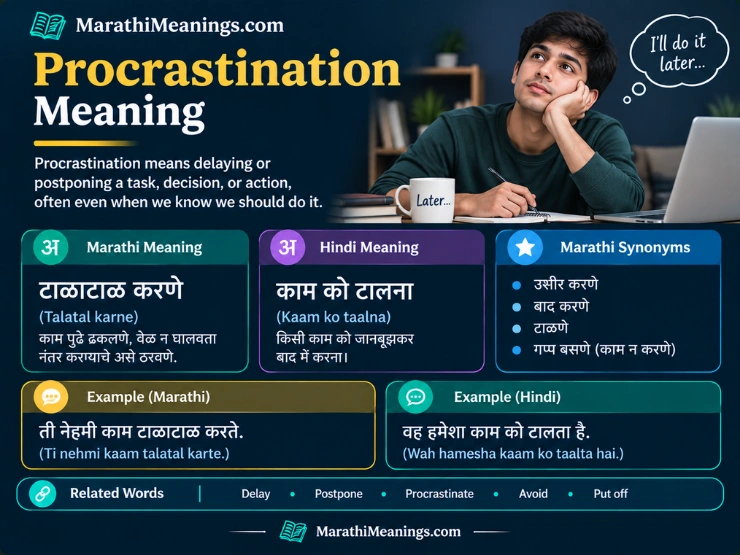
Procrastination Meaning In Marathi can be expressed naturally as टाळाटाळ (Talatala), चालढकल (Chaldhakal), or काम पुढे ढकलणे (Kam pudhe dhakalne).
In plain English, the meaning of procrastination is deliberately delaying or postponing a task that needs to be done, usually in favour of something easier or more enjoyable.
Marathi: टाळाटाळ (Talatala), चालढकल (Chaldhakal), काम पुढे ढकलणे (Kam pudhe dhakalne), कामाची दिरंगाई (Kamachi dirangai)
Hindi: टालमटोल (Talmatol), काम टालना (Kaam talna), विलंब करना (Vilamb karna)
The word is often used casually to mean “putting things off,” but the full meaning of procrastination carries a deeper psychological weight. Procrastination is not simply poor time management — it is frequently an emotional response to anxiety, fear of failure, or a task that feels overwhelming.
Quick Stats: Procrastination
| Feature | Details |
|---|---|
| Word | Procrastination |
| Part of Speech | Noun |
| Pronunciation | pro-KRAS-ti-NAY-shun |
| IPA | /prəˌkræs.tɪˈneɪ.ʃən/ |
| Marathi Meaning | टाळाटाळ, चालढकल, काम पुढे ढकलणे, कामाची दिरंगाई |
| Roman Transliteration | Talatala, Chaldhakal, Kam pudhe dhakalne, Kamachi dirangai |
| Hindi Meaning | टालमटोल, काम टालना, विलंब करना |
| Root Word | Procrastinate |
| Related Forms | Procrastinate (verb), Procrastinator (noun), Procrastinating (present participle) |
| Procrastination Synonyms | Delay, Postpone, Defer, Stall, Put off |
| Antonyms | Promptness, Diligence, Action, Initiative |
Meaning Of Procrastination In Detail
To fully understand the meaning of procrastination, it helps to start with the word itself. Procrastination is a noun that describes the act of delaying or postponing tasks, decisions, or actions — even when doing so causes negative consequences.
The key distinction is intentionality. A person who procrastinates knows that a task should be done but still avoids it. This separates it from genuine forgetfulness or necessary delay caused by circumstances.
Psychologists often describe the meaning of procrastination not as a time-management problem but as an emotion-regulation problem. People postpone tasks to avoid the negative feelings attached to them: boredom, self-doubt, anxiety, resentment, or fear of failure.
Procrastination Meaning In English
Procrastination (noun): The practice of delaying action or completing a task beyond its appropriate time, typically without a valid reason, often resulting in stress, guilt, or loss of performance.
Verb form: To procrastinate means to delay taking action on something you intend to do.
Example:
English: His procrastination cost him the deadline.
Marathi: त्याच्या टाळाटाळीमुळे त्याची अंतिम मुदत निघून गेली. (Tyachya talatalimule tyachi antim mudat nighun geli.)
Hindi: उसकी टालमटोल की आदत के कारण वह समय सीमा चूक गया।
Procrastination Meaning In Marathi
Marathi has several natural expressions for procrastination depending on the intensity and context of use.
| Marathi | Roman Transliteration | Best Used For |
|---|---|---|
| टाळाटाळ | Talatala | General putting off of tasks; emphasizes avoidance |
| चालढकल | Chaldhakal | Delaying or postponing action; emphasizes postponement |
| काम पुढे ढकलणे | Kam pudhe dhakalne | Directly expressing the act of postponing a task |
| काम पुढे ढकलण्याची सवय | Kam pudhe dhakalnyachi savay | Procrastination as a recurring habit |
| कामाची दिरंगाई | Kamachi dirangai | Unnecessary delay in official or formal work |
| टाळणे | Talane | Avoiding a task or responsibility |
| वेळकाढूपणा | Velkadhuapana | Wasting or stretching time |
| दिरंगाई | Dirangai | General delay; formal use |
टाळाटाळ (Talatala) is the most commonly understood equivalent in everyday Marathi speech. It naturally captures the sense of avoiding or brushing off tasks.
चालढकल (Chaldhakal) conveys the idea of delaying a task or avoiding immediate action and is equally natural in conversational use.
काम पुढे ढकलण्याची सवय (Kam pudhe dhakalnyachi savay) is particularly useful when talking about procrastination as a repeated habit.
कामाची दिरंगाई (Kamachi dirangai) is more appropriate in formal or official contexts, such as bureaucratic delays or missed professional deadlines.
Example 1:
English: Stop procrastinating and finish your homework first.
Marathi: टाळाटाळ बंद कर आणि आधी गृहपाठ पूर्ण कर. (Talatala band kar ani aadhi gruhapatha purna kar.)
Hindi: टालमटोल बंद करो और पहले अपना होमवर्क पूरा करो।
Procrastination Meaning In Hindi
Procrastination Meaning In Hindi is commonly expressed as:
- टालमटोल (Talmatol) — the most natural conversational word; suggests repeatedly putting something off
- काम टालना (Kaam talna) — literally “to put off work”; direct and widely understood
- विलंब करना (Vilamb karna) — more formal; closer to “causing delay”
- आलस्य (Aalasya) — laziness; related but not identical to procrastination
- कल पर टालना (Kal par talna) — “to defer to tomorrow”; closely captures the spirit of procrastination
Note: आलस्य (laziness) and टालमटोल (procrastination) are related but distinct. A person can procrastinate without being fundamentally lazy, and a lazy person does not always procrastinate on all tasks.
Example:
English: Procrastination is a common problem among students.
Marathi: विद्यार्थ्यांमध्ये टाळाटाळ ही एक सामान्य समस्या आहे. (Vidyarthyamadhe talatala hi ek samanya samasya aahe.)
Hindi: विद्यार्थियों में टालमटोल की आदत एक सामान्य समस्या है।
Procrastination vs Laziness
Procrastination is not the same as laziness.
One of the most common misunderstandings about the meaning of procrastination is that it equals laziness. Laziness generally describes an unwillingness to make the required effort, while the meaning of procrastination describes postponing an action — a person can be hardworking and still procrastinate.
For example, someone may spend the entire day completing several tasks but continue putting off one particularly difficult one. That is still procrastination.
| Procrastination | Laziness |
|---|---|
| Delaying a task | Unwillingness to make effort |
| The person may want to complete the task | The person may not want to make the effort |
| Often involves postponement | More broadly concerns lack of effort |
| Can happen even to motivated people | Usually emphasizes unwillingness or inactivity |
In Marathi, laziness is आळस (Alas) and procrastination is टाळाटाळ (Talatala). They are related but clearly distinct.
Procrastination vs Delay
Not every delay counts as procrastination.
A task may be delayed because required information is unavailable, another person has not completed their part, an unexpected event occurs, or the task genuinely needs to happen later.
Example of a delay (not procrastination):
English: The meeting was delayed because of heavy traffic.
By contrast:
Example of procrastination:
English: He knew the report was due today but kept watching television instead of writing it.
The defining factor is intentional avoidance of a task that could have been started.
Pronunciation of Procrastination
Procrastination is pronounced:
pro-KRAS-ti-NAY-shun
IPA: /prəˌkræs.tɪˈneɪ.ʃən/
The stress falls on the fourth syllable: pro-KRAS-ti-NAY-shun.
The related verb procrastinate is pronounced: pro-KRAS-ti-nayt.
In Marathi and Hindi conversation, the English word is often used directly, especially in educational or psychological contexts. The Marathi equivalent टाळाटाळ is pronounced: TAA-laa-TAA-la.
Origin and Etymology
The word procrastination comes from the Latin verb procrastinare, formed from:
- pro- meaning “forward” or “in favour of”
- crastinus meaning “belonging to tomorrow” (from cras, “tomorrow”)
The combined idea is literally: “forward to tomorrow” — pushing things ahead to the next day.
The word entered English in the 16th century. The first known use in English prose dates to around 1548.
An equivalent idea in Marathi folk wisdom appears in the proverb: “उद्या करीन म्हणताना आयुष्य निघून जातं” (Life passes by while saying “I will do it tomorrow”), which reflects the same awareness of how habitual deferral causes loss.
In Sanskrit, related concepts include विलंब (vilamba) and कालहरण (kalaharana), both suggesting wasteful delay.
Part of Speech and Word Forms
Procrastination is a noun.
| Form | Word | Example |
|---|---|---|
| Noun | Procrastination | Procrastination leads to stress. |
| Verb | Procrastinate | Don’t procrastinate on this task. |
| Noun (person) | Procrastinator | He is a chronic procrastinator. |
| Adjective | Procrastinating | She has a procrastinating habit. |
| Adverb | (none standard) | — |
Marathi verb form: “टाळाटाळ करणे” (Talatala karne) — to procrastinate
Example:
English: She tends to procrastinate when tasks feel too difficult.
Marathi: जेव्हा काम कठीण वाटते तेव्हा ती टाळाटाळ करते. (Jeva kaam kathhin vatat teva ti talatala karte.)
Hindi: जब काम मुश्किल लगता है, तो वह टालमटोल करती है।
Chronic Procrastination Meaning
Chronic procrastination refers to a persistent, long-term pattern of delaying tasks across most areas of a person’s life, rather than an occasional lapse.
While most people procrastinate on specific tasks from time to time, a chronic procrastinator delays habitually — at work, in relationships, in personal responsibilities, and in health decisions. Understanding the chronic procrastination meaning is important because it extends the core meaning of procrastination far beyond simple laziness or poor organisation.
Chronic procrastination is associated with higher levels of stress, lower self-esteem, and poorer mental and physical health outcomes. Some researchers link it with depression, anxiety, and ADHD, though procrastination itself is not a clinical diagnosis.
Marathi: दीर्घकालीन टाळाटाळ / सवयीची टाळाटाळ (Dirghakalin talatala / Savayichi talatala)
Hindi: पुरानी आदत की टालमटोल / दीर्घकालीन टालमटोल
Example:
English: Chronic procrastination can seriously affect a person’s career and relationships.
Marathi: सवयीच्या टाळाटाळीमुळे एखाद्या व्यक्तीच्या करिअरवर आणि नातेसंबंधांवर गंभीर परिणाम होऊ शकतो. (Savayichya talatalimule ekhady vyaktichya kariyaravar ani nateasambandhavar gambhir parinam hoo shakto.)
Hindi: दीर्घकालीन टालमटोल किसी व्यक्ति के करियर और रिश्तों पर गंभीर असर डाल सकती है।
Revenge Bedtime Procrastination
Revenge bedtime procrastination is a specific form of procrastination in which a person delays sleeping at night — not because they cannot sleep, but to reclaim personal time after a day they felt had no free time.
The term became widely discussed after a 2020 article brought the Chinese phrase 报复性熬夜 (bàofùxìng áoyè) — meaning “retaliatory staying up late” — to international attention.
People who engage in revenge bedtime procrastination typically have busy days with little autonomy. At night, they scroll on phones, watch videos, or engage in other leisure activities late into the evening — even knowing they will be tired the next day. It is a way of asserting control over personal time.
Marathi: बदला घेणारी झोपेची टाळाटाळ (Badla ghenyari jhopachi talatala) — a descriptive phrase rather than an established Marathi term.
Hindi: बदले की नींद टालमटोल (Badle ki neend talmatol)
Example:
English: After a long workday, she practiced revenge bedtime procrastination by watching shows until 2 a.m.
Marathi: दीर्घ कामाच्या दिवसानंतर, ती रात्री 2 वाजेपर्यंत मालिका पाहत राहिली. (Dirgha kamachya divasanantar, ti ratri 2 vajeparyant malika pahat rahili.)
Hindi: लंबे काम के दिन के बाद, उसने रात 2 बजे तक सीरीज देखकर बदले की नींद टाली।
Types of Procrastination
The meaning of procrastination does not look the same in every person. Researchers and psychologists have identified several distinct patterns, each reflecting a different aspect of this behaviour.
1. Passive Procrastination
The person intends to act but fails to do so because they are overwhelmed or unable to make decisions. This is the most commonly recognised form.
2. Active Procrastination
The person deliberately delays tasks but does so consciously, believing they work better under pressure. Active procrastinators often complete tasks at the last minute but at acceptable quality. Some researchers argue this is a functional coping style rather than a problem.
3. Chronic Procrastination
A persistent, long-term pattern affecting multiple life areas. See the section above for the full chronic procrastination meaning and its effects.
4. Revenge Bedtime Procrastination
Specific to night-time and personal time reclamation. Described in detail in the section above.
5. Decisional Procrastination
Delaying a decision, often due to fear of making the wrong choice or a dislike of commitment.
6. Academic Procrastination
Delaying studying, homework, assignments, exam preparation, or project work. A student may fully understand the importance of studying but continue postponing it anyway.
7. Workplace Procrastination
Examples include delaying reports, postponing emails, avoiding difficult projects, and waiting until the deadline to begin important work.
8. Digital Procrastination
This occurs when social media, videos, games, or unnecessary browsing repeatedly replace an important task.
How To Stop Procrastination
Learning how to stop procrastination begins with understanding the meaning of procrastination and why it happens. Because it is often rooted in emotion rather than habit alone, strategies that address only scheduling are rarely sufficient on their own.
Practical Methods
Break tasks into smaller steps. Large tasks feel overwhelming. Dividing them into clearly defined, smaller steps makes starting much easier.
Use the two-minute rule. If a task takes less than two minutes, do it immediately rather than scheduling it for later.
Set specific deadlines. Vague intentions (“I’ll do it later”) lead to delay. Specific time commitments (“I will start this at 6 p.m. today”) are far more effective.
Reduce friction. Remove distractions — silence notifications, close unrelated browser tabs, prepare materials in advance — to lower the effort required to begin.
Use body doubling. Working alongside another person, even virtually, helps many people maintain focus. The presence of another provides gentle accountability.
Reward small completions. Acknowledge when even a small task is done. This builds positive associations with completion and helps you overcome procrastination over time.
English example: She set a timer for 25 minutes and focused only on the report until it rang.
Marathi: तिने 25 मिनिटांचा टायमर लावला आणि तो वाजेपर्यंत फक्त अहवालावर लक्ष केंद्रित केले.
Hindi: उसने 25 मिनट का टाइमर लगाया और बजने तक केवल रिपोर्ट पर ध्यान केंद्रित किया।
How To Avoid Procrastination
The difference between stopping and learning how to avoid procrastination is one of timing. Avoiding it means building habits that prevent the delay from starting in the first place.
Key habits for those who want to avoid procrastination:
- Start with the most unpleasant or most important task first (often called “eating the frog”).
- Clarify priorities the night before, so morning decisions are already made.
- Build consistent routines so that starting work does not require a new decision each time.
- Address the emotional root: identify what makes a task feel threatening or unpleasant, and acknowledge that feeling rather than escaping it through distraction.
Marathi equivalent of “eating the frog” concept: आधी कठीण, मग सोपं (Aadhi kathhin, mag sopam) — “difficult first, easy later.”
How To Reduce Procrastination In Kids
Children procrastinate for many of the same reasons adults do: tasks feel too hard, too boring, or the reward seems too distant. Understanding how to reduce procrastination in kids requires recognising additional factors such as disorganised environments, unclear instructions, and limited time-management skills.
Effective approaches for parents and teachers:
- Give clear, step-by-step instructions rather than open-ended tasks.
- Break homework or chores into short timed blocks (10 to 15 minutes) with short breaks in between.
- Make the reward visible and immediate: praise right after a task is completed, not only when a long project is fully done.
- Avoid comparisons with other children, which increase anxiety and worsen avoidance.
- Model task completion yourself. Children observe adult behaviour closely.
- Address anxiety where it exists. A child who repeatedly avoids a subject may be struggling with the material rather than simply being stubborn.
A practical way to reduce procrastination in kids is to remove ambiguity entirely — children focus better when they know exactly what to do and for how long.
Marathi: मुलांमधील टाळाटाळ कमी करण्यासाठी त्यांना छोट्या छोट्या कामांमध्ये विभागून द्या आणि प्रत्येक काम झाल्यावर तात्काळ कौतुक करा.
How To Overcome Procrastination
Knowing how to overcome procrastination involves addressing both the practical and psychological sides of the habit.
Address the Emotional Root
Because procrastination is often an emotion-regulation problem, ask: What is the specific feeling I am trying to avoid with this task? Common answers include fear of failure, boredom, uncertainty, and perfectionism. Naming the feeling reduces its power.
Start Before You Feel Ready
Motivation often follows action, not the other way around. Waiting to “feel like doing” a task usually makes the delay longer. Commit to starting for just five minutes. Most people continue once they have begun.
Use Time-Boxing
Assign a fixed block of time to a task — for example, 30 minutes — and work on it only during that block. This removes the pressure of an open-ended commitment and makes it easier to begin.
Review Progress Regularly
A weekly review helps identify which tasks are being repeatedly postponed. Patterns become visible, and visible patterns are easier to address consciously.
Seek Support Where Needed
For persistent patterns that match the chronic procrastination meaning — where delay affects most areas of life and causes real harm — speaking with a counsellor or therapist can be productive. Cognitive-behavioural approaches have shown good results in this area.
Meaning Of Procrastination and Time Management
Procrastination and poor time management can appear together, but they are not identical.
The meaning of procrastination is distinct from time management: time management concerns how a person plans and organizes available time, while the meaning of procrastination concerns unnecessarily postponing an action regardless of how well time is planned.
Someone may create a detailed schedule but still repeatedly delay one difficult task. In that case, the problem is not a lack of planning — the person may simply be avoiding the task itself.
Good planning can nevertheless make it easier to avoid procrastination because it clarifies what needs to be done, when it needs to start, and which task holds priority.
Procrastination and Perfectionism
Perfectionism can contribute directly to procrastination, and grasping this connection deepens the meaning of procrastination considerably.
A person may think: “If I cannot do this perfectly, I should wait until I am ready.” That waiting can quietly become repeated postponement.
A more practical approach is to separate starting from perfecting:
First draft → Review → Correct → Improve → Final version
This approach makes it easier to begin without requiring the first attempt to be perfect. Many people find that once they start, the perfectionist pressure eases on its own.
Procrastination Synonyms
Understanding procrastination synonyms helps clarify the different shades of the same behaviour and enriches the meaning of procrastination across contexts.
| English Synonym | Meaning |
|---|---|
| Delay | To make something happen later than planned |
| Postpone | To move to a later time |
| Defer | To put off to a future time, often formally |
| Stall | To deliberately use time without progressing |
| Put off | Informal; to delay doing something |
| Dawdle | To move slowly; to waste time |
| Dither | To be indecisive; to delay through hesitation |
| Drag one’s feet | Idiom: to act with unnecessary slowness |
These procrastination synonyms are related but not always interchangeable. Postpone and defer are neutral and often formal. Stall and drag one’s feet imply intention and obstruction. Dawdle is more about pace than purpose.
Marathi Procrastination Synonyms
| Marathi | Roman Transliteration | Note |
|---|---|---|
| टाळाटाळ | Talatala | Most natural general equivalent; emphasizes avoidance |
| चालढकल | Chaldhakal | Emphasizes delaying or postponing action |
| काम पुढे ढकलणे | Kam pudhe dhakalne | Directly describes postponing a task |
| दिरंगाई | Dirangai | Formal; official/bureaucratic delay |
| उशीर | Ushir | Simple delay; not always avoidable |
| कालापव्यय | Kalapavyay | Waste of time |
| वेळकाढूपणा | Velkadhuapana | Time-stretching behaviour |
| हलगर्जीपणा | Halgarjipana | Carelessness; negligence — related but not a synonym |
Note: हलगर्जीपणा (carelessness) is related to procrastination but is not a synonym. It implies not caring, while a procrastinator may care deeply about the task and still avoid it.
Procrastination Antonyms
| English | Marathi | Roman |
|---|---|---|
| Promptness | तत्परता | Tatparata |
| Diligence | परिश्रम | Parishram |
| Action | कृती | Kruti |
| Initiative | पुढाकार | Pudhakar |
| Timeliness | वेळेवर करणे | Velavar karne |
No Procrastination and Avoid Procrastination Meaning
The phrases “no procrastination” and “avoid procrastination” are used widely in motivational contexts. Both carry the same core instruction — once you understand the meaning of procrastination, act on tasks without unnecessary delay.
No procrastination meaning in Marathi: टाळाटाळ नाही (Talatala nahi) — a direct instruction or mindset declaration.
Avoid procrastination meaning in Marathi: टाळाटाळ टाळा (Talatala tala) — notably direct; the root word टाळ appears in both the behaviour and the instruction to avoid it.
English: My only rule this semester: no procrastination.
Marathi: या सत्रातील माझा एकच नियम: टाळाटाळ नाही. (Ya satratiil majha ekach niyam: talatala nahi.)
Hindi: इस सेमेस्टर का मेरा एक ही नियम: कोई टालमटोल नहीं।
Procrastination Quotes
Procrastination quotes have long offered a sharp, memorable way to reflect on the meaning of procrastination and the habit of delay. A few well-known ones worth keeping in mind:
“You don’t have to see the whole staircase, just take the first step.” — Martin Luther King Jr.
“A year from now you may wish you had started today.” — Karen Lamb
“Procrastination is the thief of time.” — Edward Young (1742)
Marathi reflection on the last quote:
वेळेचा चोर म्हणजे टाळाटाळ. आज करण्याचे उद्यावर सोडले तर आयुष्य हातातून निघून जाते.
(Velecha chor mhanje talatala. Aaj karnyache udyavar sodal tar aayushya hatatun nighun jate.)
These procrastination quotes serve as simple reminders that time lost to avoidance cannot be recovered — a point equally true in Marathi, Hindi, or any other language.
Procrastination in Other Indian Languages
| Language | Common Expression | Roman Transliteration |
|---|---|---|
| Marathi | टाळाटाळ / चालढकल / काम पुढे ढकलणे | Talatala / Chaldhakal / Kam pudhe dhakalne |
| Hindi | टालमटोल / काम टालना | Talmatol / Kaam talna |
| Telugu | వాయిదా వేయడం, పనిని తరువాతికి వాయిదా వేయడం | Vayida veyidam |
| Tamil | தள்ளிப்போடுதல், வேலையை ஒத்திவைத்தல் | Thallippoduthal, Velaiyai othivaitthal |
| Kannada | ಮುಂದೂಡುವುದು, ಕೆಲಸವನ್ನು ಮುಂದೂಡುವುದು | Mundudhuvu, Kelasavannu mundudhuvu |
| Malayalam | നീട്ടിവയ്ക്കുക, ജോലി മാറ്റിവയ്ക്കുക | Neettivaykkuka, Joli mattivaykkuka |
| Punjabi | ਟਾਲਮਟੋਲ, ਕੰਮ ਨੂੰ ਅੱਗੇ ਪਾਉਣਾ | Talmatol, Kamm nu agge pauna |
| Urdu | ٹال مٹول، کام کو مؤخر کرنا | Talmatol, Kaam ko mu’akhkhar karna |
| Assamese | কাম পিছুৱাই দিয়া, কাম পলম কৰা | Kaam pishuai diya, Kaam polom kora |
| Farsi | اهمالکاری، به تعویق انداختن | Ehmalkari, Be ta’viq andakhtan |
Common Mistakes: Meaning Of Procrastination
1. Assuming every delay is procrastination
This is incorrect. Some delays are caused by circumstances outside a person’s control, such as unavailable information, another person not completing their part, or an emergency.
2. Confusing procrastination with laziness
Laziness means not wanting to do anything. Procrastination means knowing you should do something but still avoiding it. A person can procrastinate intensely on tasks they genuinely care about.
3. Thinking a planned break is procrastination
A deliberate break is not automatically procrastination. Rest is a normal and often necessary part of productive work.
4. Assuming being busy means you are not procrastinating
A person can stay busy with low-priority tasks while avoiding an important one. Doing something does not mean the important task is being addressed.
5. Treating procrastination as only a time-management issue
Scheduling solutions alone rarely cure procrastination, because the root cause is often emotional, not organisational. The meaning of procrastination at its core is emotional avoidance — this is why knowing how to overcome procrastination requires addressing mindset, not just calendar management.
Conclusion: Meaning Of Procrastination
Procrastination Meaning In Marathi is best expressed through टाळाटाळ (Talatala) and चालढकल (Chaldhakal) in everyday speech, and कामाची दिरंगाई (Kamachi dirangai) formally. In Hindi, the closest equivalent is टालमटोल (Talmatol).
Procrastination is not simply laziness or disorganisation — it’s a pattern of avoidance often rooted in emotional discomfort. Whether it shows up as chronic procrastination, revenge bedtime procrastination, or occasional task-avoidance, understanding the cause is the first step toward overcoming it.
“Procrastination means knowingly delaying a task that needs to be done.”
? FAQs: Meaning Of Procrastination
1. What is Procrastination Meaning In Marathi?
टाळाटाळ (Talatala) or चालढकल (Chaldhakal). In formal contexts: कामाची दिरंगाई (Kamachi dirangai).
2. What is Procrastination Meaning In Hindi?
टालमटोल (Talmatol) or काम टालना (Kaam talna).
3. What is Chronic Procrastination Meaning?
Chronic procrastination meaning refers to a persistent habit of delaying tasks across most areas of life — an intensified form of the meaning of procrastination that affects work, relationships, and health. In Marathi: सवयीची टाळाटाळ (Savayichi talatala).
4. What is Revenge Bedtime Procrastination?
Deliberately staying up late to reclaim personal time after a busy day — sacrificing sleep for leisure. In Marathi: झोप पुढे ढकलणे (Jhop pudhe dhakalne).
5. How To Overcome Procrastination?
To overcome procrastination, break the task into small steps, set a specific start time, and reduce distractions. Addressing the emotional discomfort behind the avoidance is also key.
6. How To Reduce Procrastination In Kids?
To reduce procrastination in kids, give short clear tasks, break homework into timed blocks, and praise immediately after each step is completed.
7. What is the difference between procrastination and laziness?
Laziness is unwillingness to act. Procrastination is intending to act but still delaying. In Marathi: laziness is आळस (Alas), procrastination is टाळाटाळ (Talatala).
 Also Read These Word Meanings to Build a Stronger English-Marathi Vocabulary :
- Fragile Meaning in Marathi
- Nostalgic Meaning In Marathi
- Flaxseed Meaning in Marathi
- Brat Meaning in Marathi
- Gigantic Meaning In Marathi
- Introvert Meaning In Marathi
- Ceasefire Meaning In Marathi
- Domicile Meaning In Marathi
- Carpediem Meaning In Marathi
- Narcissist Meaning In Marathi
- Pookie Meaning In Marathi
- Audacity Meaning In Marathi
- Manifestation Meaning In Marathi
- Consent Meaning In Marathi
- Nephew Meaning In Marathi
- Harmony Meaning In Marathi
- Overwhelmed Meaning in Marathi
- Migraine Meaning in Marathi
- Antonyms Meaning In Marathi
- Pcod Full Form In Marathi
- Prosperity Meaning in Marathi
- Aura Meaning In Marathi
- Bloating Meaning In Marathi
- Soulmate Meaning In Marathi
- Dignity Meaning in Marathi
- Precious Meaning in Marathi
- Possessive Meaning in Marathi
- Body Count Meaning in Marathi