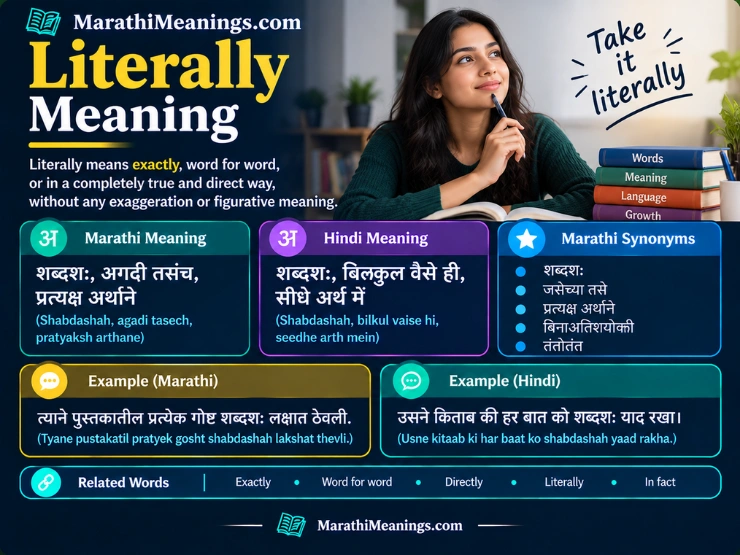
Literally means in the exact, direct, or original sense of the words, without treating them as a metaphor or exaggeration.
Literally Meaning In Marathi is commonly expressed as शब्दशः, अक्षरशः, शाब्दिक अर्थाने, प्रत्यक्ष अर्थाने, or तंतोतंत, depending on the context.
Roman Marathi: Shabdashah, Aksharashah, Shabdik arthane, Pratyaksha arthane, Tantotant
In Hindi, Literally Meaning In Hindi can be expressed as शब्दशः, अक्षरशः, शाब्दिक रूप से.
For example, when someone says “The bottle is literally empty,” the statement means that the bottle is actually empty. It is not being used as a metaphor.
The word literally is especially important when distinguishing an exact meaning from a figurative meaning. In everyday informal English, however, people also sometimes use it for emphasis, even when the statement is exaggerated.
Quick Overview: Literally Meaning
| Feature | Details |
|---|---|
| Word | Literally |
| Part of Speech | Adverb |
| Pronunciation | LIT-er-uh-lee |
| IPA | /ˈlɪtərəli/ |
| Marathi Meaning | शब्दशः, अक्षरशः, शाब्दिक अर्थाने, प्रत्यक्ष अर्थाने, तंतोतंत |
| Roman Transliteration | Shabdashah, Aksharashah, Shabdik arthane, Pratyaksha arthane, Tantotant |
| Hindi Meaning | शब्दशः, अक्षरशः, शाब्दिक रूप से |
| Related Adjective | Literal |
| Opposing Concept | Figuratively |
| Related Forms | Literal, Literally, Literalness |
Literally Meaning In English
The basic Literally Meaning is “in the exact or direct sense of the words.” It is used when the speaker wants the listener to understand a statement according to its actual wording rather than as a metaphor, idiom, or figure of speech.
For example:
“The child literally fell into the water.”
This indicates an actual physical event. The child really entered the water.
Compare this with:
“I was drowning in work.”
Usually, this does not mean that the person was physically surrounded by water. It is a figurative way of saying that the person had a very large amount of work.
Therefore, literally and figuratively often represent two different ways of interpreting language.
Literally Meaning In Marathi
The exact Marathi equivalent of Literally Meaning In Marathi depends on the sentence.
1. शब्दशः — Shabdashah
शब्दशः means according to the exact words or wording. It is particularly suitable when discussing translation or the direct wording of a sentence.
Example:
English: The translator rendered the sentence literally.
Marathi: अनुवादकाने त्या वाक्याचा शब्दशः अनुवाद केला.
Here, शब्दशः indicates that the words were translated according to their direct wording.
2. अक्षरशः — Aksharashah
अक्षरशः conveys the sense of exactly as stated, written, instructed, or described.
Example:
English: She followed the written instructions literally.
Marathi: तिने लिखित सूचनांचे अक्षरशः पालन केले.
In this context, अक्षरशः communicates strict adherence to what was written.
3. शाब्दिक अर्थाने — Shabdik arthane
शाब्दिक अर्थाने means “in the literal sense” or “according to the direct meaning of the words.”
Example:
English: The expression should not be understood literally.
Marathi: या अभिव्यक्तीचा शाब्दिक अर्थाने अर्थ लावू नये.
This expression is useful when explaining the difference between literal and figurative language.
4. प्रत्यक्ष अर्थाने — Pratyaksha arthane
प्रत्यक्ष अर्थाने means “in the actual or direct sense.” It can be appropriate when a sentence contrasts an actual event with a figurative interpretation.
Example:
English: He literally stood at the entrance for an hour.
Marathi: तो प्रत्यक्ष अर्थाने एक तास प्रवेशद्वाराजवळ उभा होता.
5. तंतोतंत — Tantotant
तंतोतंत means exactly or precisely. It can overlap with the idea of literally, but it is not a universal substitute.
Example:
English: Her account was literally the same as the original record.
Marathi: तिचे वर्णन मूळ नोंदीशी तंतोतंत जुळत होते.
Thus, शब्दशः is particularly useful for wording, अक्षरशः for exact adherence, and प्रत्यक्ष अर्थाने for an actual or direct sense.
Origin and Etymology of Literally
Literally comes from the adjective literal combined with the adverb-forming suffix -ly.
The English word literal ultimately derives through French from Latin litteralis, meaning related to letters or writing. It is connected with Latin littera, meaning “letter.”
The historical connection reflects an association with the written or exact wording of a text. The modern sense of literal developed around the idea of taking words in their direct rather than figurative sense.
Literally Pronunciation
Literally Pronunciation: LIT-er-uh-lee
IPA: /ˈlɪtərəli/
A simple pronunciation breakdown is:
lit + er + uh + lee
The first syllable receives the main stress:
LIT-er-uh-lee
The pronunciation may sound slightly different across English accents, but the general form remains recognizable.
Part of Speech and Grammar
Literally is an adverb.
It is derived from the adjective literal.
| Word | Part of Speech | Meaning |
|---|---|---|
| Literal | Adjective | Exact or direct in meaning |
| Literally | Adverb | In an exact or direct manner |
| Literalness | Noun | The quality of being literal |
Literal
Literal describes something that follows the direct meaning of the words.
Example:
“The literal meaning of the sentence is clear.”
Literally
Literally describes how an action, interpretation, or statement is being presented.
Example:
“She literally repeated the entire paragraph.”
Literalness
Literalness refers to the quality of being literal or closely tied to direct wording.
The distinction between literal and literally is useful because learners sometimes use the two forms interchangeably even though their grammatical functions differ.
Literally Meaning by Context
The translation of literally should be selected according to the context rather than applying one Marathi word everywhere.
| Context | Suitable Marathi Expression |
|---|---|
| Exact wording | शब्दशः |
| Exact adherence to instructions | अक्षरशः |
| Direct meaning | शाब्दिक अर्थाने |
| Actual sense | प्रत्यक्ष अर्थाने |
| Exact or precise correspondence | तंतोतंत |
In Translation
When someone says:
“Translate this literally.”
the intended meaning is to preserve the direct wording or meaning as closely as possible.
A natural Marathi rendering is:
“याचा शब्दशः अनुवाद करा.”
In Interpretation
When someone says:
“Do not take the statement literally.”
the speaker is saying that the statement has a figurative or non-direct meaning.
A natural Marathi rendering is:
“या विधानाचा शब्दशः अर्थ घेऊ नका.”
In an Actual Event
When literally emphasizes that an event really happened, प्रत्यक्षात or प्रत्यक्ष अर्थाने may sometimes communicate the meaning more naturally than a strict dictionary equivalent.
This is why translation requires attention to the entire sentence.
Literally vs Figuratively
One of the most important concepts associated with Literally Meaning is its contrast with figuratively.
Literally
Something is understood according to its direct meaning.
Example:
“The leaves literally fell from the tree.”
The leaves physically fell from the tree.
Figuratively
Something is understood in a non-direct or metaphorical way.
Example:
“His words cut like a knife.”
The words did not physically cut anyone. The sentence figuratively describes the emotional effect of his words.
| Literally | Figuratively |
|---|---|
| Direct meaning | Non-direct meaning |
| Actual interpretation | Metaphorical interpretation |
| Words retain their basic sense | Meaning goes beyond the basic sense |
| Often associated with factual physical events | Often associated with imagery or comparison |
Knowing this distinction helps English learners understand why literally is used in some sentences but not others.
Quite Literally Meaning
Quite Literally Meaning refers to an emphatic use of literally to state that something is genuinely true in its direct sense.
For example:
“The entire field was quite literally covered with snow.”
The speaker means that the field was actually covered with snow.
Here, quite adds emphasis to literally.
The phrase can be useful when the speaker wants to remove doubt about whether a statement is figurative.
However, quite literally should not automatically be interpreted as a separate dictionary meaning. It is a combination of quite and literally, with the exact force determined by context.
Literally Meaning Examples in English and Marathi
Example 1
English: I literally counted every page of the document.
Marathi: मी त्या दस्तऐवजातील प्रत्येक पान प्रत्यक्ष मोजले.
Example 2
English: The cup literally fell from his hand.
Marathi: कप त्याच्या हातातून प्रत्यक्ष खाली पडला.
Example 3
English: The teacher asked us to translate the paragraph literally.
Marathi: शिक्षकांनी आम्हाला परिच्छेदाचा शब्दशः अनुवाद करण्यास सांगितले.
Example 4
English: She followed the recipe literally without changing any instruction.
Marathi: तिने कोणतीही सूचना न बदलता पाककृतीचे अक्षरशः पालन केले.
Example 5
English: The word literally refers to a physical object.
Marathi: हा शब्द शाब्दिक अर्थाने एका भौतिक वस्तूचा संदर्भ देतो.
Example 6
English: The bridge was literally destroyed by the storm.
Marathi: वादळामुळे पूल प्रत्यक्षात उद्ध्वस्त झाला.
Example 7
English: He literally copied the sentence from the original document.
Marathi: त्याने मूळ दस्तऐवजातून ते वाक्य शब्दशः उतरवले.
Example 8
English: The temperature literally dropped below freezing overnight.
Marathi: रात्री तापमान प्रत्यक्षात गोठणबिंदूच्या खाली गेले.
Example 9
English: The phrase is figurative, so it should not be taken literally.
Marathi: हा वाक्प्रचार लाक्षणिक आहे, त्यामुळे त्याचा शब्दशः अर्थ घेऊ नये.
Example 10
English: The two descriptions were literally identical.
Marathi: दोन्ही वर्णने अक्षरशः एकसारखी होती.
Literally Examples in Hindi
English: The instruction was followed literally.
Hindi: निर्देश का अक्षरशः पालन किया गया।
English: This phrase is not meant literally.
Hindi: इस वाक्यांश का शाब्दिक अर्थ नहीं लिया जाना चाहिए।
English: He literally said those words.
Hindi: उसने सचमुच वही शब्द कहे थे।
These examples show that Literally Meaning In Hindi can be represented by different expressions depending on whether the context emphasizes exact wording, direct interpretation, or actual occurrence.
Literally Synonyms
People often search for Literally Synonyms, but not every word associated with exactness can replace literally in every sentence.
Exact
Exact emphasizes complete correctness or correspondence.
Precisely
Precisely means accurately or exactly.
Word for word
This expression refers specifically to reproducing or translating wording without changing it.
Verbatim
Verbatim means using exactly the same words. It is especially appropriate when referring to quotations, transcripts, or reproduced text.
In the literal sense
This directly communicates the idea of interpreting something according to its basic meaning.
Although these expressions overlap semantically, their grammatical functions and contexts differ. For example, verbatim is more specifically concerned with exact wording, while literally is primarily concerned with direct meaning.
Literally Mean and Literal Meaning
The search phrase Literally Mean generally refers to the question “What does literally mean?”
The basic answer is:
Literally means in the exact or direct sense of the words.
The related phrase literal meaning refers to the direct meaning of a word, sentence, or expression.
For example:
Literal meaning: The direct meaning of an expression.
Literally: Used to indicate that something is being understood in that direct sense.
This distinction is useful for English learners because literal is an adjective, while literally is an adverb.
Can Literally Be Used for Emphasis?
Yes. In informal modern English, literally is sometimes used to add strong emphasis to a statement, including statements that are not literally true.
For example:
“I literally laughed for an hour.”
This can mean the person actually laughed for an hour.
But consider:
“I literally exploded with excitement.”
Unless a physical explosion actually occurred, this is figurative or hyperbolic language. In casual speech, some speakers still use literally to intensify the statement.
This usage is common enough to be recognized in contemporary English, but it can create ambiguity in formal or carefully precise writing.
When the goal is clarity, literally is best reserved for situations where the direct meaning is genuinely intended.
Common Mistakes With Literally
Mistake 1: Treating Literally and Figuratively as the Same
They serve contrasting functions in many contexts.
Literally points toward direct meaning, while figuratively indicates a non-direct interpretation.
Mistake 2: Using One Marathi Translation Everywhere
शब्दशः is not always the most natural translation.
For example, a sentence about an actual physical event may be better expressed using प्रत्यक्षात, while an instruction about exact wording may require शब्दशः.
Mistake 3: Confusing Literally With Exactly
Exactly emphasizes precision or complete correspondence.
Literally emphasizes the direct or non-figurative interpretation.
The two can overlap, but their meanings are not identical.
Mistake 4: Assuming Literally Always Means “Actually”
In some contexts, actually may communicate the intended idea, but it is not the basic definition of literally.
Mistake 5: Interpreting Informal Hyperbole as a Factual Statement
When someone says:
“I literally died laughing.”
the sentence is generally an exaggeration rather than a report of an actual death.
Context determines whether literally is being used in its traditional sense or as an informal intensifier.
Word Family of Literally
The main related forms are:
| Word | Meaning |
|---|---|
| Literal | Exact, direct, or non-figurative |
| Literally | In an exact or direct manner |
| Literalness | The quality of being literal |
Literal Meaning
A literal meaning is the direct meaning of words without adding a metaphorical interpretation.
Literal Translation
A literal translation attempts to retain the direct wording or structure of the source, although a literal translation is not always the most natural translation in another language.
This distinction is particularly important between English and Marathi because natural Marathi may require a contextual expression rather than a word-for-word conversion.
Literally Meaning In Other Indian Languages
The following compact table provides useful equivalents for related regional-language searches.
| Language | Literally Meaning |
|---|---|
| Hindi | शब्दशः, अक्षरशः, शाब्दिक रूप से |
| Tamil | சொல்லர்த்தமாக, வார்த்தைக்கு வார்த்தை |
| Telugu | అక్షరాలా, పదశః |
| Malayalam | അക്ഷരാർത്ഥത്തിൽ |
| Bengali | আক্ষরিকভাবে, শব্দশঃ |
| Kannada | ಅಕ್ಷರಶಃ, ಶಬ್ದಶಃ |
| Gujarati | શાબ્દિક રીતે, શબ્દશઃ |
| Punjabi | ਸ਼ਾਬਦਿਕ ਤੌਰ ‘ਤੇ, ਅੱਖਰਸ਼ |
| Assamese | আক্ষৰিকভাৱে |
| Farsi | به معنای واقعی کلمه |
| Odia | ଆକ୍ଷରିକ ଭାବରେ, ଶବ୍ଦଶଃ |
| Urdu | لفظی طور پر |
| Nepali | शाब्दिक रूपमा, अक्षरशः |
These are contextual equivalents rather than a claim that each language has only one fixed translation for literally.
Conclusion
Literally Meaning In Marathi is expressed through words such as शब्दशः (Shabdashah), अक्षरशः (Aksharashah), शाब्दिक अर्थाने (Shabdik arthane), प्रत्यक्ष अर्थाने (Pratyaksha arthane), and तंतोतंत (Tantotant). The appropriate Marathi expression depends on what the sentence emphasizes.
The English word literally traditionally indicates that something should be understood in its exact, direct, or non-figurative sense. It is different from figuratively, which refers to metaphorical or non-direct language. It can also be used informally as an intensifier, especially in conversational English.
For accurate usage, always consider the context. शब्दशः works well for exact wording, अक्षरशः can indicate exact adherence, and प्रत्यक्ष अर्थाने can express an actual or direct sense. This contextual approach makes the meaning of literally clearer in both English and Marathi.
? FAQs About Literally Meaning
1. What is Literally Meaning In Marathi?
Literally Meaning In Marathi includes शब्दशः, अक्षरशः, शाब्दिक अर्थाने, प्रत्यक्ष अर्थाने, and तंतोतंत. The correct choice depends on the context.
2. What is the Literally Meaning in English?
Literally means in the exact, direct, or non-figurative sense of the words. It indicates that a statement should generally be understood according to its direct meaning.
3. What is Literally Meaning In Hindi?
Literally Meaning In Hindi can be expressed as शब्दशः, अक्षरशः, or शाब्दिक रूप से. Different expressions suit different contexts.
4. What is Literally Pronunciation?
Literally Pronunciation is commonly represented as LIT-er-uh-lee, with the IPA pronunciation /ˈlɪtərəli/.
5. What are the main Literally Synonyms?
Contextual alternatives include exactly, precisely, word for word, verbatim, and in the literal sense. These are related expressions rather than universal replacements.
6. What does Quite Literally mean?
Quite literally emphasizes that something is intended in its actual or direct sense. It adds emphasis to the idea that the statement is not merely metaphorical.
7. Is literally the opposite of figuratively?
They commonly express contrasting interpretations. Literally refers to the direct sense, whereas figuratively refers to a metaphorical, symbolic, or non-direct sense.
8. Can literally be used for exaggeration?
Yes. In informal English, literally is sometimes used as an intensifier with exaggerated or figurative statements. In formal writing, its use should be clear enough that readers can distinguish literal meaning from hyperbole.
📚 Also Read These Word Meanings to Build a Stronger English-Marathi Vocabulary :
- Carpediem Meaning In Marathi
- Narcissist Meaning In Marathi
- Pookie Meaning In Marathi
- Audacity Meaning In Marathi
- Manifestation Meaning In Marathi
- Consent Meaning In Marathi
- Nephew Meaning In Marathi
- Harmony Meaning In Marathi
- Overwhelmed Meaning in Marathi
- Migraine Meaning in Marathi
- Antonyms Meaning In Marathi
- Pcod Full Form In Marathi
- Prosperity Meaning in Marathi
- Aura Meaning In Marathi
- Bloating Meaning In Marathi
- Soulmate Meaning In Marathi
- Dignity Meaning in Marathi
- Precious Meaning in Marathi
- Possessive Meaning in Marathi
- Body Count Meaning in Marathi
- Fetched Meaning In Marathi
- Desire Meaning In Marathi
- Virtual Meaning In Marathi